Get Full Government Meeting Transcripts, Videos, & Alerts Forever!
Get email alerts on the Radioactive Waste Investigation Fund topic
No spam. Unsubscribe anytime.
Missouri committee advances bills to remove $150,000 cap on radioactive‑waste investigation fund
Summary
The Special Committee on Intergovernmental Affairs advanced bills from Representatives Chappell and Prouty to remove a statutory $150,000 annual cap on the state's radioactive waste investigation fund and clarify who pays for cleanup; federal and state officials warned about funding sources and scope.
The Special Committee on Intergovernmental Affairs voted to advance a package of bills that would remove the $150,000 statutory cap on Missouri's radioactive waste investigation fund and expand the state's ability to investigate suspected radioactive contamination.
The bills heard together were House Bill 778, sponsored by Representative Chapel (sponsor) and House Bill 290, sponsored by Representative Rachel Prouty, who told the committee the existing cap — created by statute in 2018 and capped at $150,000 per year — is no longer sufficient to support meaningful testing and investigations.
The legislation would remove the statutory limit and allow the Department of Natural Resources to use larger sums for investigations when local governments request testing in an identified area. "This fund was created via statute in 2018 ... it had not been funded at all until last year," Representative Rachel Prouty said, adding that $150,000 in 2018 is roughly the equivalent of $190,000 today and would not cover meaningful sampling and analysis.
Why it matters: testimony and questions showed the bills would unlock investigative capacity for communities with known or suspected contamination (Florissant, Ferguson, Berkeley, Bridgeton, areas around the St. Louis Airport and Coldwater Creek were cited). Sponsors also said they expect the attorney general to pursue federal reimbursement when contamination dates to the Manhattan Project-era activities.
Federal and state officials provided informational testimony. Phil Mosier, chief of the environmental branch for the U.S. Army Corps of Engineers' St. Louis District, said the Corps has had FUSRAP (Formerly Utilized Sites Remedial Action Program) responsibilities in the St. Louis area since 1997 and has remediated source areas while continuing to investigate residual contamination. "The Army Corps has had the mission since 1997," Mosier told the committee, and he said the Corps' authority and testing focus are limited to radionuclides and related contaminants tied to the early atomic energy program.
Jake Buxton, deputy director at the Missouri Department of Natural Resources (DNR), told the committee DNR supports the concept of removing the cap but cautioned about where the money would come from. "I would caution against the further siphoning of these dollars out of the hazardous waste fund," Buxton said, explaining that the hazardous waste fund is fee-based and used for services fee payers receive. He recommended general revenue or another sustainable source and suggested statutory language that makes clear the federal government bears cleanup responsibility rather than forcing the state to front costs and later seek reimbursement.
Kira Moore, DNR Division of Environmental Quality director, said the department's role at FUSRAP sites has been largely oversight since a 2019 funding agreement with the Corps lapsed. She said Missouri has not conducted independent testing at some sites since 2019 because funding for that work stopped when the agreement expired.
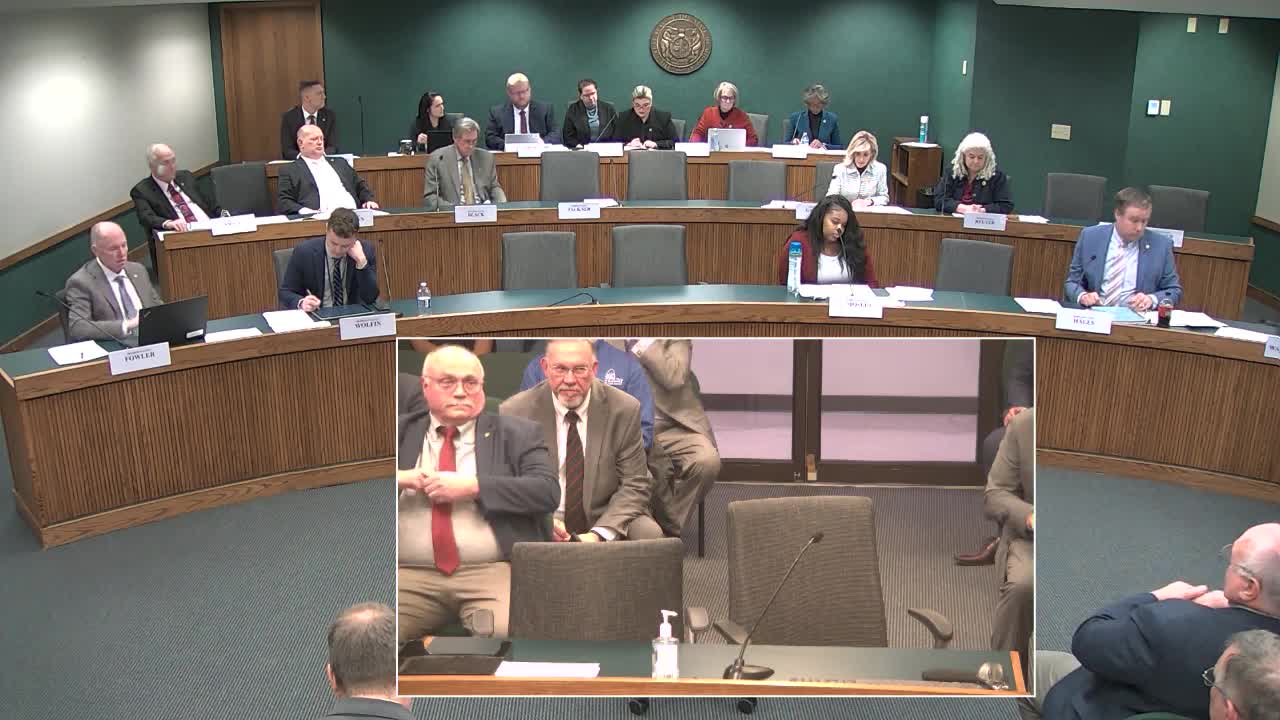
Committee action: the panel later voted the House Committee substitute for House Bills 516, 290 and 778 "do pass" by a roll call of 12 ayes, 0 noes.
What the bills do and limits: Sponsors said the bills remove the statutory transfer cap to allow more robust investigations, require a written request by a local governing body that identifies the area of concern, and prioritize requests at federally designated sites where contaminants are known to reasonably exist. The bills do not themselves appropriate money; sponsors and staff reminded members that actual spending depends on the appropriations process.
Next steps: The committee advanced the substitute bill package to the next stage; sponsors said they intend to combine language clarifying federal responsibility and the state's standing to seek federal payment for cleanup costs.
Ending note: Army Corps and DNR witnesses emphasized the technical limits of their authorities (the Corps' FUSRAP mission targets radionuclides tied to Manhattan Project-era work; other contaminants fall to other programs), and DNR recommended careful drafting to avoid unintended impacts to fee-funded programs and to clarify mechanisms for federal payment or state reimbursement.