Get Full Government Meeting Transcripts, Videos, & Alerts Forever!
Get email alerts on the Telecom Deregulation topic
No spam. Unsubscribe anytime.
Deregulation bill draws split testimony over copper networks, 911 and consumer protections
Summary
LB 4 would create a statutory path to deregulate certain landline exchanges with competition; supporters say it modernizes regulation and frees resources for fiber investment, while the Public Service Commission and local officials warned about consumer protections, outage response and areas left without a carrier of last resort.
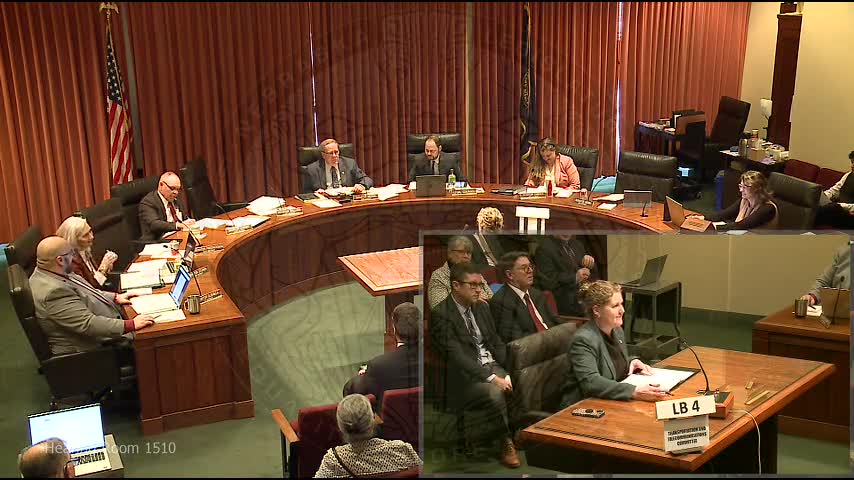
Sen. Carolyn Bosn introduced LB 4, the Nebraska Telecommunications Exchange Deregulation Act, telling the Transportation and Telecommunications Committee the bill would update state law to reflect markets where multiple providers exist and permit reclassification of exchanges where competition meets specified thresholds.
"The Nebraska Telecommunications Exchange Deregulation Act aims to update our telecommunications regulations to better align with the current environment where multiple service providers exist," Bosn said. Under the bill, exchanges with population greater than 100,000 would be eligible for deregulation; for smaller exchanges the PSC would have discretion when at least two other carriers provide service in at least 75% of the square miles of the exchange.
Industry supporters framed LB 4 as modernization. Trent Feller, vice president of government affairs for Windstream, said companies should not be compelled to maintain aging copper networks in areas where competitive alternatives exist and that deregulation would help direct resources toward fiber and other broadband upgrades. Peter Goese of Lumen (CenturyLink) said deregulation is “a modest change” that preserves critical safeguards including 911 while relieving incumbents of obligations for legacy copper where reasonable competition exists.
Opponents — led by Nebraska Public Service Commission Chair Tim Schram and other local government witnesses — warned the bill as drafted is overly broad and could remove meaningful PSC authority to address outages, billing disputes and consumer complaints in deregulated exchanges. Schram said last year the commission handled 551 consumer complaints that saved consumers $44,000 and that losing enforcement authority in deregulated areas would weaken the PSC’s ability to require refunds or restorations of service. He also cautioned automatic reclassification for exchanges over 100,000 residents could leave edge pockets without adequate service.
Witnesses pressed two specific points repeatedly in committee questioning: (1) whether deregulation would strip PSC authority to investigate and sanction carriers for outages or billing complaints in deregulated areas; and (2) how deregulation would affect 911 and next‑generation 911 networks that rely on IP infrastructure. Supporters responded that 911 and outage reporting would be preserved and that the PSC retains oversight for emergency services, and they emphasized the bill’s aim to allow carriers to concentrate investment on modern broadband networks.
The Nebraska Rural Broadband Alliance and other stakeholder witnesses suggested harmonizing LB 4 with existing rural sustainability law to avoid duplicative statutes and encouraged the committee to consider targeted amendments to preserve PSC oversight where needed. No committee vote was taken during the hearing.