Get Full Government Meeting Transcripts, Videos, & Alerts Forever!
Get email alerts on the Rural Broadband topic
No spam. Unsubscribe anytime.
Sen. Storer pushes bill to let competitive carriers seek Nebraska Universal Service Fund support
Summary
A bill heard before the Transportation and Telecommunications Committee would let competitive providers, not just incumbent local exchange carriers, initiate requests to receive Nebraska Universal Service Fund (NUSF) support and assume carrier‑of‑last‑resort duties in high‑cost rural areas.
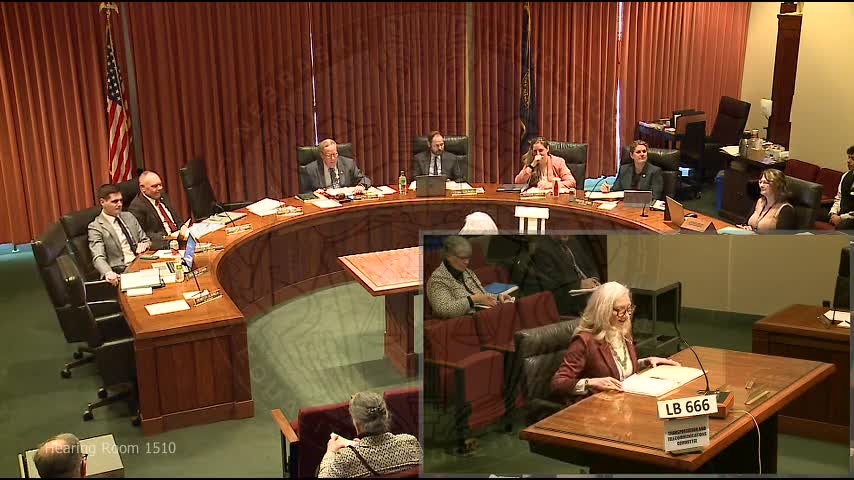
Sen. Tanya Storer, chairing an introducer presentation to the Transportation and Telecommunications Committee, introduced LB 666 on behalf of rural providers and advocacy groups, saying the bill would let competitive carriers — not only incumbent local exchange carriers (ILECs) — request Nebraska Universal Service Fund support and the related carrier‑of‑last‑resort responsibilities.
Storer said the change would address rural affordability and long‑term sustainability for broadband and voice service outside Nebraska’s urban centers. “LB 666 allows competitive providers, not just the incumbent carriers, to initiate actions at the Public Service Commission to receive the Nebraska universal service fund support,” she said.
The bill responds to the 2023 Rural Communications Sustainability Act (LB 683) and to ongoing Public Service Commission (PSC) dockets that are reviewing how NUSF payments should support broadband‑capable networks. Bakhtiyar Komatov, CEO of Pinpoint Holdings (which operates incumbent and competitive subsidiaries), told the committee his company serves about 20 communities in 11 counties, is ready to serve roughly 15,000 locations and that about 1,700 of those are in high‑cost, low‑density areas requiring additional operating support. “When we deploy telecom networks in order to sustain these networks … those high‑cost defined areas require additional support to sustain it over a long time,” Komatov said.
Supporting witnesses argued LB 666 would reduce wasted subsidy overlap where two carriers receive support for the same customers and help sustain networks after federal deployment grants. Tip O'Neill, president of the Nebraska Telecommunications Association, said the bill “clarifies that a competitive provider, which has completed a broadband project in an incumbent provider’s local exchange area, should have explicit statutory authority to apply to the PSC for carrier of last resort responsibility and for transfer of NUSF allocations.”
The PSC testified in a neutral capacity. Cullen Robbins, director of the PSC’s telecom and NUSF department, said the commission already has a rule‑based process for competitive carriers to petition to assume carrier‑of‑last‑resort duties and receive support, and the PSC is conducting docket NUSF‑01/1939 to evaluate how funding might be allocated to competitive providers. He said the PSC “does not oppose memorializing this process in statute,” but that LB 666 may not materially change existing PSC authority.
Committee members asked whether the change could allow competitive carriers to obtain continuing NUSF support as a leverage tool. Proponents said the statutory change mainly creates a procedural path for competitive carriers to initiate transfers when incumbents do not, and that incumbents would remain parties in any PSC proceeding. Andy Pollack of the Nebraska Rural Broadband Alliance said the bill was intended as “a voice and a trigger” to start negotiations when incumbents are not initiating transfers.
No formal action or vote occurred during the hearing. The introducer closed by asking the committee to advance LB 666 to general file so the statutory procedure and PSC reforms can operate together.
LB 666 remains at the committee hearing stage, where stakeholders from incumbents, competitive providers, trade groups and the PSC urged the committee to weigh both consumer protections and long‑term sustainability of rural networks.