Get Full Government Meeting Transcripts, Videos, & Alerts Forever!
Get email alerts on the Fireworks Regulation topic
No spam. Unsubscribe anytime.
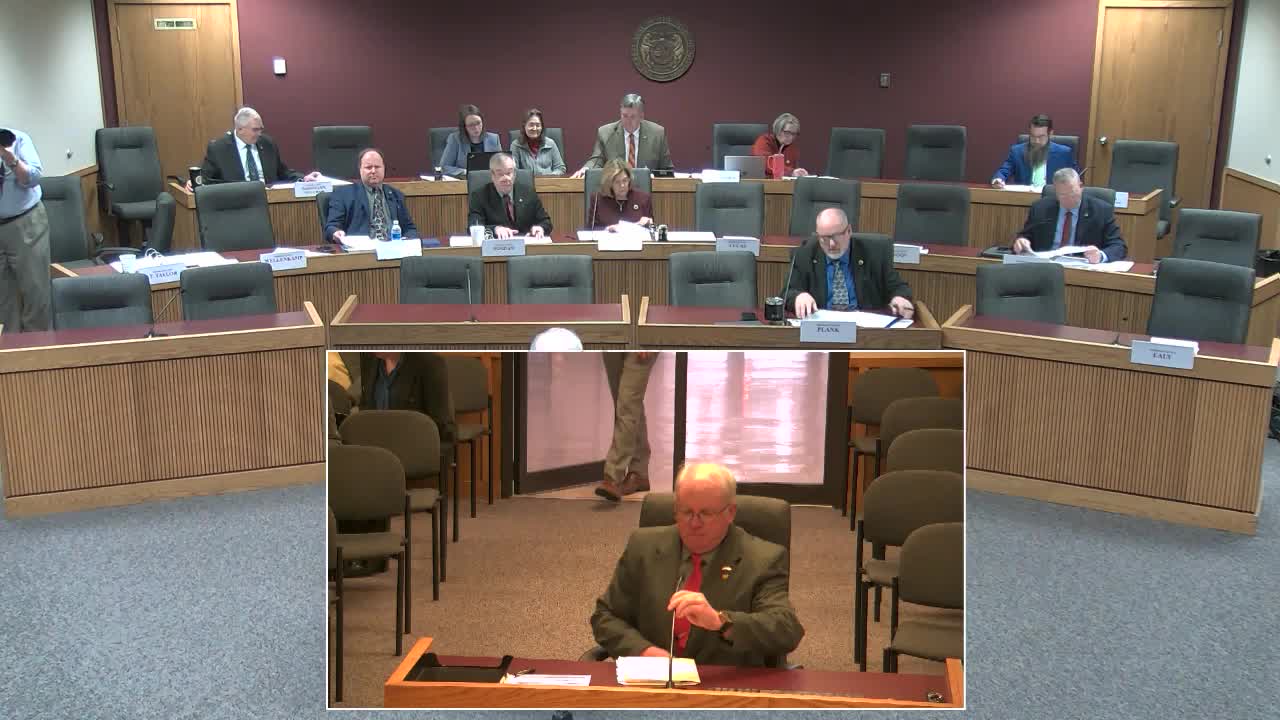
House committee hears bill to modernize Missouri fireworks law; no vote taken
Summary
The House Committee on Conservation and Natural Resources heard testimony on House Bill 806, a three-year industry-backed effort to update Missouri's fireworks statutes, with supporters citing safety and enforceability and lawmakers pressing on fees, enforcement and local control. The committee did not vote on the bill.
The Missouri House Committee on Conservation and Natural Resources heard testimony on House Bill 806, sponsored by Representative Tim Taylor, a multi-year effort to update the state's fireworks statutes. The committee held a hearing and did not take a vote on the measure.
Representative Tim Taylor, sponsor of HB 806 and a member of the committee, described the bill as a multi-year effort to modernize older law. "What House Bill 806 is the culmination of 3 years of work, to bring to to modern times, you might say, the statutes pertaining to fireworks, which were created in 1987," Taylor said, adding that product types, industry practice and safety standards have changed since the original law.
Supporters framed the bill as a public-safety and enforceability update. John Walker of Spirit of 76 Fireworks, a wholesaler and distributor based in Columbia and Booneville, said industry participants and the state fire marshal's office spent three years drafting the proposal and that the top priorities are safety, clarity and enforceability. "First and foremost is first and foremost is firework safety. We in the industry care immensely about firework safety," Walker said.
Heath Clarkston, testifying for the Missouri Fireworks Association, also supported the bill and said statutory definitions and references are outdated. Clarkston told the committee some regulations or rules have not been updated since 2004 and said the association sought to avoid changing local rules about where fireworks may be sold.
The state fire marshal, Tim Bean of the Division of Fire Safety, appeared for informational purposes and described how fees and administration are organized under the proposal. Bean said current permitting work is handled by a small staff and that some of the fee structure is intended to support education and administrative costs; in committee discussion he said, briefly, "We are good," when asked whether the office could handle additional duties with the proposed structure.
Lawmakers pressed on several implementation points during the hearing. Committee members asked whether the bill preserves local control; Taylor and witnesses said the measure does not remove local authority to regulate use or possession. Committee members also asked about categories in the bill: witnesses described three broad classes of fireworks in the draft—consumer fireworks sold to the public, large display fireworks used for public shows, and a middle category of pyrotechnic/arcous products that require training and licensing.
Members raised enforcement questions, including how "willful" violations would be defined in practice and whether enforcement would fall to local fire departments or to the state fire marshal. Witnesses said local enforcement and coordination with the state fire marshal are expected but that some investigations and regulatory authority rest with the state office.
Committee members also focused on fees. Witnesses said the bill includes new or increased fees to help support regulation and education; committee discussion cited language allocating fees to the fire education fund and to a cigarette/firefighter-related fund. Witnesses acknowledged some language about exact fee routing would need clarification and said they would work with lawmakers to refine that language.
Supporters said the bill references industry safety standards — witnesses named the National Fire Protection Association standards (NFPA) cited in the draft — and that clearer licensing and permit steps for higher-power products should make events safer. Representative Miller and other members asked whether the bill would affect typical backyard consumer use; witnesses replied it would not prohibit customary private noncommercial displays and that the statute includes provisions allowing private noncommercial displays under specified conditions.
Several committee members noted past legislative attempts had failed or lacked expert testimony; Taylor and witnesses said industry and the fire marshal's office participated in drafting the current proposal and that the bill reflects revisions made after earlier hearings.
The committee concluded the hearing with no committee vote. Chair Bifapson said HB 627 and HB 995 would be scheduled for a later date. No amendments or formal actions on HB 806 were recorded at the hearing.