Get Full Government Meeting Transcripts, Videos, & Alerts Forever!
Get email alerts on the Child Safety Allergies topic
No spam. Unsubscribe anytime.
'Elijah’s Law' bill would require child‑care allergy plans and training; sponsors stop short of requiring EpiPens statewide
Summary
House Bill 222, called Elijah’s Law, would require licensed child‑care providers to adopt written allergy‑prevention and response policies and require the state education department to issue model policies.
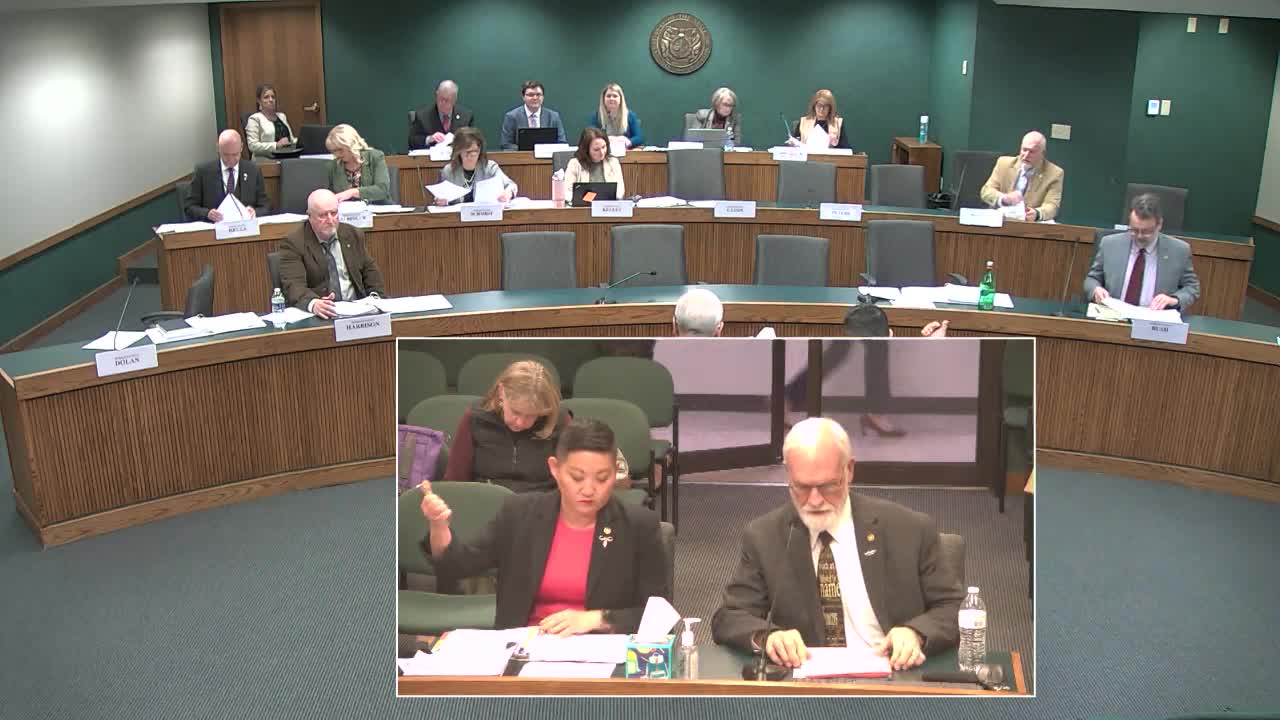
Representatives Schulte and Emily Weber presented House Bill 222 (paired with House Bill 580) to require licensed child‑care providers to adopt written allergy‑prevention and response policies, named "Elijah’s Law." The bills would add child‑care facilities to entities for which a physician may prescribe an epinephrine auto‑injector and require child‑care providers to adopt policies addressing life‑threatening food allergies.
Weber described the 2017 death of a 3‑year‑old named Elijah and said parents and advocates asked for similar protections that exist in schools to be extended to child‑care settings. Sponsors said the Department of Elementary and Secondary Education must develop a model policy by July 1, 2026, and that licensed providers must adopt a policy by July 1, 2027.
Sponsors told the committee they did not require every child‑care center to stock epinephrine auto‑injectors because of the financial burden on some centers; instead they proposed model policies, training requirements similar to DESE standards and grant opportunities to help centers obtain epinephrine devices. Supporters including parents, the Asthma and Allergy Foundation of America, and local advocacy groups testified that written policies and training would reduce the risk of fatal anaphylaxis in child‑care settings.
Committee members suggested making the written allergy policy part of licensing standards so it would be required documentation for licensed centers; sponsors said they were open to that conversation. Members also discussed training requirements and whether DESE would incorporate required training into licensing inspections.
Supporters described personal incidents where children were mistakenly served allergenic food and staff failed to provide medication; a parent said her child once self‑administered epinephrine at age 9 after school staff failed to give his medication. Sponsors encouraged the committee to adopt the bills as an incremental, fiscally sensitive step to improve child‑care safety for children with food allergies.
House Bills 222 and 580 were heard together; no committee vote was taken at the hearing.