Get Full Government Meeting Transcripts, Videos, & Alerts Forever!
Get email alerts on the Federal Mandates Costs topic
No spam. Unsubscribe anytime.
Bills would require state tracking of federal‑mandate compliance costs; sponsor says data gap hampers decisions
Summary
Representative Lewis Riggs proposed House Bill 868 to require state agencies to track staff time and other costs of complying with federal mandates; HB 767 was presented as a companion for school districts.
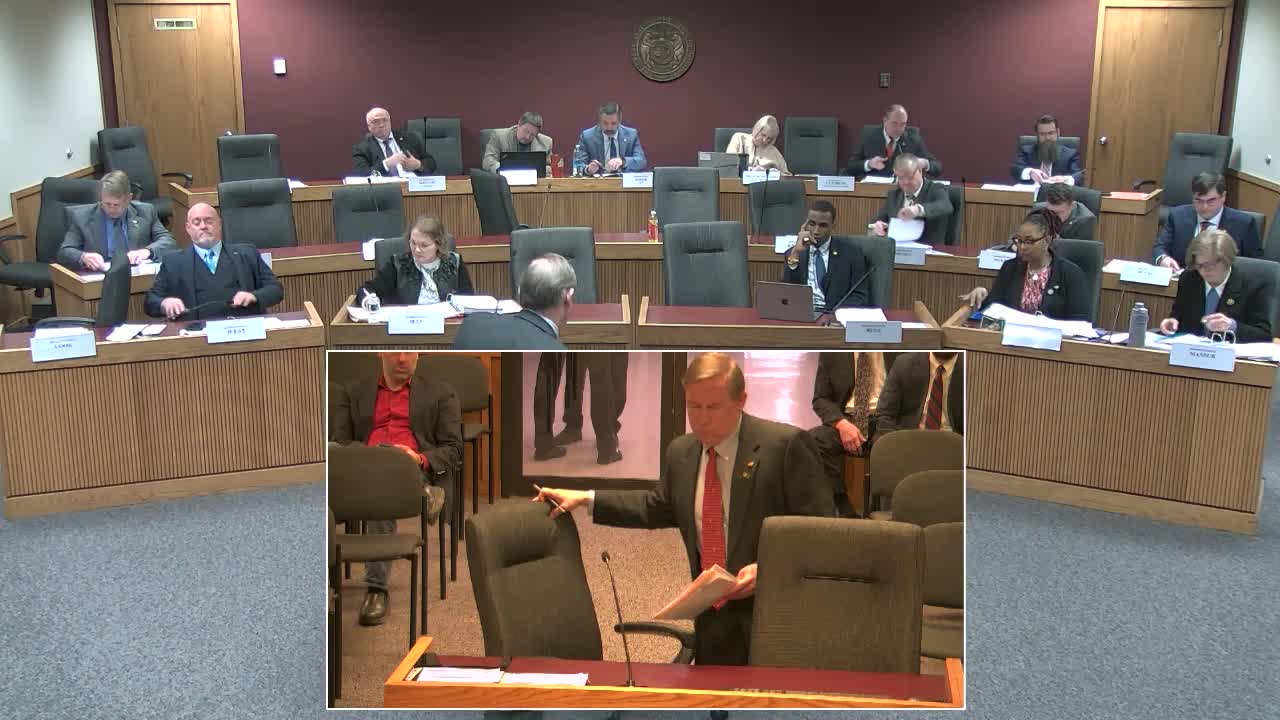
Representative Lewis Riggs told the committee that House Bill 868 would require state agencies to capture and report the costs — particularly staff hours — required to comply with federal mandates. He said the idea arose from a superintendent who gave him a lengthy list of federal and state requirements and lacked reliable information on staff time devoted to compliance.
"This bill would require the state to actually track how much it costs to jump through those federal hoops," Representative Lewis Riggs said, describing an aim to quantify compliance as a kind of cost‑benefit input for policy decisions.
Riggs said the bill’s reporting cadence was set quarterly so the Legislature could evaluate data while in session. He and witnesses said the measure is intended to give policymakers better information to assess whether a federal program’s administrative burden outweighs its benefits for Missouri.
Arnie C. ACDinos, State Public Advocate, testified in favor, saying: "I'm sick and tired of the federal government continually giving Missouri mandates without any funding or compensation to pay for the deliverance of the mandate... The more factual, transparent information that we have, the better."
Witnesses for informational purposes included Brandon Alexander for the state auditor, who described the auditor's existing triage for audits and noted capacity constraints. Mike Lodewiggan of the Missouri Council of School Administrators cautioned that the fiscal‑note request system used by state agencies is difficult for local school districts to navigate. He suggested the committee consider improving the fiscal‑note process and providing clearer documentation when agencies seek cost information.
Representative Riggs also introduced House Bill 767 as a companion measure intended to capture similar compliance-time data within school districts. He described classroom examples — reading assessments that require one‑student‑at‑a‑time computer work that pulled instructional time away — to illustrate how mandates can consume staff hours. Supporters urged the committee to quantify those costs so appropriators and policy makers can judge whether particular mandates are worth the administrative burden.
Questions from the committee covered whether the bills would capture benefits as well as costs (Rep. Reed proposed adding benefit-tracking; Riggs said he would accept the amendment), how data would be collected and reported, and whether the state auditor or Office of Administration would be assigned responsibility. Brandon Alexander said the bill as drafted would require the Office of Administration to bid out the work and that the auditor’s office provided estimates of fiscal impact if it were required to carry out audits internally. He also flagged potential procurement challenges and workload prioritization.