Get Full Government Meeting Transcripts, Videos, & Alerts Forever!
Get email alerts on the Performance Audits topic
No spam. Unsubscribe anytime.
Rep. Riggs renews push for periodic third‑party performance audits of state departments
Summary
Representative Lewis Riggs introduced House Bill 869 to require periodic performance audits of state departments using private sector firms, citing Ohio’s model and claimed savings. The state auditor’s office described existing financial and performance-audit responsibilities and flagged capacity and procurement limits.
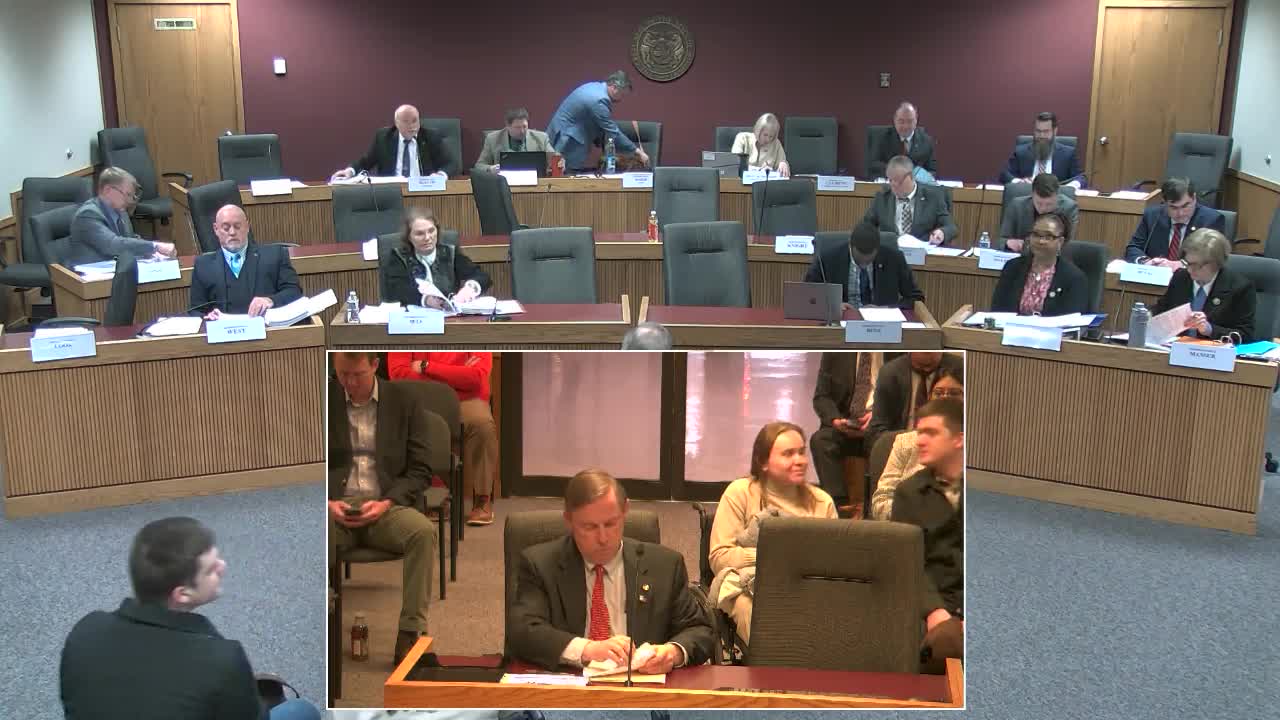
Representative Lewis Riggs, R‑5th District, told the committee that House Bill 869 would require state departments to undergo periodic performance audits conducted by private-sector firms, modeled on Ohio’s program. Riggs said the proposal is intended to prompt departments to ask whether particular functions should be performed and by whom, and he cited Ohio’s long-running program and an asserted $1.2 billion savings there.
"The simple bill mandates the state departments do what the private sector does routinely, conduct performance audits on a periodic basis," Representative Lewis Riggs said, adding the legislation "states a preference for private sector solutions based on legislation from Ohio, which has been performing these audits for about 30 years now, having saved $1,200,000,000 in the process."
Supporters in the hearing said periodic audits could reveal inefficiencies and save taxpayer money. Arnie C. ACDinos, State Public Advocate, testified in favor: "Whenever we can audit, and come up with efficiencies and ways to do government better, save taxpayers money, I'm all for it. I believe that this bill's intention is to keep transparency open, keep honesty and efficiency, trust and responsibility, and especially accountability of the department being audited."
Brandon Alexander, chief of staff for the state auditor, told the committee the state auditor's office already conducts both financial and performance audits and currently has more than 40 audits in progress, including about 10 state-level performance audits. Alexander explained the office triages audits by risk, available audit hours and mandatory work; required annual tasks (for example, the treasurer's office audit and statewide single audit) consume a large share of capacity. He also flagged procurement difficulties: increased federal fund flows have made private-sector auditors scarce and procurement of outside firms more competitive and costly.
Alexander said staffing grows have been recent but remain below historical peaks. He summarized an internal fiscal estimate that expanding audit responsibilities to staff up and conduct statutory new work could cost millions: "we did, dollars 2,400,000.0 as our fiscal note reply on this bill if we were to have to staff up to try and conduct." He added that the office is hiring but competes with the private market for talent.
Committee members asked about scope and contracting: Riggs said the bill would require departments to obtain audits and that departments — via normal procurement processes — would select auditors. Alexander clarified that the auditor's office typically pursues program‑level performance audits based on risk and available hours and that some county-level work is already contracted.
The committee concluded the hearing on House Bill 869 after public testimony and informational exchanges; no committee vote on HB 869 was recorded in the transcript.