Get Full Government Meeting Transcripts, Videos, & Alerts Forever!
Get email alerts on the Special Education Consent topic
No spam. Unsubscribe anytime.
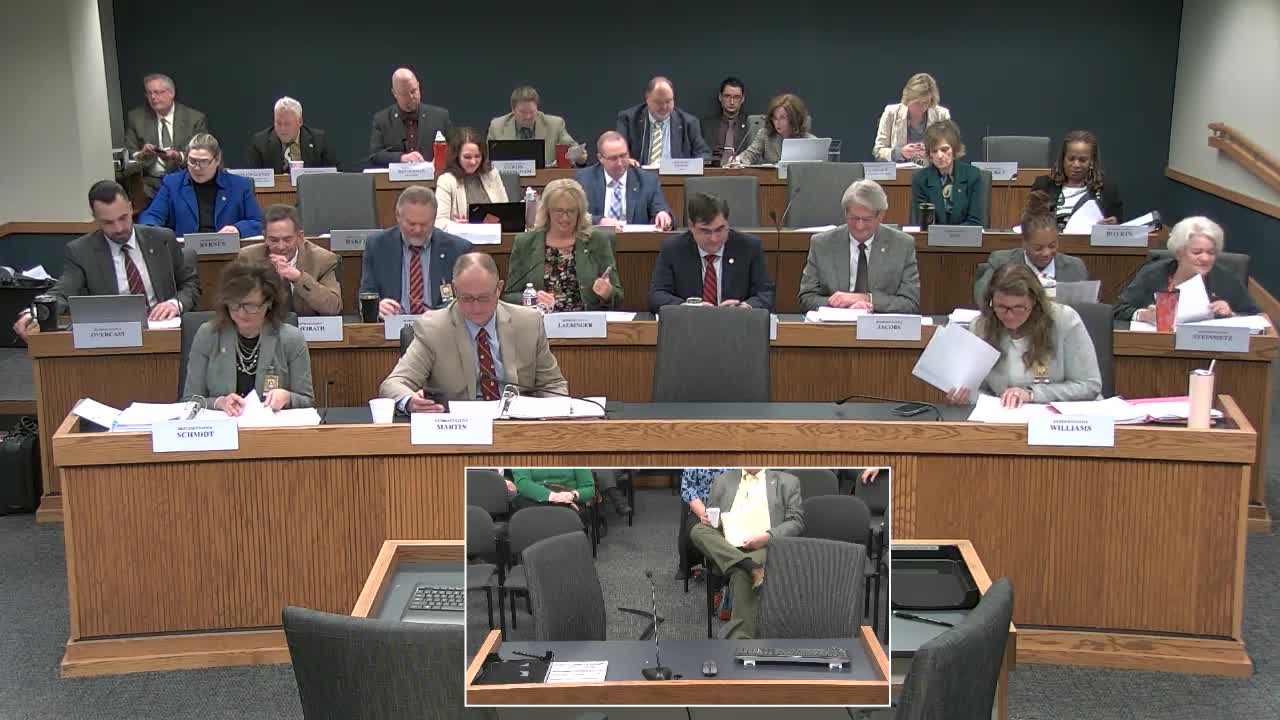
House committee adopts substitute for bill changing IEP consent timetable and dispute process
Summary
The House Committee on Elementary and Secondary Education voted to adopt a committee substitute for House Bill 477, changing timelines and dispute-resolution language for parental consent and implementation of individualized education program (IEP) amendments, including new definitions and expanded time for dispute resolution.
The House Committee on Elementary and Secondary Education on a voice vote adopted a committee substitute for House Bill 477 and then voted the substitute "do pass." Chairman Lewis said the substitute clarifies definitions, expands timelines and preserves existing dispute-resolution options in special education cases.
The substitute adds definitions for placement and school day, expands the definition of parent to include an emancipated child, and amends timelines for agreement on amended IEPs. "The timetable is 10 school days for an agreement or an addendum," Chairman Lewis said, and the substitute "adds an additional 20 days, and that can happen up to 2 times." The substitute also replaces references to "business days" with "school days," and lists the dispute-resolution options that remain available, including facilitated IEP meetings, child complaint investigations, state-paid mediation and traditional due process.
The nut graf: supporters said the substitute is intended to give parents more time to consider requested IEP changes while preserving schools' ability to continue agreed services and to use existing dispute-resolution processes; opponents raised safety and administrative-burden concerns.
Representative Steinhoff, a committee member, said she intended to vote for the substitute but remained concerned that the measure might not fully address safety issues for other students and staff if placements change. "I'm not sure that we have accounted for safety as much as we should," Steinhoff said. Representative Jacobs asked whether special-education staff would be required to run parallel plans when parts of an IEP are in dispute; committee members and the sponsor's floor designee said the substitute allows agreed services to proceed while disputed elements remain governed by the prior IEP unless a safety subsection applies.
Chairman Lewis and other committee members repeatedly said the substitute does not remove a parent's ability to pursue due process. "The school then would implement the... process is giving them more time; it is not giving them veto power," Lewis said. The committee adopted the substitute and then recorded a roll-call vote on the substitute: 18 ayes, 2 no and 1 present. The chair announced, "By your vote of 18 to 2, 1 present, the House Committee substitute for House Bill 477 is voted passed." The transcript records the roll-call but the committee's clerk has the official tally sheet.
Ending: The committee advanced the bill to the next stage with the substitute in place. The sponsor was not present; the chair and committee members said they had worked with DESE staff and the head of DESE's special education division during drafting and that DESE informed them the substitute should not increase the number of due-process cases, according to the chair's description of his conversation with DESE.