Get Full Government Meeting Transcripts, Videos, & Alerts Forever!
Get email alerts on the Hemp Regulation Hb696 topic
No spam. Unsubscribe anytime.
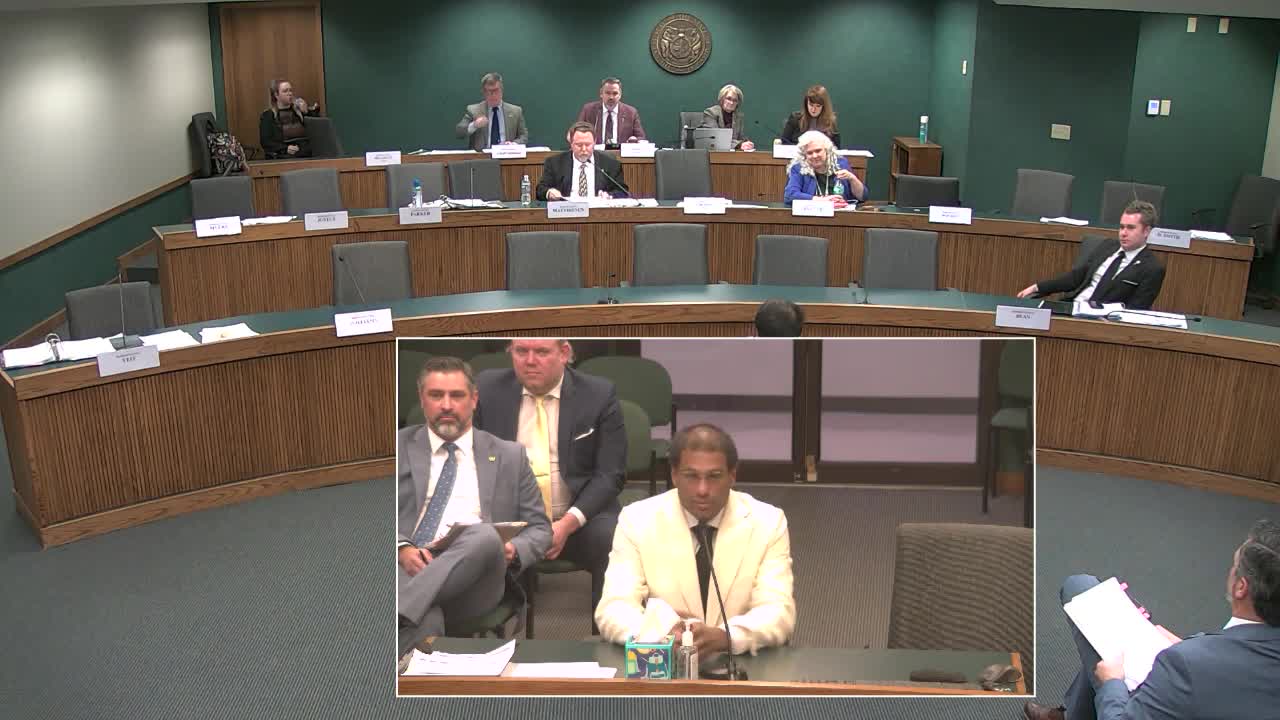
Missouri House committee hears divided testimony on HB 696 over hemp‑derived intoxicants and market access
Summary
Witnesses for and against House Bill 696 told a Missouri House committee that the measure would clarify regulation of hemp‑derived products, with supporters urging broad retail access and opponents saying federal law distinguishes non‑intoxicating hemp from intoxicating cannabis.
At a Missouri House committee hearing, witnesses testified both for and against House Bill 696, a proposal to regulate hemp‑derived products and to address whether intoxicating products made from hemp fall under the federal hemp framework established in the 2018 farm bill.
The bill matters because it would determine who may sell federally lawful hemp products in Missouri, how those products are tested and labeled, and whether a separate regulatory approach is needed from the state’s marijuana licensing system. Supporters told the committee HB 696 would protect small hemp businesses and permit broad retail access; opponents said federal law and recent federal policy make an important legal distinction between non‑intoxicating hemp and intoxicating cannabis.
Ethan Thampy, representative of American Shaman and affiliated beverage company Purellis Kana, testified in favor. Thampy said he has worked on cannabinoid policy for 16 years and urged that the committee consider adopting distribution language similar to the three‑tier alcohol system. "We've been working with Representative Hinman... specifically regarding beverage distribution and... the 3 tier distribution system," Thampy told the panel, and he asked the committee to build on prior legislative work and the medical marijuana history to craft a well‑vetted regulatory structure.
Alec Rosenblum, a registered lobbyist for the Missouri Cannabis Trade Association, testified in opposition and urged the committee to treat intoxicating products differently than non‑intoxicating hemp. Rosenblum disputed proponents' reading of the 2018 farm bill and said congressional drafting and later commentary sought to distinguish non‑intoxicating CBD from intoxicating cannabis. Rosenblum read excerpts from congressional and policy sources and put a short passage on the record from a Heritage Foundation brief: "If it is intoxicating, it is not hemp. If it is hemp, it does not intoxicate."
Craig Katz, government relations and compliance manager for CBD Kratom, spoke in favor and criticized a fiscal estimate the hearing produced as "way out of line." Katz said the Department of Health and Senior Services (DHSS) had requested a far smaller regulatory budget in response to an earlier executive order and called HB 696 "the only bill that is non exclusionary" because, he said, it would allow existing small businesses and family farmers to remain in the marketplace. Katz also referenced a May 2024 letter he said came from the DEA that discussed THCA and told the committee he was not aware of any subsequent federal enforcement actions against THCA since that letter.
Ron Leone, executive director of the Missouri Petroleum Convenience Association, also supported the bill on behalf of gas station and convenience store owners. Leone said his members would not sell products illegal under federal law and underscored points of agreement he said existed among stakeholders: sales restricted to customers 21 and older, testing and safety standards, packaging and labeling requirements, licensing and enforcement. "Hemp derived products are lawful under federal law. Marijuana is illegal under federal law," Leone told the committee.
Several other industry representatives and lobbyists registered support for HB 696, including Jake Silverman of the Missouri Vape and Alternative Products Association and Ron Hicks, a former state representative now registered with the Missouri Hemp Trade Association. Hicks said the state legislature should act to regulate an existing, largely unregulated industry and to protect legitimate hemp businesses from what he described as attempts by the marijuana industry to limit market access.
Farmers and producers also spoke. Brian Regal of Regal Dairy and Southpointe Hemp told the committee he had grown fiber hemp and said he currently had plant material on his farm containing THCA and delta‑9. Regal said some proposed restrictions in competing marijuana‑industry bills would not be workable for his crop.
Committee members asked few substantive questions in the excerpt of testimony provided. Witnesses differed over how to interpret federal law, the size and source of any regulatory fiscal note, and whether the state should allow broad retail access to hemp products or restrict sales to a narrower set of licensed retailers tied to the marijuana system. The transcript excerpts do not record any committee vote or formal action on HB 696 during the hearing period covered.
The sponsor referenced in testimony was Representative Baker; proponents noted Representative Hinman has similar language in a separate bill. The committee did not announce a date for further action in the transcript excerpts provided.