Get Full Government Meeting Transcripts, Videos, & Alerts Forever!
Get email alerts on the Local Charter Revision topic
No spam. Unsubscribe anytime.
Charter commission moves to elect three council members per cycle, endorses council–manager switch; retains three‑reading rule
Summary
Sunbury’s charter commission voted to change the council election cycle to a 3‑and‑3 rotation with a transitional two‑year seat and approved pursuing a council–manager form of government for placement on a future ballot. The commission kept the existing three‑reading requirement for ordinances and left vote‑recording rules to council procedures.
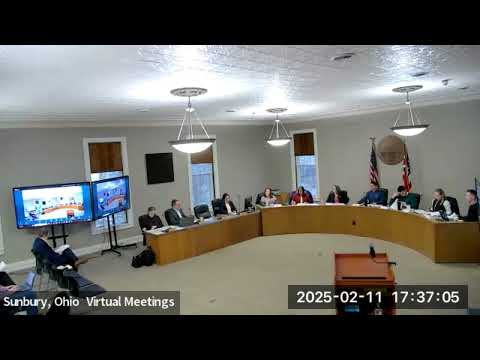
The Sunbury Charter Commission voted Tuesday to change the city’s council election cycle and signaled support for shifting to a council–manager form of government, while voting to retain the current charter provision that typically requires three readings of ordinances.
The commission approved language to elect three council members in each odd‑numbered election cycle (a 3‑and‑3 rotation) and to include transitional language requiring one two‑year seat to bring terms onto the new cycle. Commissioners also voted that the commission should proceed toward replacing the current mayor–council/administrator arrangement with a council–manager government and asked legal staff to prepare redlines showing the required charter edits for future review and for eventual placement on the ballot.
The votes come after several hours of line‑by‑line review of proposed charter updates in articles 3 and 4. Commissioners debated administrative details — including whether technical state building and fire codes should be adopted by reference or amended locally, how and when meeting materials should be posted online, and whether the charter should specify that individual roll‑call votes be recorded by name or left to council rules.
Legal counsel flagged one early request from a resident to add explicit authority for new community authorities to the charter. Mr. Bridal, outside legal counsel, told commissioners that new community authorities are established under state statute and are separate political subdivisions: “New community authorities are statutory … they are a separate entity when they are created,” and he recommended against adding authority to create them in the city charter.
Commission staff read a written submission from a resident, Paul Holler, that urged tighter rules on agendas and recommended other changes. Becky, a staff member, summarized a separate set of suggested charter items she had discussed with the mayor of New Albany, who, she said, recommended maintaining nonpartisan elections and directly electing the mayor; she told commissioners those were items the New Albany mayor had emphasized: “Number 1, maintain nonpartisan elections … Number 2, mayor elected directly by the voters.”
On administration and process, commissioners debated whether to require that meeting agendas and available supporting documents be posted on the municipal website by a fixed time before meetings. Staff and counsel recommended placing any such timing requirement in council rules rather than in the charter so the rules can be adjusted administratively. Commissioners also discussed adding a charter provision to allow council to appoint an alternate clerk of council to act when the clerk is absent; commissioners approved language to add an alternate clerk position.
A lengthy discussion addressed the charter’s clause on technical building and fire codes. Commissioners agreed it would be useful to clarify that Sunbury may adopt state technical codes by reference and may add city‑specific requirements when those local additions do not conflict with state law. Staff said they had reached out to the fire chief and the county inspection provider and will return with recommended wording and operational details.
Commissioners also discussed the longstanding requirement that ordinances be read on three separate days unless five council members vote to suspend the requirement. Some commissioners and public commenters favored reducing the norm to two readings, but a majority concluded the current three‑reading default should remain in the charter for now to preserve visibility and public notice. The commission voted to keep the three‑reading provision unchanged.
Commissioners reviewed the process and timeline for ballot placement: staff noted the commission’s work needs to be complete by July 1 so council can act in time to place amendments on the November ballot and that the city plans a mailer (the commission previously spent roughly $7,000 on mailing) and a red‑line version on the city website to explain proposed changes to voters.
Votes at a glance
- Change council election cycle to a 3‑and‑3 rotation with transitional two‑year seat: Motion approved (motion moved and seconded on the record; roll call 7‑0). Notes: staff will add transitional language specifying one two‑year term during the first cycle to align seats with the new schedule.
- Add provision for alternate clerk of council: Motion approved (mover: Amy; second: Nancy; roll call 7‑0). Notes: commissioners discussed removal/suspension language for the clerk and concerns about majority‑driven removals; the charter retains emergency authority but staff advised careful transitional language and administrative protections.
- Keep three readings requirement for ordinances (no change): Motion to keep current charter language approved (mover: Amy; second: Chris; roll call 6‑1; one recorded no). Notes: commissioners discussed a possible future move to two readings; for now the default remains three readings with a five‑of‑seven suspension threshold.
- Leave vote‑recording rules to council rules (no charter change): Motion approved (moved by Shannon Stark; second recorded; motion passed). Notes: commissioners weighed transparency against the volume of charter changes and preferred that council codify roll‑call recording in its rules.
- Proceed with council–manager form of government (place process items on next steps): Motion approved (mover and second on the record; roll call 7‑0). Notes: commissioners asked legal staff to prepare red lines showing the charter edits required to convert to a council–manager form; any final change would require council action and, ultimately, voter approval under the Ohio Constitution.
Discussion vs. decisions
The article summarizes both discussion points and formal votes. Substantive discussion included whether the charter should mention new community authorities (legal counsel advised against it because NCAs are statutory and separate entities), whether technical codes should be adopted automatically or with local additions (staff will return with recommended text after consulting the fire chief and the county inspection provider), and procedural transparency items such as the timing of agenda postings and whether roll‑call votes should be recorded by name in the charter.
What’s next
Legal staff will prepare red‑lined charter language reflecting the commission’s votes and suggestions — including the election‑cycle transition language and the initial draft necessary for a council–manager conversion — and will return to the commission for additional review. Staff reiterated the commission’s internal deadline to finish its work by July 1 to meet statutory timelines for placing charter amendments on the November ballot; the commission also agreed to publish a red‑line version on the city website and to mail proposed changes to residents as part of the voter notice process.
All direct quotations in this article are drawn from the meeting transcript and are attributed to speakers recorded by the commission during the meeting.