Get Full Government Meeting Transcripts, Videos, & Alerts Forever!
Get email alerts on the Energy And Utilities topic
No spam. Unsubscribe anytime.
House defeats move to bar ratepayer recovery for small modular reactor planning; approves higher tech-customer share in utilities bill
Summary
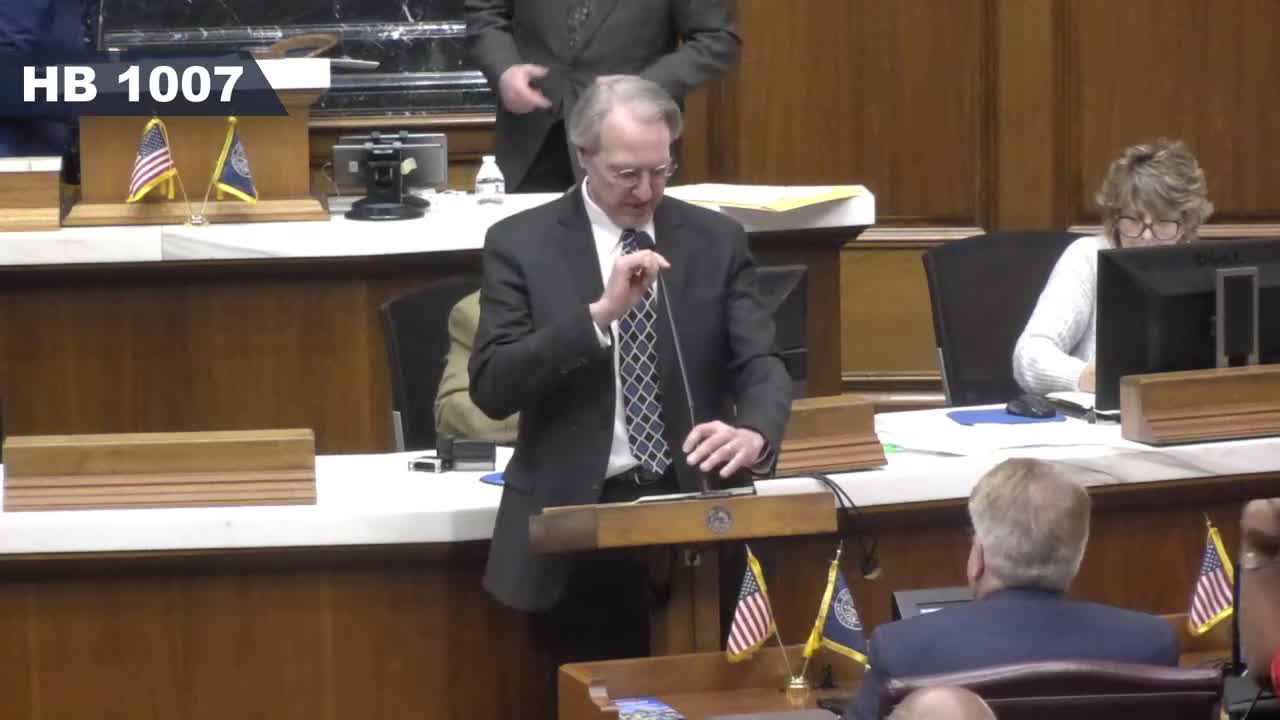
Representative Pierce offered a string of amendments to House Bill 1007 on Tuesday, pressing the House to limit how utilities can shift financial risk for small modular reactors, or SMRs, onto ratepayers.
Representative Pierce offered a string of amendments to House Bill 1007 on Tuesday, pressing the House to limit how utilities can shift financial risk for small modular reactors, or SMRs, onto ratepayers.
Pierce framed his main proposal as a protection for utility customers, arguing utilities should keep “skin in the game” rather than passing speculative planning and construction costs to ratepayers. “If they go through that process and they expend millions of dollars... and they decide, you know what, it just doesn't make sense to do, the current bill is written, allows the utility to recover from the rate payer,” Pierce said while urging support for his amendment.
The House voted 29 in favor and 69 opposed to Amendment 1, which would have removed a provision permitting utilities to recover planning costs for SMR projects that are never built; the amendment was defeated. The House then considered, and adopted by voice, a separate amendment that raises the required contribution by a large technology customer for expedited approval of new generation from 75% to 80%.
Why it matters: The exchanges centered on whether the state should help create incentives for SMR manufacturing and deployment in Indiana or instead protect current electricity customers from paying for unproven technology. Pierce repeatedly pointed to the lack of deployed SMRs nationwide and to projects that rose sharply in cost despite federal subsidies, saying the risks are real for ratepayers if planning and early construction costs are recoverable regardless of final project completion.
Supporters of the bill’s existing provisions said the measure is intended to encourage investment and manufacturing for SMRs in Indiana and to position the state competitively. In floor remarks opponents of the amendment argued that the bill includes oversight mechanisms — including regulatory review by the Indiana Utility Regulatory Commission — and that incentives are necessary to attract SMR manufacturing and jobs. Those proponents also said some recovery mechanisms are already supervised by regulators and are not automatic.
Other contested changes: Pierce also proposed removing construction-work-in-progress (CWIP or “QIP”) recovery for SMRs. That amendment (Amendment 3) was debated at length and ultimately defeated. Lawmakers who opposed cutting CWIP argued that the IURC oversight and statutory limits make immediate recovery supervised and potentially beneficial to ratepayers by reducing financing costs; supporters of the amendment warned CWIP shifts too much risk onto consumers for projects with historically large overruns.
Official actions and outcomes recorded on the floor for HB 1007: - Amendment 1 (remove utility recovery of SMR planning costs): moved by Representative Pierce; vote tally 29 yes, 69 no; outcome: failed. - Amendment 2 (increase large-load customer contribution for expedited new generation from 75% to 80%): moved by Representative Pierce; adopted (voice vote; tally not specified). - Amendment 3 (remove construction-work-in-progress/QUIP recovery for SMRs): moved by Representative Pierce; defeated (roll-call/tally not specified in transcript excerpts). - Following consideration of the amendments, the bill was ordered to engrossment.
Clarifying details from the debate: - Pierce cited the one major U.S. SMR cluster effort that had received roughly $4,000,000,000 in promised federal subsidies and reported escalating cost estimates (examples he read from the floor: $3 billion → $4.2 billion → $6.1 billion → $9.3 billion in successive public program estimates). He used that sequence to illustrate cost escalation risk for unproven SMR projects. - The bill includes multiple pathways that could allow utilities to recover planning or construction costs, and Pierce’s amendments targeted those recovery pathways rather than the bill’s tax-credit provisions for manufacturers. - Supporters noted that any recovery under construction-work-in-progress would still be subject to IURC review and must be “reasonable and just,” as referenced on the floor.
Meeting context and next steps: The exchange over HB 1007 consumed substantial floor time, with multiple members debating technical and economic risk, regulatory timelines, and the state’s interest in attracting SMR manufacturing. After the votes recorded above, the speaker ordered the bill to engrossment; the transcript does not show final passage of HB 1007 on the floor during this session excerpt.
Ending: HB 1007 will move forward in the process with the floor’s adopted and defeated amendments recorded in the House journal; further action, including final passage and potential Senate consideration, will determine whether the measure’s utility cost‑recovery provisions become law.