Get Full Government Meeting Transcripts, Videos, & Alerts Forever!
Get email alerts on the Childcare Tax Policy topic
No spam. Unsubscribe anytime.
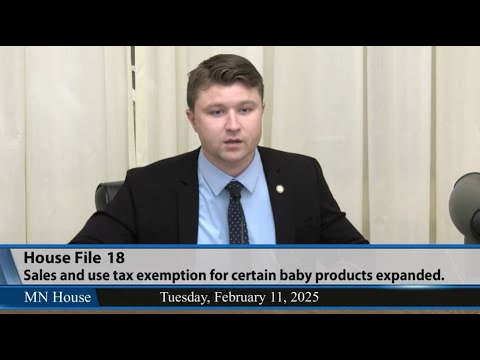
House taxes committee advances bill to exempt infant items from state sales tax, sends measure to Ways and Means
Summary
The Minnesota House Taxes Committee voted to send House File 18 to the Ways and Means Committee after debate over whether a sales-tax exemption for infant products or an expansion of the child tax credit better targets aid to families. A DE1 amendment that would have altered the bill was withdrawn during the hearing.
The Minnesota House Taxes Committee on Feb. 12 voted to advance House File 18, a bill to exempt certain infant care items from the state sales tax, sending the measure to the House Ways and Means Committee after discussion and the withdrawal of a proposed DE1 amendment.
Representative Daniel Engin, the bill sponsor, told the committee the proposal is “going to make Minnesota a better state to raise a family and to start a family or expand a family.” Engin said the bill would expand the list of tax-exempt infant items and estimated an overall revenue impact of about $10,000,000.
The debate centered on whether a blanket sales-tax exemption is the most effective way to help families. Chair Brett Gomez, who proposed a DE1 amendment and then withdrew it, argued that broad sales-tax exemptions are not income-targeted and can disproportionately benefit higher-income purchasers. Gomez pointed to Minnesota’s 2023 child tax credit, saying that program — which provides $1,750 per child and includes periodic advance payments from the Department of Revenue — is a more targeted way to help lower-income families.
Testimony at the committee hearing came from advocates and policy groups. Sarah Gangelhoff, director of advocacy and innovation at the Women’s Foundation of Minnesota, said the sales tax on baby products “has a disparate impact on women and single female-headed households” and that the cost of infant care and other child-related expenses increases families’ economic insecurity. Maggie Haney, policy associate with the Minnesota Catholic Conference, told lawmakers eliminating the sales tax could save low-income parents more than $100 on a typical bundle of infant items and argued those savings can help families afford safer new products rather than used goods with potential safety issues.
Members and staff discussed implementation details. Nonpartisan staff member Miss Hagler said states with similar exemptions vary in which products are included and noted that sales-tax exemptions must be specific in statute. Joanna Bares, legislative director for the Minnesota Department of Revenue, said the department would notify taxpayers and retailers of any tax change and conduct education and audits to ensure compliance; she said the department took no position on the bill.
Committee members raised additional questions about scope and equity. Some members asked whether the exemption should be capped to exclude luxury items; others asked whether the policy should include older children’s goods or remain limited to infant-specific items that are less likely to be used by adults. Research staff and members noted there are no income thresholds on sales-tax exemptions, so the benefit would apply to all purchasers.
Representative Engin said the exemption is intended to provide immediate at-the-register relief for families who must purchase infant items now, and that he would consider amendments narrowing or expanding the product list in consultation with colleagues. Committee discussion also referenced other states that have enacted similar exemptions in recent years, including Florida, Iowa and Kentucky; staff said product lists vary by state.
After discussion, Chair Davids moved that House File 18 be passed and sent to Ways and Means. The motion carried by voice vote with committee members answering “Aye”; the motion was recorded as prevailing and the bill will proceed to Ways and Means for further consideration.
The hearing also recorded that Chair Gomez withdrew the DE1 amendment during the committee proceeding; no formal vote on that amendment occurred.
Votes at a glance House File 18 — Advance to Ways and Means. Motion moved by Chair Davids; DE1 amendment withdrawn. Committee voice vote: Aye; motion prevails (no roll-call tally recorded in the transcript).