Get Full Government Meeting Transcripts, Videos, & Alerts Forever!
Get email alerts on the Whistleblower Protections topic
No spam. Unsubscribe anytime.
Committee approves bill to extend whistleblower protections for state employees, 7-6
Summary
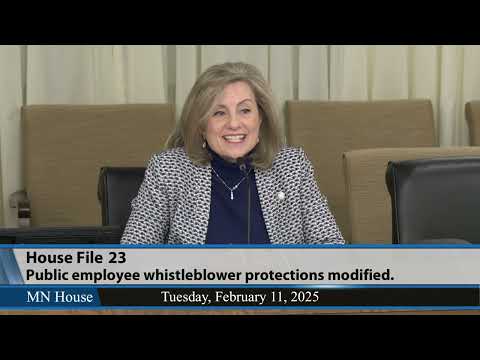
Representative Robbins brought House File 23 to the Fraud Prevention and State Oversight Policy Committee and, after adopting an author’s A1 amendment, the committee voted 7-6 to send the bill to the Workforce, Labor and Economic Development Committee.
Representative Robbins brought House File 23 to the Fraud Prevention and State Oversight Policy Committee and, after adopting an author’s A1 amendment, the committee voted 7-6 to send the bill to the Workforce, Labor and Economic Development Committee.
The A1 amendment, which the sponsor said “just gets the bill in the shape that I would like to have it,” clarifies statutory definitions of “abuse, fraud and waste” and aligns those definitions with language in Minn. Stat. §127A.21 and related inspector-general provisions, Representative Robbins said. The amendment was adopted by voice vote before the committee considered the full bill.
The bill’s sponsor, Representative Robbins, said the measure “is to expand protection for potential whistleblowers in the state of Minnesota,” and described it as a bipartisan effort that would explicitly extend whistleblower protections to state employees reporting waste, fraud or abuse to legislators, the legislative auditor or constitutional officers such as the attorney general.
Devin Bruce, director of legislative and political affairs for the Minnesota Association of Professional Employees (MAPE), testified in support of the bill’s intent but urged broader changes. “It takes a far less punitive approach than what we’ve seen in other proposals,” Bruce said, and recommended extending the same protections to all public employees rather than limiting them to the classified service. Bruce also cautioned that the bill does not change the rules about sharing nonpublic or proprietary information and pointed to the Minnesota Data Practices Act (chapter 13) and specific grant-data rules (citing Minn. Stat. §16B.97, subd. 5) that can limit disclosure.
MAPE asked the committee to consider making the identity of employees who report certain matters private under the whistleblower statute’s subdivision 2; currently that privacy protection applies only to a narrower set of reports, Bruce said. He also noted that fraud can be a crime when committed, but that the whistleblower-protection question is separate from criminal prosecution.
Committee members asked how the bill differs from existing whistleblower protections in Minn. Stat. §181.932, which already protects people who report suspected violations of federal or state law. Representative Robbins said the A1 amendment was meant to align the whistleblower statute with the inspector-general definitions in statute 127A so employees would not be subject to inconsistent language across statutes.
Representative Bonner moved to table (lay over) the bill, saying there were outstanding issues; that motion failed. Representative Howard moved to refer the bill to the Fraud Prevention and State Oversight Policy Committee instead of Workforce, Labor and Economic Development; that motion did not prevail. On a roll-call vote the committee approved referral to Workforce, Labor and Economic Development, 7-6. The clerk announced, “There being 7 ayes and 6 nays, the bill is voted in favor and will be moving to workforce, labor and economic development.”
Members who recorded “aye” during the roll call included Chair Nash, Vice Chair Davis and Representative Anderson; members recorded as voting “no” included Representatives Bonner, Clardy, Freiberg, Howard, Jones and Kraft. Other named members recorded as voting yes in the roll call were Representatives Joy, Kosnick, Quam and Sexton.
The committee discussion emphasized two themes: (1) the policy goal of broadening statutory protection for employees who report waste, fraud or abuse, and (2) remaining questions about data privacy and whether the bill should cover unclassified state employees and local public employees. Several members said those narrower technical issues — particularly how the bill interacts with chapter 13 and grant-data confidentiality statutes — are better addressed in the next committee stop.
Representative Robbins said she expects labor/workforce committee members to address those technical and privacy questions and welcomed further amendment there; she did not indicate the bill would return to the Fraud Prevention committee for further action.
Votes at a glance: A1 (author’s amendment) — adopted by voice vote. House File 23 — passed on roll call, 7 ayes to 6 nays; referred to Workforce, Labor and Economic Development.
The committee hearing record shows testimony from a state employee union representative and several committee members pressing for clarifications; no final changes to chapter 13 or anonymity provisions were adopted in this hearing. The bill will next be considered in the Workforce, Labor and Economic Development Committee, where members and stakeholders indicated they expect to debate data-privacy interactions, coverage of unclassified employees, and whether subdivision 2 identity protections should be expanded.