Get Full Government Meeting Transcripts, Videos, & Alerts Forever!
Get email alerts on the State Budget Tax Policy topic
No spam. Unsubscribe anytime.
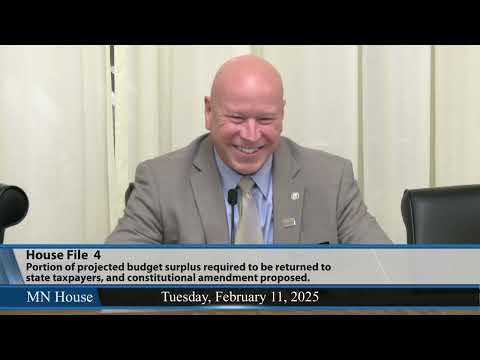
House Taxes Committee hears House File 4 to send surplus above 105% back to taxpayers; amendment adopted, bill laid over
Summary
Representative Johnson presented House File 4 to the Minnesota House Taxes Committee, proposing a constitutional amendment to transfer projected general‑fund revenue that exceeds 105% of projected expenditures into a tax relief account for refunds or one‑time tax reductions.
Saint Paul — Representative Johnson presented House File 4 to the Minnesota House Taxes Committee, proposing a constitutional amendment that would require projected general‑fund revenues exceeding 105% of projected expenditures to be transferred into a new “tax relief” account for property‑ or income‑tax refunds or one‑time tax reductions.
The bill, as amended, would compare the legislature’s chosen forecast (either of the two most recent official forecasts) and transfer projected revenues that exceed 105 percent of projected expenditures into the account. The legislature would then be required to appropriate money from the account for tax refunds or to offset the cost of one‑time tax reductions; refunds would be limited to taxpayers’ existing tax liability.
The matter drew sharply divided testimony. Rhianna Lee, Legislative and Coalitions Director for the Americans for Prosperity Minnesota chapter, told the committee, “Minnesotans, not government officials, are the best stewards of their money,” and urged returning surpluses to taxpayers and considering triggers that reduce rates automatically. By contrast, Nan Madden, Director of the Minnesota Budget Project, warned against constitutional revenue limits and cited Colorado’s Taxpayer’s Bill of Rights (TABOR) as an example of harms in other states: “This proposal does not give you more tools to respond to the needs of Minnesota residents, it instead ties your hand.” Eric Bernstein, Coalition Director of We Make Minnesota, said the amendment would “weaken the state’s ability to fund essential social and physical infrastructure” and urged lawmakers to vote no.
Committee staff described how the proposal would operate in practice. A staff member said income‑tax refunds would be available to “any person subject to, or any person that has a liability, a tax liability under the income tax,” and that property‑tax refunds would likely be available to property owners with property‑tax liability. Another staff member said funds meeting the transfer criteria would be set aside “as soon as practical” and held so the legislature could appropriate them only for the constitutionally prescribed uses.
Members pressed a series of policy questions about timing and flexibility. Representative Smith asked whether large commercial property owners or corporations would qualify; staff answered that property‑owning corporations with a property‑tax liability could be eligible. Representative Stevenson raised the risk of exogenous shocks, citing the 2020 pandemic and a hypothetical federal funding freeze, and asked what recourse the legislature would have if a large shortfall arose after a forecast had triggered a transfer. Representative Johnson and staff said that current budget decisions could be revised later but acknowledged the amendment would limit the legislature’s control over amounts placed off limits for other uses.
Members adopted two changes on the record. Representative Johnson moved and the committee approved the “4A2” amendment to put the bill into the author’s preferred form. Later, Representative Smith moved and the committee approved a verbal amendment inserting the word “projected” before “expenditures” in the ballot question language to match the operative text.
Committee members also discussed procedure. Members cited House Rule 4.15 (referral of constitutional amendments) and agreed that a referral path of Ways and Means followed by Rules would satisfy the rule. A fiscal note for the bill with the 2A amendment was reported as in process; staff said the Secretary of State’s preliminary estimate showed no cost but the fiscal note was not final.
With substantial follow‑up questions pending, Chair Davids concluded the meeting by laying the bill over for future consideration. The committee did not issue a final recommendation to the floor at this hearing and will reschedule further consideration at the chair’s discretion.