Get Full Government Meeting Transcripts, Videos, & Alerts Forever!
Get email alerts on the House File 9 Energy topic
No spam. Unsubscribe anytime.
Minn. committee hears wide debate on House File 9 — nuclear, hydropower, carbon capture, rate off‑ramps
Summary
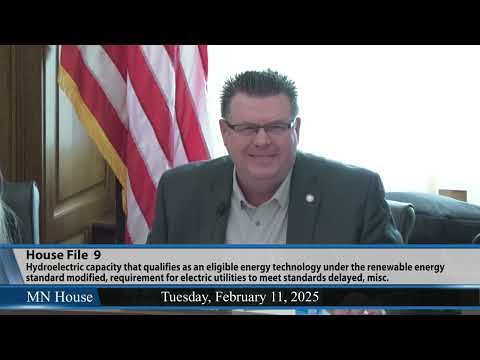
The Minnesota House Committee on Energy Finance and Policy spent a full hearing on House File 9, an energy omnibus bill that would lift the state’s moratorium on new nuclear plants, broaden which hydropower counts toward the state’s clean‑energy goal, study carbon capture and storage, create a rate‑based off‑ramp to the 100% clean electricity by 2040 law, and bar demolition of retired fossil‑fuel electric generating plants.
The Minnesota House Committee on Energy Finance and Policy spent a full hearing on House File 9, an energy omnibus bill authored by Rep. Joshua S. Swazinski that would lift the state’s moratorium on new nuclear plants, broaden which hydropower counts toward the state’s clean‑energy goal, study carbon capture and storage (CCS), create a rate‑based off‑ramp to the 100% clean electricity by 2040 law, and prohibit demolition of retired fossil‑fuel electric generating plants.
Why it matters: HF 9 would alter how Minnesota balances reliability, affordability and the 100% clean electricity standard passed in 2023. Supporters say the changes are needed to preserve base‑load options and keep business costs competitive; opponents say the bill would delay decarbonization, risk public health and environmental justice harms (especially for Prairie Island) and open the door to costly, unproven technologies.
Lawmakers and dozens of testifiers addressed five central questions: whether to lift the nuclear moratorium, whether larger hydropower should count toward the state target, whether CCS and associated CO2 pipelines should receive a state policy preference, whether utilities should get an automatic grace period if rates exceed a threshold, and whether local entities should be barred from demolishing fossil‑fuel plants.
Supporters’ case: Rep. Swazinski, the bill’s author, framed HF 9 as an “all‑of‑the‑above” effort to preserve reliability and lower costs for businesses and ratepayers. Michelle Benson, director of energy policy for the Minnesota Chamber of Commerce, told the committee the bill “directly addresses the energy concerns of Minnesota innovators and employers” and argued lifting the moratorium and studying CCS could reduce costs and improve reliability.
Some utilities and municipal representatives urged flexibility. Ken Sollum of the Minnesota Municipal Utilities Association said lifting the nuclear moratorium would allow “meaningful dialogue” about future investments and partnerships, and Jenny Glumack of the Minnesota Rural Electric Association said cooperatives support including all carbon‑free, dispatchable resources as demand grows.
Opponents’ case: Dozens of environmental, public‑health and community groups urged rejection. Blake Johnson, government relations representative for the Prairie Island Indian Community, said the tribe “cannot support the repeal of the nuclear moratorium” given the history of the Prairie Island plant and onsite spent fuel. Public‑health speakers warned CCS and CO2 pipelines carry safety and equity risks; Dr. Daniel Trajano of Health Professionals for a Healthy Climate said concentrated CO2 “is a poisonous asphyxiant” and cited past CO2 pipeline ruptures. Multiple witnesses — including Aurora Vatran of the 100% coalition, Sierra Club legislative director Peter Wagenius and Fresh Energy policy director Alan Gluckner — warned the bill’s automatic delay mechanism and other provisions would undercut the state’s 100% clean electricity law and its PUC implementation processes.
Technical and economic testimony: Two academics testified by video: Mark Jacobson of Stanford summarized a 100% renewable plan for Minnesota, saying electrification plus wind, solar and hydro would reduce statewide energy demand and yield large cost and public‑health benefits; M. V. Ramana (University of British Columbia) testified that small modular reactors have not yet proven cost advantages and that nuclear remains expensive globally.
State perspective: Pete Wyckoff, Deputy Commissioner for Energy at the Minnesota Department of Commerce, told the committee HF 9 “seeks to elevate three sources of clean, firm dispatchable technologies: nuclear, hydropower, and carbon capture and storage,” and said Commerce shares an interest in affordability and reliability. He warned, however, that applying a statewide 5%‑below‑national‑average rate test to each utility would create perverse incentives and that the 2023 law already contains off‑ramps being developed in a PUC docket.
Votes at a glance: Committee members offered three recorded floor amendments to HF 9 during the hearing; all three failed on roll calls.
• A2 (offered by Rep. Kraft) — would have added a storage requirement/condition before lifting the moratorium; failed (7 ayes, 8 no). • A5 (offered by Rep. Acomb) — would have removed Section 2 of HF 9 (the automatic rate‑based delay to the 100% law); failed (7 ayes, 8 no). • A7 (offered by Rep. Acomb) — would have deleted Section 4 (the prohibition on demolition of retired fossil‑fuel generating plants); failed (7 ayes, 8 no).
What didn’t change at the hearing: the committee did not record a final committee vote to refer HF 9 to another committee; Representative Swazinski did move that House File 9 be referred to the Committee on Taxes, but no disposition on that motion appears in the hearing transcript.
Context and next steps: Testimony reflected a deep divide between business and labor interests emphasizing reliability and competitiveness and environmental, health and tribal groups emphasizing risks, equity and the need to keep the 100% clean electricity timeline intact. Committee members asked witnesses to return for questions after testimony and debated the bill’s scope and timing. The hearing recessed following the amendment votes; further committee action was not recorded in the transcript.
Ending: Committee members and witnesses signaled strong interest in further technical briefings — on PUC off‑ramps, lifecycle cost modeling for nuclear and renewables, safety rules for CO2 pipelines, and consultation with the Prairie Island Indian Community — before any final committee decision on HF 9.