Get Full Government Meeting Transcripts, Videos, & Alerts Forever!
Get email alerts on the Higher Education Financial Aid Eligibility topic
No spam. Unsubscribe anytime.
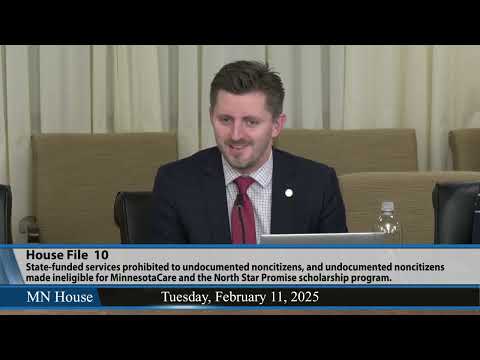
Minn. committee re-refers HF 10 after debate over North Star Promise eligibility
Summary
The Minnesota House Committee on Higher Education voted 7-6 on Friday to recommend that House File 10 be re-referred to the House Committee on Health Finance and Policy after roughly an hour of testimony and member questioning about whether undocumented students should remain eligible for state financial aid.
The Minnesota House Committee on Higher Education voted 7-6 on Friday to recommend that House File 10 be re-referred to the House Committee on Health Finance and Policy after roughly an hour of testimony and member questioning about whether undocumented students should remain eligible for state financial aid.
Representative Isaac Schultz, who introduced House File 10, said the bill is intended “to address our looming budget deficit,” noting “With over $5,000,000,000 projected as a deficit in just a couple years.” The bill would revise eligibility for resident-student criteria used by the Office of Higher Education and would remove certain pathways that allow people without lawful immigration status to receive state financial-aid awards, including awards made through what is commonly called the Minnesota Dream Act and the North Star Promise program.
The question of scale and scope was central to committee discussion. Commissioner Olson of the Office of Higher Education told the committee the agency’s most recent available data show 145 students had applied for North Star Promise funding through the Dream Act process; 11 students received North Star Promise base awards totaling $23,299 and 137 students received North Star Promise Plus awards totaling $63,100, for a combined total of $86,399. Olson also reported that for fiscal year 2023, 411 students were awarded the Minnesota State Grant through the Dream Act application process out of 67,854 total state grant recipients (about 0.6%), and in fiscal year 2024, 506 students were awarded through the Dream Act out of 71,530 total recipients (about 0.7%).
Nonpartisan staff member Mr. Hopkins explained the statutory path the committee was discussing, citing the statutory definitions in Minnesota law and saying, “that statute is... 135A.043,” and noting that subdivision language in 136A.101 cross-references the Dream Act criterion as the only route in the resident-student definition by which an undocumented immigrant could become eligible for state financial aid.
Supporters and opponents of the bill gave two-minute testimonies. Emma Jop, who identified herself as a 19-year-old college student from Malacca, Minnesota, testified in support of HF 10, saying taxpayer funds are limited and urging members to “keep the hardworking citizens of Minnesota in mind.” Several speakers opposed the change. Sagradio Torres Flores, a university employee and member of Comunidades Organizando el Poder y la Acción Latina (COPAL), said stripping the North Star Promise “only serves to hurt the future we are trying to build.” Eva Pena, who identified herself as a North Star program beneficiary, said the program enabled her to attend college. Danielle Huck, an English professor at Minnesota State University, Mankato, said the program “is a vital investment in our region and our state's future.” Samantha Diaz, political director of SEIU Local 26, told the committee unions representing janitors, hospitality and grocery workers oppose narrowing eligibility and framed the bill as a diversion from addressing rising higher-education costs.
Committee members pressed the author and agency staff on the bill’s path and on fiscal detail. Chair (identified in the transcript as “Madam Chair”) told members a fiscal note had been requested and is being prepared; she committed to returning the bill to this committee when the fiscal note is available. Representative Schultz told members he expects the bill to go next to Health Finance and Policy and then to State Government, with the possibility of returning to Higher Education as the process continues.
After brief member debate, the committee conducted a roll-call vote. The roll call recorded the following votes as read into the record: Schwartz (Aye); Allen (Aye); Coulter (No); Duran (Aye); Hansen (No); Hicks (No); Cleburne (No); Liebling (No); Noor (No); Novotny (Aye); Robbins (Aye); Scott (Aye). The transcript records a 7-6 result; one aye was recorded in the tally but the member name was not specified in the meeting excerpt. The committee’s recommendation is procedural: HF 10 will advance to the House Committee on Health Finance and Policy for further consideration.
The committee made no final determination on the bill’s full fiscal impact. Chair said the committee will revisit HF 10 when a formal fiscal note is ready and that additional jurisdictional stops remain possible. The bill’s language, as presented, would change the resident-student eligibility criteria in state law that the Office of Higher Education currently applies to programs such as the North Star Promise and certain state grants.
Votes at a glance: recommended re-referral of House File 10 to the Committee on Health Finance and Policy; roll-call result recorded in committee as 7 ayes, 6 nays.