Get Full Government Meeting Transcripts, Videos, & Alerts Forever!
Get email alerts on the Judicial Investiture topic
No spam. Unsubscribe anytime.
Alabama justices sworn in at Montgomery investiture; Chief Justice Sarah Hicks Stewart begins new term
Summary
Chief Justice Sarah Hicks Stewart and three judges — Tommy E. Bridal, James Christopher McCool and Richard D. Anderson — were invested and sworn at a ceremony at First Baptist Church in Montgomery. Speakers emphasized judicial independence, humility and the duty to "do justly, love mercy, and walk humbly."
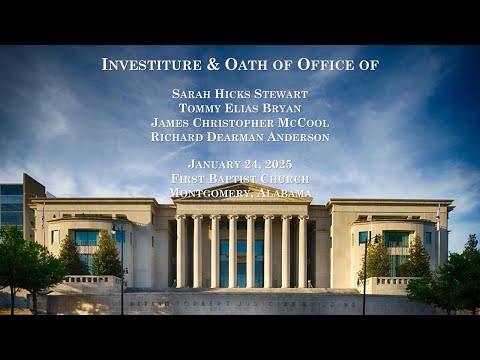
Chief Justice Sarah Hicks Stewart, Associate Justices Tommy Elias Bridal and James Christopher McCool, and Judge Richard Dearman Anderson were formally invested and took their oaths of office at an investiture ceremony held at First Baptist Church in Montgomery.
Lieutenant Governor Will Ainsworth presented the commissions, saying the officials were elected in November 2024 and were being commissioned to their respective offices. Representative Jim Hill administered the oath to Stewart; Presiding Judge Mary Windham of the Alabama Court of Criminal Appeals administered the oath to James Christopher McCool; Judge W. Mark Anderson III administered the oath to Richard Dearman Anderson. The transcript does not specify who administered the oath to Tommy Elias Bridal.
The ceremony included remarks from multiple speakers and from the newly sworn judges about the responsibilities of the bench. Chief Justice Sarah Hicks Stewart said the judiciary’s authority rests on public trust and pledged transparency and accountability. “All we have is the trust of the people,” Stewart said, adding her administration will work “to deliver justice fairly, equitably, and under the rule of law.” She noted her incoming term will cover the next six years and referenced the roughly 2,100 employees of the Unified Judicial System who serve across the state.
James Christopher McCool, who had served on the Alabama Court of Criminal Appeals, said he felt humbled by the appointment and invoked Micah 6:8, urging judges to “do justly, love mercy, and walk humbly with thy God.” Richard D. Anderson framed his responsibility through a longstanding judicial injunction he cited from Deuteronomy — to “judge righteously” and “show no favoritism” — and said the robe must remind judges that their authority does not come from themselves but from law and constitution.
Speakers at the ceremony traced the honorees’ legal careers and thanked family, campaign teams and mentors. Several speakers emphasized judicial restraint, saying judges must follow the law and facts rather than policy preferences or political pressure. Representative Jim Hill, who administered the oath to Stewart, and others recounted the justices’ prior public service: Stewart’s years on the trial bench and appeals court, Bridal’s and McCool’s prior judicial service, and Anderson’s tenure at the Court of Criminal Appeals (as referenced in remarks).
The program included an invocation and benediction from local clergy, an appearance by the clerks and marshals of the appellate courts, and a reception following the ceremony.
The investiture did not include legislative votes or policy decisions; it was a ceremonial administration of oaths and presentation of commissions. Lieutenant Governor Ainsworth read the commissions on behalf of Governor Kay Ivey and congratulated the newly commissioned justices and judge. The convening also acknowledged the administrative staff who organized the event and the hospitality provided by First Baptist Church.