Get Full Government Meeting Transcripts, Videos, & Alerts Forever!
Get email alerts on the Early Learning & K 12 Education topic
No spam. Unsubscribe anytime.
Bill would fund expansion of YES summer programs to connect students to natural‑resources careers
Summary
Senate Bill 5,567 would direct OSPI to select a nonprofit partner to expand an established ‘YES’ (Youth Engagement in Sustainability) summer program that provides high school students credit, wages and hands‑on experience in conservation and natural‑resources careers; students, educators, industry and DNR testified in support.
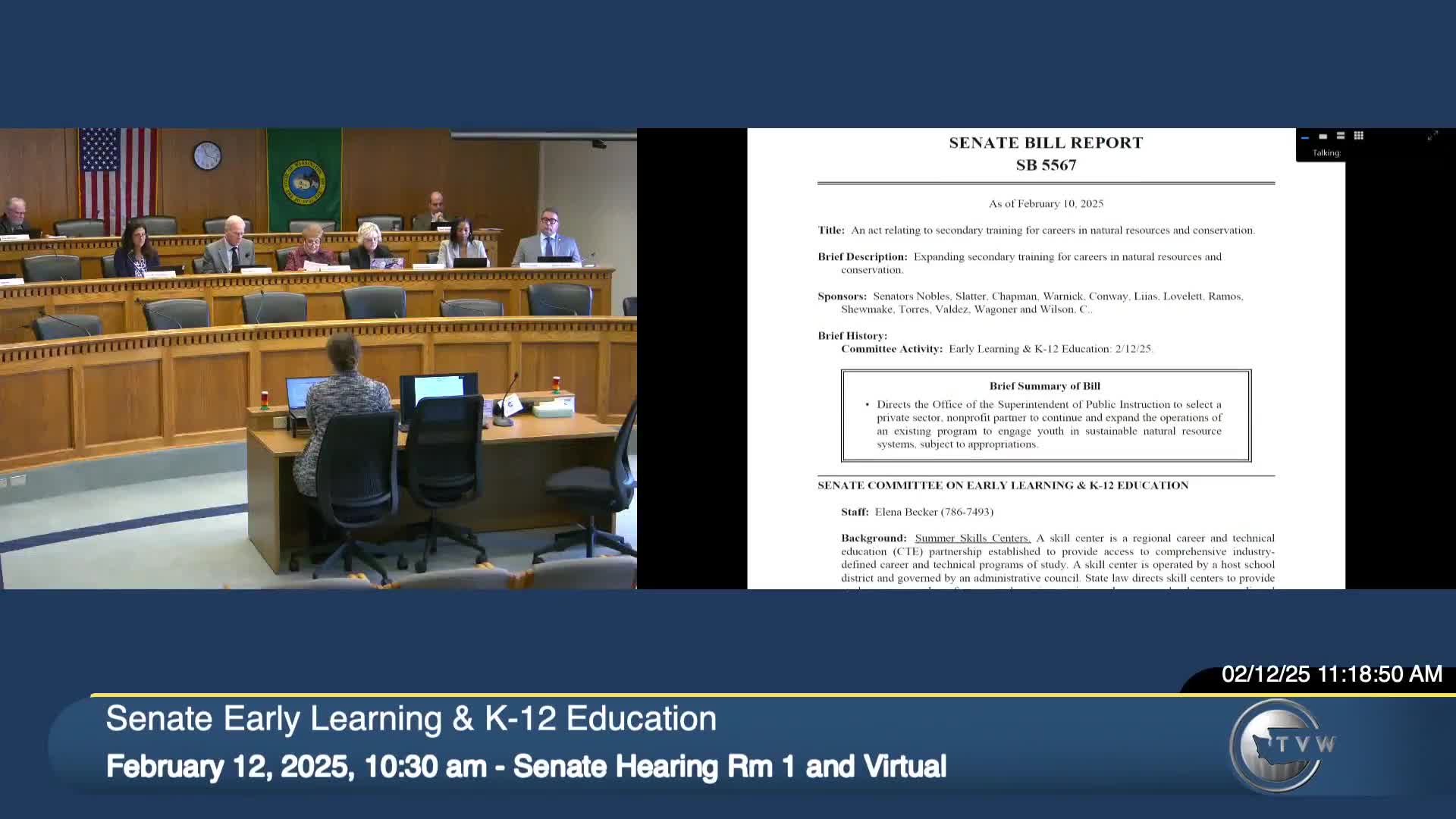
Senate Bill 5,567 would direct the Office of Superintendent of Public Instruction (OSPI) to select a private‑sector nonprofit partner to continue and expand an existing summer program that engages high school students in natural resources, conservation and related career pathways.
Sponsor Senator Tawanna Nobles told the committee the program addresses workforce needs and helps historically marginalized students gain experience, school credit and stipends. “We should make it easier, not harder for students to explore these careers, get hands‑on experience, and build a future in conservation and resource management,” Nobles said.
Committee staff described program requirements in the bill, including a 90‑hour summer skill center structure, dual‑credit and CTE framework alignment, and selection criteria for the nonprofit partner such as more than 20 years’ experience and a demonstrated ability to secure private contributions of funds, equipment or job offers for graduates. Staff said a fiscal note estimated $104,000 in the 2025–27 biennium to implement the program.
Multiple current and former YES participants and local educators testified in support. Student Ella Henry said the program offered more hands‑on learning in six weeks than her previous year of science classes and that it helped her consider natural‑resource careers. “I learned more in those 5 to 6 weeks than my previous science teacher taught me the whole year,” Henry said. Another student, Miguel Lavera, and student Renee Baez described earning science credit, learning technical skills, and discovering local career and volunteer opportunities such as river restoration and fisheries work.
Educators and program partners said YES improves academic engagement, social‑emotional outcomes and career awareness. Kristen Edlund, assistant director of teaching and learning for Riverview School District, said the program produces observable gains in engagement and mental health and helps districts prioritize the costly summer program. Robin Driver, a CTE teacher who runs the Yakima Valley YES program, said the program expanded from four students to cohorts of 15 with waiting lists and is seeking capacity for more sites.
Industry and agency supporters testified that the program supplies tangible employer connections. Jacqueline Early of Sierra Pacific Industries said the program aligns with industry needs and offers work‑based learning. Evan Pierce of the Department of Natural Resources said DNR has partnered on restoration projects and forestry data collection and urged the committee to fund expansion to prepare a workforce that reflects Washington’s demographics.
OSPI reporting back to the Legislature at regular intervals is required under the bill. Committee members asked about the private‑sector contribution requirement; staff said the contribution could be funds, equipment, facilities, faculty, scholarships or offers of employment.
The bill’s supporters asked the committee to approve funding so more students across the state can participate in proven outdoor, CTE‑aligned programming.