Get Full Government Meeting Transcripts, Videos, & Alerts Forever!
Get email alerts on the Energy Policy House File 9 topic
No spam. Unsubscribe anytime.
House Energy Committee sends HF 9 to taxes panel after rejecting carbon-capture and sales-tax changes
Summary
The Minnesota House Energy Committee voted to refer House File 9 to the Committee on Taxes after rejecting two roll-call amendments: one that would have removed a carbon capture and sequestration provision and one that would have removed a proposed sales-tax exemption.
The Minnesota House Energy Committee referred House File 9 to the Committee on Taxes after roll-call votes that defeated two amendments seeking to narrow or remove parts of the bill.
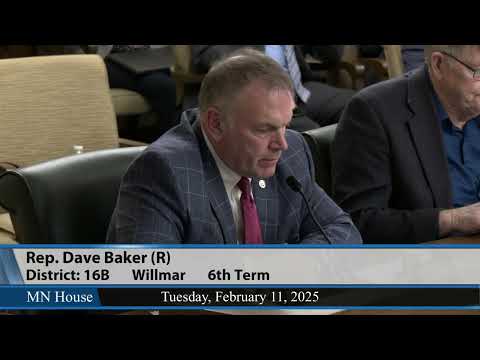
The committee rejected Amendment A8, offered by Representative Acum, which would have deleted Section 5 of the bill addressing carbon capture and carbon sequestration. Representative Acum framed the amendment as a technical, “friendly” change and argued the technologies named in the bill are already permitted under existing law. "I would encourage people to support the amendment the friendly amendment to be seen as friendly and vote to remove that section of the bill," Acum said. Representative Baker opposed the amendment, saying, "I will not support the amendment," and arguing Section 5 keeps more options on the table as the state works toward its zero-emission objective (referenced in the record as "02/1940"). The A8 amendment failed on a roll call, with 7 ayes and 8 noes.
The committee also rejected Amendment A9, moved by Representative Kraft, which would have removed a proposed sales-tax exemption tied to elements of the bill. Kraft told the panel the exemption would reduce state revenue substantially: "this would cost the state, you know, pretty close to a hundred million a year," and said he would prefer targeted spending through the Low Income Home Energy Assistance Program (LIHEAP). Chair Swadzinski urged members to vote no on A9, saying the exemption would give relief broadly to those paying energy costs. The A9 amendment likewise failed on a roll call, 7 ayes to 8 noes.
After debate on the bill and the failed amendments, the committee voted to refer House File 9 to the Committee on Taxes. Chair Swadzinski renewed the motion to refer the bill; the referral passed on a roll call, 8 ayes and 7 noes. The committee record notes Senator Matthews as the Senate author on related paperwork and that Representative Mecklen will present a separate data center bill at the committee's next scheduled meeting.
Votes at a glance: A8 — Motion to delete Section 5 (carbon capture/carbon sequestration). Mover: Representative Acum. Second: not specified in record. Outcome: Failed (7 ayes, 8 noes). A9 — Motion to remove proposed sales-tax exemption. Mover: Representative Kraft. Second: not specified in record. Outcome: Failed (7 ayes, 8 noes). Representative Kraft argued the exemption would cost the state roughly $100 million annually and suggested targeting LIHEAP instead. Referral — Motion that House File 9 be referred to the Committee on Taxes. Mover: Chair Swadzinski (renewed). Outcome: Passed (8 ayes, 7 noes).
Why it matters: House File 9 frames the committee's approach to reaching the bill's stated zero-emissions policy goal (recorded in committee discussion as "02/1940") by listing technologies and tax measures that could affect utilities, ratepayers and state tax revenue. Supporters of keeping Section 5 said enumerating technologies expands tools for utilities and businesses; opponents said singling out technologies can bias policy choices and that tax exemptions are blunt instruments compared with targeted assistance for low-income households.
What was said and next steps: Committee members who opposed removing the carbon-capture language argued the provision preserves options to meet the state's emissions objective; those who favored deletion argued for technology neutrality. On the sales-tax exemption, members who opposed the exemption pointed to its estimated price tag and urged a targeted LIHEAP-focused approach. With the committee referral, House File 9 will next be considered by the Committee on Taxes. Committee staff announced the next Energy Committee meeting is scheduled for Thursday, Feb. 13 at 1:00 p.m. to hear Representative Mecklen's data-center bill.