Get Full Government Meeting Transcripts, Videos, & Alerts Forever!
Get email alerts on the Affordable Housing Funding topic
No spam. Unsubscribe anytime.
Minnesota Housing outlines 2023 investments, program rollout delays and preservation priorities
Summary
Minnesota Housing Commissioner Jennifer Ho told the House Housing Finance and Policy Committee that 2023 legislative investments greatly expanded the agency's programs but many new programs are slower to launch, funding remains oversubscribed and preservation of existing affordable housing — including Huntington Place — is a priority.
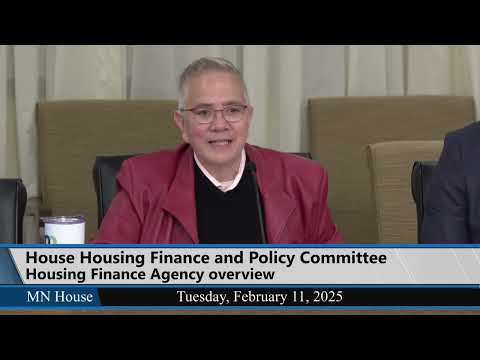
Chair Representative Spencer Igoe convened the House Housing Finance and Policy Committee and invited Jennifer Ho, commissioner of the Minnesota Housing Finance Agency, to give an agency overview and update on the investments the Legislature made in 2023 and 2024.
Commissioner Jennifer Ho summarized Minnesota Housing’s role, finances and recent activity, saying the agency “equably collaborat[es] with individuals, with communities, and with partners to create, preserve, and finance housing that’s affordable.” She told the committee the agency is a mission-driven finance institution that issues bonds and reinvests earnings from its mortgage lending to support operations and programs across a broad housing continuum from homelessness response to homeownership assistance.
Ho told members that in federal fiscal year 2024 Minnesota Housing had about $1.96 billion in total expenditures and helped more than 73,000 households. She said the agency’s largest dollar activity was mortgage financing through its bank (about $1.2 billion) and that the agency also administers roughly $256 million in federal rental assistance contracts. Ho repeated that many programs created by the 2023 session are “new” to the agency and therefore have taken longer to stand up than money put into established programs.
Why it matters: committee members said the state still faces a large shortfall in housing supply and that one-time infusions are unlikely to close that gap. Representative Mike Howard said the slide showing supply shortages “should guide a lot of our work in our housing committee this year,” and Representative Jim Nash warned that even the large 2023 investments would not be sufficient without sustained effort. Ho said some investments made in 2023 will still produce housing over the next year or two because construction and financing chains take time.
Key program details and figures Ho provided: Minnesota Housing’s consolidated Request for Proposal process selected about $348 million in projects in 2023 and about $191 million in 2024 (selection totals reflect only the consolidated RFP portfolio). The agency’s first-generation down payment assistance distributed $50 million in 2024 and assisted roughly 1,450 first-generation homebuyers; Ho said about 80% of those using the program identified as Black, Indigenous or people of color. Selections from 2023 included nearly $110 million for homeownership and roughly $150 million in state resources for multifamily/rental production and preservation. Ho said about 55% of consolidated-RFP funding went to the Twin Cities metro and 45% to Greater Minnesota in the most recent rounds she reviewed.
Oversubscription and implementation bottlenecks: Ho said many programs are oversubscribed and that new programs in particular require additional staff, procurement processes and program guides. She described the practical limits of standing up multiple new programs at once — hiring, procurement and ongoing oversight of pass-through grants add time — and said the agency has increased staff from roughly 250 to over 300 but still faces recruiting challenges because private-sector pay can be higher.
Preservation priorities, NOAH and Huntington Place: the commissioner described “naturally occurring affordable housing” (NOAH) — private-market, unsubsidized rental housing that rents below market — and explained the agency’s new “community stabilization” work to try to keep such properties affordable. Ho described Huntington Place as “one of the largest complexes of what they call naturally occurring affordable housing,” saying the 2023 legislative appropriations included a legislatively named grantee for Huntington Place and that the situation is complex: the agency’s investment was a part of a broader financing picture and “it was a small part of solving a big challenge.” Ho said the agency is exploring how to structure investments that preserve affordability over time when properties lack traditional regulatory subsidy agreements.
Housing infrastructure bonds and public housing: Ho highlighted housing infrastructure bonds and other bonding tools as “unique Minnesota” mechanisms that enabled preservation deals (she cited Trellis’s acquisition of properties in St. Louis Park that received $8.6 million in housing infrastructure bonds). She also noted a governor’s recommendation (presented to the committee) for $77 million for public housing preservation and said the sector has a long backlog of needed repairs.
Bring It Home rental assistance and program design issues: Ho outlined the Bring It Home rental assistance program created by the Legislature to increase access to rental assistance for up to 5,000 households, targeted to renters at or below 50% of area median income with priority to households at 30% AMI and to families with children. She described technical challenges linking a state-funded voucher look-alike to the existing HUD-connected IT systems used by local housing authorities.
Committee questions: representatives pressed Ho on a range of topics. Representative Wayne Johnson asked about whether pandemic rental assistance checks had been paid to landlords; Ho said the state’s emergency rental assistance program sent payments to landlords (she noted, however, that local jurisdictions also ran parallel programs). Representative Jim Nash and others urged bipartisan action on zoning and land-use policy as one lever to increase supply, a topic Ho said the agency watches but does not regulate. Representative Hulda Hiltz Lee and others raised preservation and repair backlogs for large complexes; Ho replied that agency investments alone cannot solve every deferred maintenance need and described the agency’s prioritization and stewardship role.
Ho closed by urging the committee to prioritize program design that matches legislative intent, to consider the health of the overall housing ecosystem and to recognize that many of the 2023 investments are still in various stages of being matched to projects, financed and built. She said the agency has committed or matched a large share of 2023 funding but that the state still faces a significant shortfall of affordable units and continued high demand for assistance.
Ending: committee leadership thanked Ho for the briefing and said the committee will continue to consider both funding and policy options this session. The presentation, members said, framed multiple possible follow-up bills and budget choices committee members may pursue.