Get Full Government Meeting Transcripts, Videos, & Alerts Forever!
Get email alerts on the Hydraulic Project Approval Hpa topic
No spam. Unsubscribe anytime.
Bill would add factors for DFW to consider when requiring woody‑debris mitigation after storms
Summary
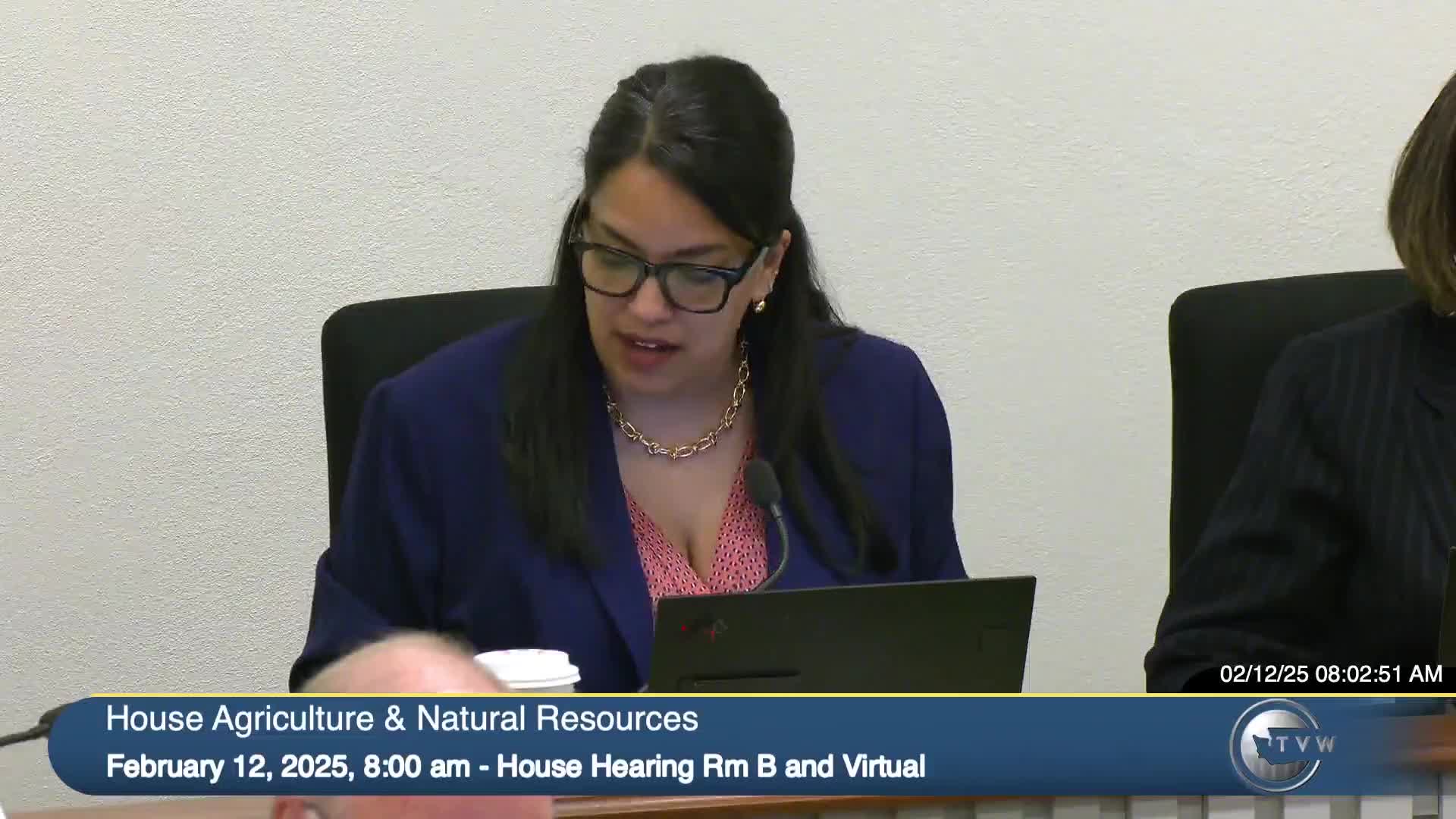
House Bill 19-22 would add factors for the Department of Fish and Wildlife to consider when conditioning hydraulic project approvals (HPAs) requiring placement or replacement of woody debris after extreme weather events or natural disasters. Sponsor Representative Victoria Hunt said the bill responds to storm damage in her district.
House Bill 19-22, introduced to the House Agriculture and Natural Resources Committee on Feb. 12, would require the Department of Fish and Wildlife (DFW) to consider a set of additional factors when conditioning hydraulic project approvals that require placement or mitigation of woody debris following extreme weather events or natural disasters.
Lily Smith, committee staff, explained that DFW currently regulates activities affecting the natural flow or bed of waters through the Hydraulic Project Approval (HPA) permit process and can condition permits with mitigation such as placement of woody debris to protect fish life. The bill would add factors for consideration when mitigation follows emergency work, including:
- the emergency nature of the work; - limitations on appropriate placement sites; - any increased flooding risk or the potential to create problematic log jams; - whether substantial mitigation (greater than 1:1) is warranted; and - limiting replacement to debris accumulated during the event rather than subsequent accumulations.
Sponsor context: Representative Victoria Hunt (5th LD) said the bill was prompted by the November 18 bomb cyclone that damaged large trees across areas from Issaquah to Enumclaw in her district. She stressed local complexity: many stream banks are on private property and Issaquah contains floodplain areas where debris can create flooding risks for homes. Representative Hunt provided an example cost estimate from Issaquah for habitat restoration following the event — $350,000 for design and $750,000 for construction — and described the bill’s intent as enabling DFW to consider proportional mitigation to achieve no net loss of habitat function while recognizing emergency circumstances.
Process notes: Committee staff noted a preliminary fiscal note is in the bill packet. The hearing was temporarily suspended and then resumed; public testimony scheduled from Issaquah’s mayor did not occur in the Zoom room and would be accepted in writing.
Ending: Committee members asked for clarifications about how the bill interacts with emergency declarations; staff said an emergency declaration can speed DFW permitting but the bill’s factors are broader than declarations and remain subject to DFW discretion under the current statutory framework.