Get Full Government Meeting Transcripts, Videos, & Alerts Forever!
Get email alerts on the Child Nutrition Program Oversight topic
No spam. Unsubscribe anytime.
Auditors tell Minnesota House panel MDE oversight of Feeding Our Future was inadequate; agency outlines reforms
Summary
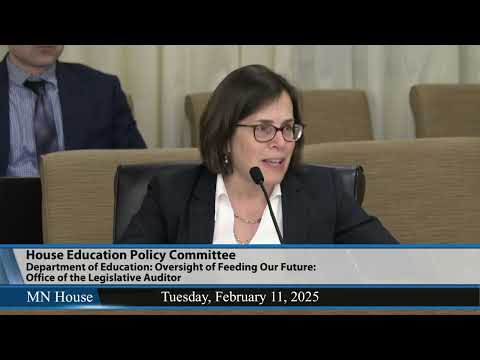
The Office of the Legislative Auditor told the Minnesota House Education Policy Committee on Feb. 11 that the Minnesota Department of Education provided inadequate oversight of Feeding Our Future, a nonprofit later tied by federal prosecutors to an alleged $250 million fraud scheme.
The Office of the Legislative Auditor told the Minnesota House Education Policy Committee on Feb. 11 that the Minnesota Department of Education provided inadequate oversight of the nonprofit Feeding Our Future, a sponsor in two federal child nutrition programs later linked by federal prosecutors to an alleged $250 million fraud scheme.
The audit, released in June 2024 and presented to the committee by Legislative Auditor Judy Randall and OLA Special Reviews Director Catherine Tyson, found repeated missed opportunities by MDE between 2018 and 2022 to detect and act on warning signs, failed complaint investigations, and approvals of annual sponsor applications despite serious concerns about Feeding Our Future’s financial controls and program management.
The OLA report focused on MDE’s responsibilities under the Child and Adult Care Food Program (CACFP) and the Summer Food Service Program (SFSP), federal programs administered by the United States Department of Agriculture. Tyson told the committee the department repeatedly approved Feeding Our Future’s applications and meal claims even after finding problems such as inflated attendance records, menus that did not match served meals, and the loss of the organization’s nonprofit status with the Internal Revenue Service.
"When bad actors collude with the intent to commit fraud, the fraud can be very difficult to discover and it can be very difficult to stop," Tyson said. She summarized three central findings: MDE did not act on pre-pandemic warning signs; it did not effectively use its authority to hold the sponsor accountable; and it was ill-prepared to respond when problems emerged.
The report cited concrete figures: at its peak MDE paid Feeding Our Future nearly $32 million for about 12 million meals and snacks claimed in April 2021, an increase the OLA described as an outlier compared with other sponsors. Federal criminal charges filed between September 2022 and February 2024 named roughly 70 defendants; the federal government described Feeding Our Future as central to the alleged scheme.
MDE Commissioner Willie Jett told the committee the department has since moved to strengthen oversight. He described creation and staffing of an Office of Inspector General at MDE, revisions to complaint and fraud-reporting procedures, investments in technology for child nutrition program tracking, additional legal staffing in MDE’s Office of General Counsel, and follow-up reviews for sponsors flagged as high risk. "As a continuous improvement agency, the Department of Education has taken numerous steps to strengthen our oversight capabilities," Jett said.
The commissioner and MDE general counsel declined to answer several specific litigation-related questions in detail at the hearing on the grounds that federal criminal trials and related court matters remain active. Counsel said some matters may be subject to attorney–client privilege or could affect ongoing proceedings and offered to provide written responses where appropriate.
Committee members pressed MDE on why serious deficiencies were deferred and why earlier steps such as termination of sponsorship were not completed. OLA witnesses said MDE had authority to act in many instances but did not always use it; the OLA recommended statutory rulemaking authority or clearer statutory criteria for sponsor approval to reduce interpretive gaps that it said hindered enforcement.
Tyson told the committee that MDE deferred serious deficiencies in 2021 without collecting sufficient evidence that the issues had been fully and permanently addressed and that MDE approved meal claims even when documentation contained irregularities, including attendance lists and menus inconsistent with claimed meals.
Commissioner Jett described additional legislative and administrative proposals MDE plans to pursue, including statute changes to clarify OIG powers and protections for reporters, tools to maintain confidentiality of active investigations, and sponsorship criteria (for example board governance and limits on year-to-year site growth) that the department said would make it harder for high-risk sponsors to enroll and expand rapidly.
The OLA said it has made recommendations to the Legislature and to MDE; OLA officials told the committee they have received some documentation from MDE showing progress on eight recommendations but that additional file review would be needed to verify implementation in some areas. OLA staff also said their special review is complete but that they will follow up periodically on implementation status.
Several committee members asked for written follow-up from MDE on specific questions (including the stipulation agreement and communications with the Attorney General’s office) because MDE said it could not answer certain questions publicly while criminal proceedings are ongoing. MDE agreed to provide written materials where not restricted by privilege or active litigation.
The hearing included questions from multiple representatives about interagency coordination, grant-management tools, and the number of sites and staffing used to monitor programs; MDE agreed to provide additional written information on site counts and OIG staffing. The department reported that its OIG has received approximately 140 complaints, with about 80 closed and 60 open at the time of the hearing.
The OLA recommended that the Legislature establish clearer statutory criteria or give MDE rulemaking authority for sponsor approvals, and recommended that MDE strengthen verification of information in sponsor applications and responses to corrective-action plans, prioritize independent fact finding in complaint investigations, and use risk-based monitoring when waivers reduce oversight. The OLA also recommended MDE evaluate statutory changes related to investigatory authority and pursue additional steps to verify sponsor-provided documentation.
The hearing ended with committee leaders and agency officials committing to continue the conversation and to pursue both administrative fixes and, where needed, statutory changes to reduce the risk of fraud in federal child nutrition programs and to protect program recipients.
Closing note: the federal criminal case and related proceedings remain active. Several committee participants and MDE counsel said they would avoid public comments that could affect ongoing prosecutions and would supply written answers where permitted.