Get Full Government Meeting Transcripts, Videos, & Alerts Forever!
Get email alerts on the Public Safety Criminal Justice topic
No spam. Unsubscribe anytime.
House Public Safety Committee backs House File 7 package, advances bill to Judiciary
Summary
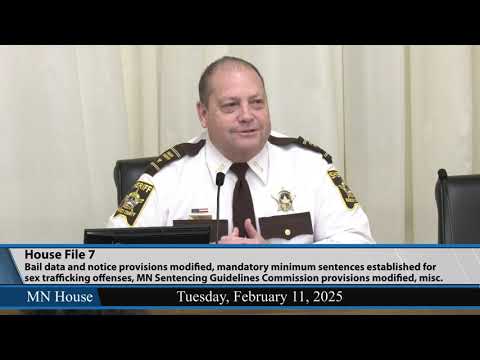
Chair Novotny opened the Feb. 11 committee hearing by introducing House File 7, a 12-part public safety package that the author said would expand penalties for certain offenses, allow trackers on stolen or fleeing vehicles in additional circumstances, and create new public reporting requirements.
Chair Novotny opened the Feb. 11, 2025 meeting of the House Public Safety Committee by introducing House File 7, a multi-part public safety package the chair described as aimed at "helping law enforcement make our communities safer" and keeping "violent and dangerous offenders off the street."
The bill, described by the author as a 12-section priorities package from the House Republican caucus, includes provisions that would (per the bill text and witnesses’ testimony): expand criminal penalties for fleeing police and for blocking critical roadways; create a standalone offense for being in a stolen motor vehicle; increase penalties for assaulting peace officers; authorize placement of mobile tracking devices on stolen or actively fleeing vehicles when unoccupied; require public, searchable reporting on stayed sentences and county attorney dismissals; and change how sentencing-guidelines changes take effect.
Undersheriff Mike Martin of the Ramsey County Sheriff’s Office told the committee the tracking-device change would reduce risky pursuits by allowing law enforcement to ‘‘hang back’’ and plan an arrest operation. "Our number one priority is always public safety. We wanna keep the community safe, and we wanna do that by hopefully avoiding pursuits," Martin said, describing incidents where juveniles abandoned stolen vehicles and returned later, after which the vehicle could no longer be located. Ramsey County figures cited in testimony said carjackings and auto thefts had fallen sharply after prior tracking-law changes; Martin said he had seen about a 74 percent decrease in Ramsey County (as reported to the committee).
Representatives of statewide law enforcement groups — Shane Myrie, president of the Minnesota Police and Peace Officers Association (MPPOA); Sheriff Brian Welk, speaking for the Minnesota Sheriffs Association; and Jeff Potts, executive director of the Minnesota Chiefs of Police Association — urged support for multiple HF7 provisions. They argued the measures would give officers tools to reduce dangerous pursuits, hold more people accountable for being in stolen vehicles, and address a rise in assaults against public-safety officers. "If law enforcement is able to apply that mobile tracking device on a stolen vehicle while it's unoccupied, . . . it creates time and space between law enforcement and the stolen fleeing vehicle," Myrie said.
Witnesses and policy experts disagreed with some policy approaches and raised civil‑liberty and policy‑effectiveness questions. Will Cooley, policy director at the Minnesota Justice Research Center, said the state should prioritize investigative capacity and prevention over additional mandatory minimums and longer sentences: "The best way law enforcement can prevent violent crime is to enhance the certainty of being caught," Cooley told the committee, citing data on unsolved shootings and investigator staffing shortages. Testimony from Addie Best and Amy Brailler referenced past pipeline protests and expressed opposing views about whether tougher penalties for infrastructure‑related offenses were needed or would chill protected protest activity.
Nate Reitz, executive director of the Minnesota Sentencing Guidelines Commission, testified about section 4, which would change the current "legislative override" process so that commission policy initiatives would not take effect without affirmative legislative approval. Reitz described the historical role the current override structure played in producing major sentencing reform in 2016 and said the commission had not taken an institutional position on the proposed change.
Several committee members asked detailed questions about statutory overlap, civil‑liberty safeguards, and fiscal impacts. Representative Pinto and others asked how new provisions would differ from existing statutes (for example, the transcript cites Minn. Stat. § 609.546 regarding entering a motor vehicle). Representative Feist asked how the tracking-device expansion would intersect with privacy protections for vehicles on private property and whether warrants would be needed in some circumstances; Chair Novotny replied the bill targets fast‑moving policing situations where obtaining a warrant is not practicable. Representative Berg and other members expressed concerns that public disclosure requirements for dismissals or stayed sentences could endanger victims or reveal sensitive information.
The committee considered two floor amendments offered during the hearing: the A2 amendment, presented by Chair Novotny, would require that offenders who receive a stay of adjudication for certain criminal conduct and who are on supervision must register as predatory offenders; if the offender has no supervision agent the Bureau of Criminal Apprehension (BCA) would notify the offender and local law enforcement, and the offender would be required to register within 30 days of notice. The committee adopted the A2 amendment by voice vote. A separate A3 amendment was offered and then withdrawn by its sponsor.
After public and expert testimony and floor discussion, Chair Novotny renewed the motion recommending House File 7 "as amended" to pass and be re-referred to the Judiciary Committee. The motion carried by voice vote; the transcript records that "house file 7 as amended is passed to judiciary committee." The committee did not record a roll‑call tally in the hearing transcript.
The committee set its next meeting for Feb. 12, 2025, at 3 p.m.
Ending: House File 7 is now scheduled for the Judiciary Committee; its provisions include several cross‑cutting changes to criminal penalties, tracking authority for stolen or fleeing vehicles, transparency requirements for sentencing data, and changes to the process by which sentencing‑guidelines changes take effect. Committee members asked for fiscal notes and further briefing on several sections; opponents urged caution about privacy, victim safety, and the effectiveness of longer sentences versus stronger investigative capacity.