Get Full Government Meeting Transcripts, Videos, & Alerts Forever!
Get email alerts on the Education Committee Actions topic
No spam. Unsubscribe anytime.
House Education Committee advances multiple bills; parental-choice data proposal laid over
Summary
The House Education Committee advanced a slate of education bills to the next stage and cleared several without major change. Lawmakers laid over a proposal to expand reporting on the Oklahoma Parental Choice Tax Credit after extended debate over privacy, aggregation of homeschool data and potential effects on private school pricing.
The Oklahoma House Education Committee advanced a package of education measures Wednesday and sent them to the next level, but delayed consideration of a high-profile proposal to expand data reporting on the Oklahoma Parental Choice Tax Credit.
The committee approved a series of bills — including measures on teacher-reporting procedures, accreditation hearings, charter-school administrative paperwork, recess requirements and others — by recorded votes ranging from unanimous to narrow majorities. After prolonged questioning about taxpayer privacy, data aggregation and the effect on private-school tuition, members laid over the parental-choice data bill so sponsors and opponents can continue negotiations.
Why it matters: The committee’s votes advance bills that affect classroom operations, teacher certification and school accountability. The parental-choice data proposal drew sustained attention because it would require additional reporting about where tax-credit dollars flow; supporters said aggregated data would help plan future education investments, while opponents warned of privacy risks and unintended impacts on school pricing.
Key developments
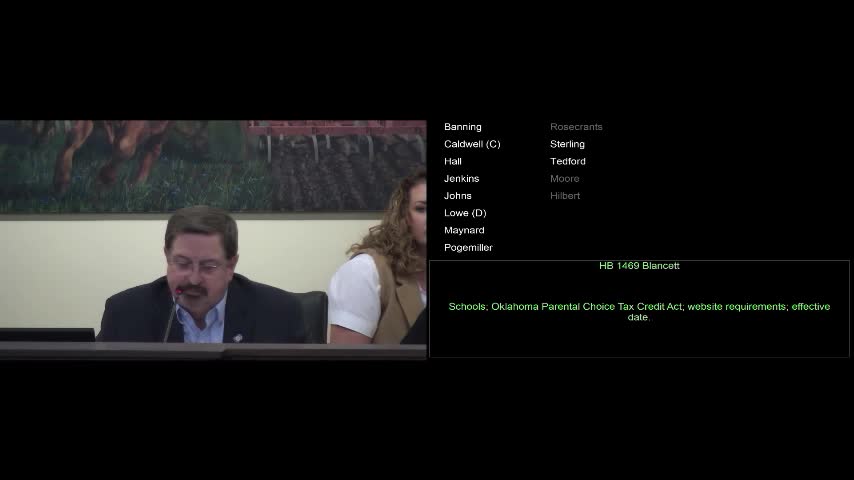
- Parental-choice data proposal laid over: Representative Blansey (Representative), who introduced House Bill 14‑69, said the bill would require the state to collect additional, mostly aggregated data on how Parental Choice Tax Credit funds are used so lawmakers could evaluate and target future investments. During more than an hour of questioning, members raised two recurring concerns: whether the tax commission or the Department of Education holds the appropriate records and whether any reporting would invade individual taxpayers’ privacy. Representative Maynard and Representative Meijer pressed on the limits of tax‑return confidentiality; Representative Tidford and others sought clarity on how homeschool data would be handled. After those exchanges the sponsor agreed to continue conversations and the bill was laid over for further work. The sponsor said the bill would not seek individual taxpayer data and described the requested homeschool numbers as aggregated only; the committee did not adopt the bill at this hearing.
- Teacher misconduct reporting tightened (House Bill 10‑75): Representative Hildebrandt explained the bill would require that investigations of teachers accused of inappropriate conduct be completed and a recommendation made to the State Department of Education before a teacher may resign and seek employment elsewhere. The bill also adds language permitting automatic expungement when investigations find no substantiated misconduct. Hildebrandt said the measure does not remove criminal due process protections (title 21) and is aimed at ensuring school-level investigations are completed and reported under title 70. The committee approved the bill, 9‑2.
- Private‑school practices: House Bill 13‑96, introduced as a response to concerns that some private schools had required parents to apply for the Parental Choice Tax Credit or had raised tuition tied to the credit, was amended on the floor. Committee members agreed to delete the provision that would have tied allowable tuition increases to inflation; the committee retained a separate prohibition on requiring parents to apply for the tax credit as a condition of enrollment. After the sponsor accepted a friendly amendment removing the price‑control language, the amended measure passed, 8‑4.
Other bills advanced
The committee recorded votes and advanced a number of other education bills to the next stage (see “Votes at a glance” below). Several passed unanimously or with strong margins, including bills that: - Clarify due‑process hearings before the State Board of Education issues an accreditation deficiency (House Bill 14‑66; passed 11‑0); - Direct the State Department of Education to provide a portal for school administrators to mark students who leave (House Bill 14‑08; passed 11‑0); - Add new requirements on parent consent for students with disabilities (House Bill 13‑93; passed 12‑0); - Require State Department of Education disclosure of federal guidance documents (House Bill 21‑51; passed 12‑0); - Allow charter schools to apply sibling preference for enrollment (House Bill 2,153; passed 12‑0); - Exempt charter schools from filing an “estimate of needs” form not applicable to their funding (House Bill 21‑54; passed 11‑0); - Make a cleanup to alternative graduation requirements and related career‑tech pathways (House Bill 15‑21, as amended; passed 12‑0).
What supporters and critics said
Supporters of the parental‑choice reporting measure said more granular, aggregate information would help lawmakers and education leaders understand where families are using the tax credit and where additional investment could yield returns. As one sponsor put it during debate, the state has limited high‑level data and “the more data we can have, the more responsible we can be in making those investment choices.”
Opponents repeatedly raised concerns about tax‑return confidentiality and about whether reporting on where parents spend the credit would amount to intrusive data collection. Representative Meijer and others said the Tax Commission already publishes high‑level annual reports on credits and cautioned that collecting more detailed information could cross into personal taxpayer data. Representative Tidford expressed particular concern about how homeschool information would be counted. The sponsor said homeschool figures in the bill were intentionally aggregated and that no individual taxpayer records would be published.
What happens next
The bills the committee approved will move to the next committee level or to the House calendar, depending on statutory procedure. Sponsors of the parental‑choice data bill agreed to continue negotiations and to return with revised language; the committee did not vote on that bill at this meeting.
Ending note
Committee members said they expect additional education measures to return for further consideration next week and asked members and staff to continue work on the parental‑choice language before the bill’s next appearance.