Get Full Government Meeting Transcripts, Videos, & Alerts Forever!
Get email alerts on the Veterans Benefits topic
No spam. Unsubscribe anytime.
Committee holds public hearing on bill to expand state benefits for veterans, uniformed services and military spouses
Summary
A House bill would broaden eligibility for state pension credit, licensing protections and employment preferences to include additional uniformed services and Space Force guardians; committee heard staff briefing, sponsor remarks and Department of Defense support but took no vote.
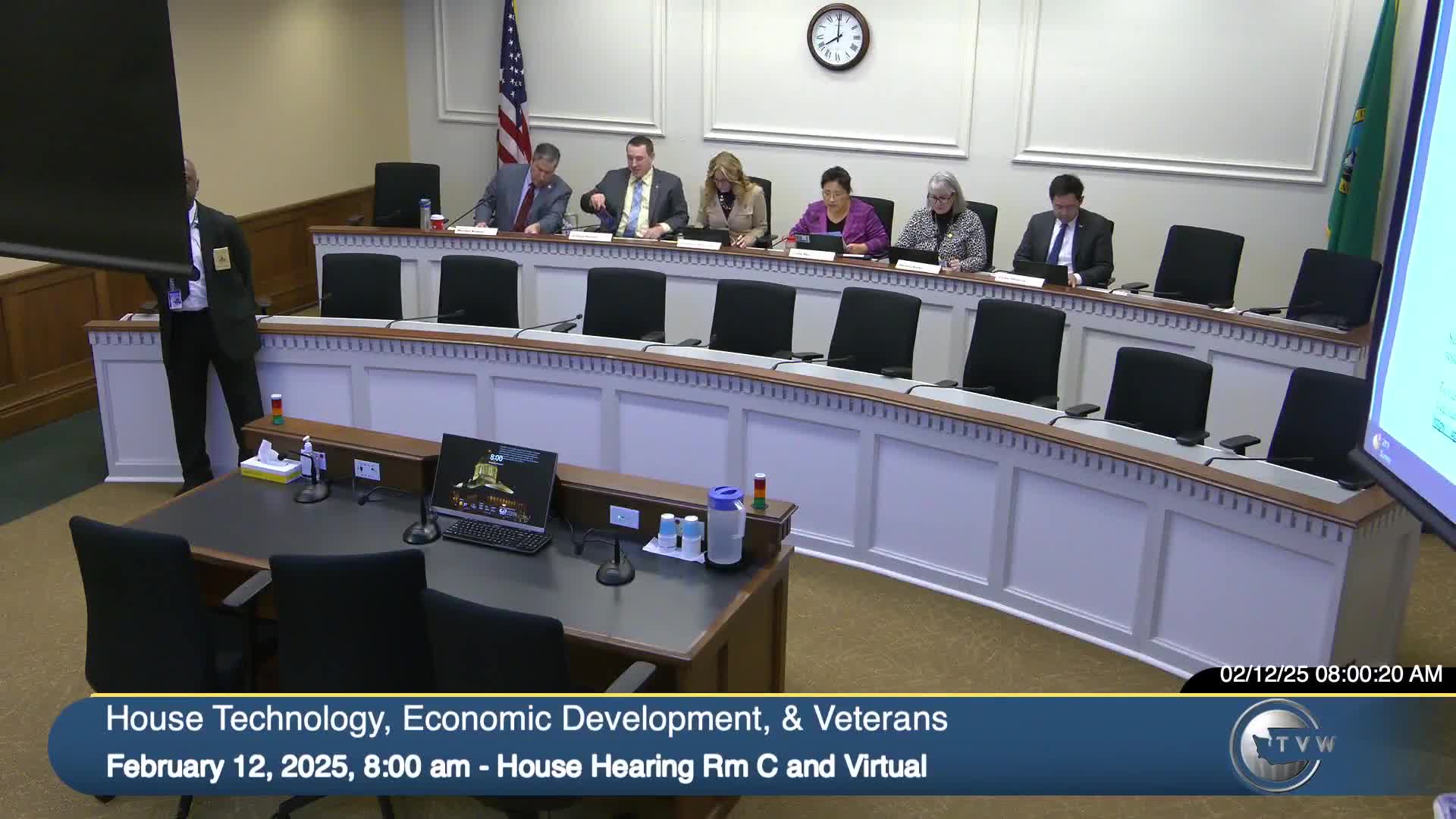
The Technology, Economic Development, and Veterans Committee held a public hearing Feb. 12 on House Bill 1738, which would expand eligibility for certain state pension and retirement benefits, licensing protections and employment preferences to include members of additional uniformed services and military spouses.
Committee staff told members the bill would add the Public Health Service Commissioned Corps and the National Oceanic and Atmospheric Administration Commissioned Officer Corps (NOAA Corps) to definitions used in several state benefits, and would explicitly include Space Force members (referred to in the bill as “Guardians”) in other provisions.
Martha Whaling, staff to the committee, summarized the bill’s main changes and said the measure is a companion to Senate Bill 5420. She said the bill would expand the type of military service that can be counted for pension and retirement benefits for firefighters, police and PERS 1 (the Public Employees’ Retirement System for certain public employees), broaden eligibility for a Department of Licensing moratorium and change veterans scoring criteria used in public service hiring. Whaling also noted the bill removes a requirement that a veteran have received a campaign ribbon in some benefit calculations and adds uniformed services and Guardians to multiple statutory definitions used elsewhere in state law.
Representative Bose, the bill’s prime sponsor, told the committee the legislation “is about removing barriers and opening doors,” and said it seeks to recognize a broader set of military and uniformed service experiences when Washington determines eligibility for state benefits. Bose urged the committee to advance the bill and indicated willingness to work on amendments as the measure moves through the process.
Tammy Perot, testifying for the Department of Defense, voiced departmental support and said staff work on the bill had been coordinated with WDBA and the National Guard in Washington. Perot noted the bill would provide equity for the Space Force and said it would help military spouses, citing that “Washington state military spouses face over 20% unemployment rate.” She asked the committee to move the legislation forward.
Members asked clarifying questions. Representative Penner asked whether the definition of “veteran” adopted in last year’s legislation would apply; Whaling replied that the amended definition of veteran would apply where the bill uses that term, while other provisions change the definition of military service more broadly. Penner also asked whether a state veteran with an “other than honorable” or bad-conduct discharge who is receiving VA care would be eligible; Whaling answered “Yes.”
Representative Keaton asked about an apparent change in service-credit scoring (questions referenced a move from 5 points to 10 points). Whaling said the staff did not have precise impact numbers available at the hearing but that the partial fiscal note filed so far showed most agencies identified no fiscal impact from the change.
The committee did not take a vote during the Feb. 12 hearing. Committee members were told two other bills on the executive session agenda would be delayed until Friday for additional amendments and fiscal-note work. No formal action on House Bill 1738 was recorded at the hearing.