Get Full Government Meeting Transcripts, Videos, & Alerts Forever!
Get email alerts on the Fiscal Notes topic
No spam. Unsubscribe anytime.
Legislative Budget Office outlines fiscal-note process, who may request notes
Summary
The Legislative Budget Office told the House Workforce, Labor and Economic Development Finance and Policy Committee it coordinates fiscal notes for the state, explained who can request regular and unofficial fiscal notes, and described timelines and agency workload limits.
The Legislative Budget Office explained to the House Workforce, Labor and Economic Development Finance and Policy Committee how fiscal notes are produced, who can request them and why timing and precise bill language matter for producing timely estimates.
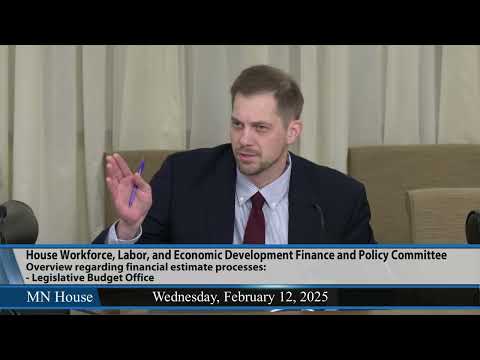
For the record, Christian Larsen, director of the Legislative Budget Office, told the committee the office is “a nonpartisan legislative office serving both the House and Senate” and that its work centers on three statutory responsibilities: coordinating the fiscal-note process, running local impact notes, and supporting the Tax Expenditure Review Commission.
Larsen said a fiscal note provides an “objective estimate of the fiscal impact imposed [by] legislation to the state budget.” He described the front page of a fiscal note as a five-year table of dollar impacts and full-time-equivalent (FTE) changes, followed by a narrative containing the bill description, assumptions, sources, formulas and a discussion of long-term effects and local impacts.
Larsen reviewed who can request different types of fiscal notes. He said regular fiscal notes — on introduced legislation or amendments — may be requested by the chair of the standing committee in which the bill resides, the chair of the House Ways and Means Committee and the chair of the Senate Finance Committee. Unofficial fiscal notes on draft language may be requested by any member; a subset can be treated as classified and shared only with the requesting member, the LBO and responding agencies until the bill becomes public.
Larsen described the practical workflow: a member’s request enters the LBO system, staff assign affected agencies, agencies develop assumptions and estimates, the LBO reviews them against the uniform standards and procedures, and approved notes are distributed to authors, relevant chairs and — generally within 24 hours — posted publicly on the LBO website.
He told members the average turnaround for a fiscal note is about two weeks (13–14 calendar days) but that local impact notes take much longer — two to six months — because they include surveys of local governments and more detailed analysis. On operating-budget years the LBO said agencies complete roughly 800 fiscal notes with roughly 1,500 agency assignments; in non-operating years the counts are substantially lower.
Larsen and committee members discussed capacity limits during the busiest 10-week window of session. “Volume does impact agency responsiveness,” Larsen said; the office relies on committee staff to flag meeting schedules so analysts can prioritize work. He urged precise bill language and early communication between authors and the LBO to speed and clarify analyses.
Representative Pinto and others pressed for statutory clarity about who may request fiscal work and the legal differences between Minnesota Statute 3.98 (the enacting statute for fiscal notes) and Minnesota Statute 13.64 (data-practices rules that can govern unofficial classified requests). Larsen acknowledged that 3.98 more clearly sets agency response responsibilities, while 13.64 defines confidentiality for certain draft requests.
The briefing concluded with committee members and staff discussing how the volume of requests, prioritization and the need for precise language affect timelines.
Ending: Committee members said the overview would guide how they request and prioritize fiscal work during the session and underscored the LBO’s role in reviewing agency assumptions and publishing official fiscal estimates.