Get Full Government Meeting Transcripts, Videos, & Alerts Forever!
Get email alerts on the Commerce Budget And Policy topic
No spam. Unsubscribe anytime.
Commerce commissioner outlines governor’s budget and policy priorities, urges action to sustain reinsurance program
Summary
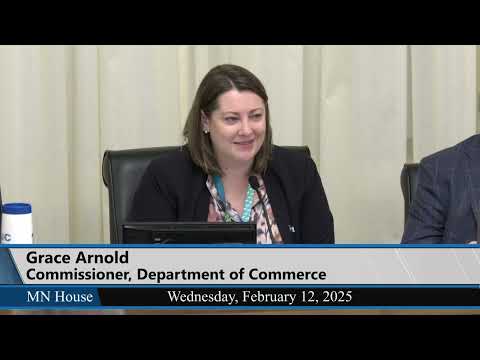
Grace Arnold, commissioner of the Minnesota Department of Commerce, told the House Commerce Committee on March 11 that the department needs modest operating increases and policy changes to maintain consumer protections across insurance, banking, securities and other regulated markets.
St. Paul — Grace Arnold, commissioner of the Minnesota Department of Commerce, told the House Commerce Committee on March 11 that the department needs modest operating increases and policy changes to maintain consumer protections across insurance, banking, securities and other regulated markets.
"We protect the public interest," Arnold said in opening remarks, describing the agency’s work across financial institutions, insurance, enforcement, licensing, unclaimed property and the Petro Fund. She briefed lawmakers on the governor’s budget proposals and several policy bills under the committee’s jurisdiction.
The presentation, which drew sustained questioning from committee members, focused on how the department would fund the premium security plan (the state reinsurance program), staffing for securities oversight, technology and database upgrades for the Petro Fund, a proposed licensing regime for earned-wage-access services, and authority for weights-and-measures inspections of electric-vehicle charging ports.
Why it matters: The premium security plan supports about 187,000 Minnesotans who buy individual-market coverage. Arnold warned the reinsurance account faces depletion without a funding change and said that could raise premiums on the individual market sharply and reduce access to primary care for some enrollees. Committee members pressed for actuarial detail on any premium impacts and for a return briefing that breaks down reinsurance payments by condition and cost drivers.
Key proposals and details
• Operating request: Arnold described a modest agency operating increase of $1.16 million in fiscal 2026 and $1.84 million thereafter to cover inflation, IT and staffing costs across an agency that has grown to roughly 460 employees. She said the department has reduced office footprint and other costs but needs investment in modern systems to protect sensitive company and consumer data.
• Reinsurance (Premium Security Plan): The commissioner said the premium security account lowers premiums for about 187,000 Minnesotans in the individual market and that without action premiums in that market could rise by 25% or more. Arnold described one funding approach as spreading an assessment more broadly across payers, noting the assessment is designed to stabilize the market. Representative Davids asked how the assessment and premium savings net out; Arnold said the net premium effect on other payers is small on a percentage basis but agreed to follow up with actuarial detail.
• Petro Fund financing and IT: The Petro Fund reimburses cleanup of leaking petroleum storage tanks. Arnold said the fund has reimbursed about $476 million and addressed nearly 14,000 leak sites since 1987; the department seeks an ongoing $500,000 increase to keep pace with salary and database modernization needs.
• Securities office staffing and fees: The department asked to bolster staff who examine investment advisers. Arnold said Commerce currently registers and examines 447 registered investment adviser firms that manage about $11 billion in Minnesota assets across roughly 51,000 accounts, and it oversees nearly 10,000 investment-adviser representatives. The department proposes increasing examiner capacity (to a level Arnold said would be comparable with peer states) and to offset the cost through licensing and other fees.
• Earned Wage Service Act (early wage access): The department proposes a revenue-neutral, fee-funded licensing and examination program to regulate earned-wage-access and related short-term payment services. The proposal would add one FTE to administer licensing and exams; Arnold said regulation would help flag bad actors while preserving access to legitimate services.
• Electric vehicle charging inspections: Arnold recommended authorizing weights-and-measures inspection of EV charging ports so consumers pay for the electrical energy they receive, similar to regulation of liquid fuel pumps. The department cited approximately 2,276 public charging ports in Minnesota (U.S. Department of Energy) and proposed a $100 inspection fee per port.
• Benchmark update for essential health benefits: The department plans a benchmark update under the Affordable Care Act, using the state’s CGIP (current government employee plan) as a starting point, to reflect modern benefits and reduce state defrayal payments. Commerce projects about $3.9 million in state savings in fiscal 2028 from updating the benchmark and said the new benchmark would take effect Jan. 1, 2027 after public comment and CMS submission.
• Consumer and insurance policy bills: Arnold summarized policy bills that would clarify consumer rights around policy review and appraisals, modernize some insurance group capital calculations (to preserve NAIC accreditation), authorize administrative data calls, and permit adjustments to guarantee-renewability rules for small plans with very few enrollees. She said some proposed statutory changes are needed to retain national accreditation and to align state practice with federal or NAIC standards.
Questions and committee direction
Lawmakers questioned where federal enforcement changes might create gaps in consumer protection; Arnold said enforcement is a patchwork across federal and state authorities, that Minnesota regulators are monitoring federal shifts closely, and that some work would shift to the state if federal resources decline. Representative Finke requested that Commerce alert the committee to regulatory gaps so the Legislature can consider statutory fixes.
Representative Davids pushed the department to help expand availability of short-term major medical products, saying Minnesota lacks a robust market for those policies. Arnold said the department has not barred companies from entering that market and offered to engage further.
Members also asked for more detail on how reinsurance assessments would affect premiums for different groups; Arnold and lawmakers agreed to a follow-up hearing dedicated to reinsurance and actuarial details. The committee chair announced a separate hearing on an executive-branch reorganization involving transfer of the Commerce Fraud Bureau to the Bureau of Criminal Apprehension; the commissioner and the BCA superintendent will appear at the next session.
Speakers and attributions in this report include Grace Arnold, commissioner of the Minnesota Department of Commerce; Chair (Rep.) Cheryl Driscoll (House Commerce Committee); Representative Hewitt; Representative Davids; Representative Finke; Representative Elkins; Representative Dotseth; Representative Breyer; Representative Van Pinsburg; and others who asked questions recorded in the committee transcript.
Ending
The committee adopted the minutes from the March 11 session by voice vote before the presentation and adjourned with additional hearings scheduled: a discussion of the Commerce fraud investigators transfer and a follow-up session dedicated to reinsurance and the governor’s proposal. The department pledged written follow-ups on actuarial impacts, comparator states for earned-wage-access regulation, and staffing/fee proposals for securities oversight.