Get Full Government Meeting Transcripts, Videos, & Alerts Forever!
Get email alerts on the Veterans Services Mdva topic
No spam. Unsubscribe anytime.
Minnesota Department of Veterans Affairs reviews services, veterans homes and suicide-prevention work; lawmakers press for data on suicide funding
Summary
Commissioner Brad Lindsey and MDVA deputies briefed the House Veterans and Military Affairs Division on statewide veterans programs, veterans homes, grants, and homelessness and suicide-prevention efforts; lawmakers asked for clearer data on suicide-prevention outcomes and federal funding risks.
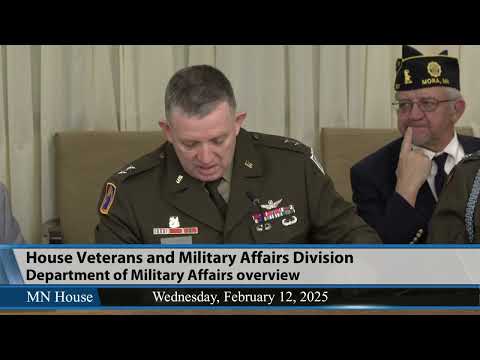
Saint Paul — The Minnesota Department of Veterans Affairs provided a broad overview of its programs, veterans homes and grants on Feb. 12, and committee members pressed for more detailed suicide-prevention data and clarification on federal funding risks.
Lede: Commissioner Brad Lindsey said MDVA serves Minnesota veterans by connecting them to federal and state benefits, operating eight state veterans homes, managing four veterans cemeteries and distributing grants funded in part by license-plate revenues and legislative appropriations.
Nut graf: MDVA leaders outlined ongoing work on veterans homelessness, education benefits and community grants; deputies described a newer community-health navigator initiative aimed at suicide prevention that committee members said needs clearer metrics and faster scaling.
Key facts and programs - Population and locations: MDVA cited an estimated 286,000 veterans in Minnesota (federal VA estimate). The agency runs eight state veterans homes, four state veterans cemeteries, and maintains regional offices including a presence at the Fargo VA regional office to assist Northwest Minnesota. - Grants: MDVA manages “Support Our Troops” and legislative grants (the license-plate program) and provides grants to county veteran service officers, veterans service organizations and community organizations such as the Minnesota Assistance Council for Veterans (MACV). - Minnesota GI Bill and education: MDVA administers a state “last-dollar” GI Bill benefit up to $15,000 over a veteran’s lifetime for education, training, licenses and apprenticeships, along with campus representatives and outreach. - Veterans homes and care: Deputy Commissioner Eric Maetinen described MDVA’s healthcare division: eight homes serving roughly 800 veterans with long-term care, domiciliary programs and adult-day services; the agency operates a central pharmacy and provides dental services at some homes. MDVA highlighted external quality recognitions. - Homelessness: MDVA and partners such as MACV said they have focused on ending veteran homelessness; MDVA noted most Continuums of Care in Minnesota have reached a federal declaration of “functional zero” for veteran homelessness. - Suicide prevention: Lindsey and deputies said the suicide-prevention initiative is newer: MDVA recently funded a director of veteran community health and plans to staff community health navigators who will work in hospitals and community settings to connect veterans to VA and MDVA services. Lindsey said funding for the suicide-prevention program is more recent than homelessness funding and additional staffing is pending.
Committee questions and concerns - Data and spending priorities: Vice Chair Bjorn Olsen pressed for more data on suicide-prevention outcomes and asked why homelessness spending appeared much larger per person in existing budget slides. MDVA leaders said homelessness efforts have been funded and scaled for a longer period (roughly a decade) while suicide-prevention was funded only recently; they agreed to provide more granular outcomes and staffing plans. - Federal funding uncertainty: Representative Sandra Feist asked whether MDVA programs could be affected by recent federal hiring or funding freezes. Commissioner Lindsey said per-diem and health-related federal funding had not been reported as affected yet but that the department and veterans advocates were monitoring potential impacts to VA benefit processing and grant flows.
Next steps: MDVA will provide more detailed suicide-prevention metrics, staffing plans for community health navigators and any available federal-risk assessments to the committee. Committee members expressed support for site visits and follow-up briefings on veterans homes and suicide-prevention results.
Ending: Lindsey thanked the committee; lawmakers scheduled the next division meeting for Feb. 19 and asked staff to follow up on the requested data.