Get Full Government Meeting Transcripts, Videos, & Alerts Forever!
Get email alerts on the National Guard Budget Modernization topic
No spam. Unsubscribe anytime.
Minnesota National Guard outlines personnel gains, modernization plans and asks for state funding for incentives and hangar design
Summary
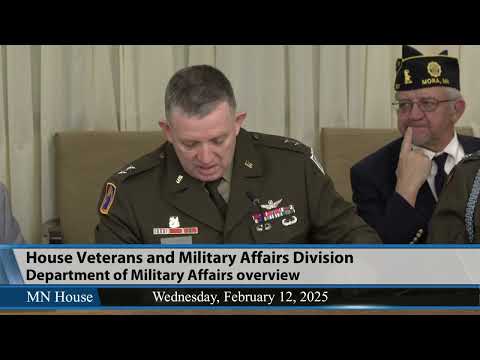
Adjutant General Maj. Gen. Sean Mankey and Department of Military Affairs executive staff briefed the House Veterans and Military Affairs Division on Guard strength, modernization investments and a slate of state budget and bonding requests, including increased enlistment incentives and design funding for Duluth hangars.
Saint Paul — Major General Sean Mankey, the Adjutant General of the Minnesota National Guard, told the House Veterans and Military Affairs Division on Feb. 12 that the Guard now fields roughly 13,000 soldiers and airmen and is pursuing a mix of state and federal investments to keep units modern and mission-ready.
Mankey said the Guard’s force includes about 10,400 Army soldiers and a little more than 2,200 airmen and described retention and recruiting as top priorities. “My three priorities: people, modernization, and partnerships,” he told the committee.
Why it matters: The Guard has a dual mission — state emergency response and federal deployments — and the division’s decisions on state funding and bonding authority can affect readiness, basing competitiveness and local economies, especially in communities hosting major units such as Duluth and Arden Hills.
Most important facts - The Guard reports roughly 13,000 members statewide, with the Army component around 10,400 and the Air component about 2,200. Mankey said Minnesota is slightly above authorization on both components in personnel strength percentages. - Federal modernization investments of roughly $2.4 billion are being made in Minnesota, primarily for the Army’s armored brigade combat team (including joint light tactical vehicles and M1 Abrams tanks) and for new C-130J airlifters for the Minnesota Air National Guard. The first C-130J tail for Minnesota is expected in January 2027. - The Guard operates 63 armories and training facilities in more than 50 communities and maintains Camp Ripley, a 53,000-acre training site near Little Falls used by multiple agencies.
State funding and policy requests - Enlistment incentives: Department of Military Affairs Executive Director Don Kerr asked for an $8 million increase over the upcoming biennium to sustain enlistment and reenlistment incentive programs the department says were effective in retaining service members. Kerr said some bonus programs had been paused because the department feared they were “over executing” without a secured funding stream. - Cyber coordination cell: The department asked for sustained state funding to continue a cyber coordination cell that the department says has helped integrate state and federal cyber defense efforts and partnerships with nonstate entities. - Holistic Health and Fitness (H2F): The department requested one year of state funding to bridge a timing gap while federal H2F staffing and reimbursements are phased in. Kerr said the program currently uses two service tours and three contract positions but is expected to transition to five federally funded positions. - State Armory Building Commission bonding authority: The department said it will introduce a bill to increase the existing bond-issuing cap for the Minnesota State Armory Building Commission. The commission helps match federal funds for new armories. Kerr said the current $15 million statutory cap is inadequate: construction costs for a single armory have grown from about $5 million (when he began) to $40 million two years ago and now may exceed $60 million. The requested increase is an authority change only, not an appropriation. - Duluth hangars: The department requested $3 million in design funding to replace aging hangars in Duluth. Kerr said securing a design could make the project eligible for congressionally directed spending; if federal funds do not materialize, the state could later request bonding to build the hangar. The department stressed that modern hangars are important to remain competitive for basing of future fighters or other aircraft.
Questions and clarifications - Title 10 vs. Title 32: Representative Sandra Feist asked how Title 10 (federal mobilization) differs from Title 32 (state training and duty). Mankey explained that Title 10 removes authority to the president and is typically used for deployments; Title 32 is used for most training and state activities and places soldiers under the governor’s authority while receiving federal pay/benefits. - State active duty retirement points and pay: Representative Bjorn Olsen and other members pressed whether state active duty should earn retirement points or higher pay—Mankey and Kerr acknowledged the concern and described it as a funding and federal-policy issue that would require multi-party work to resolve. Kerr said the department continues to research options, including possibly paying an increment to offset lost retirement credit.
What’s next: The department indicated it will introduce a statutory bill to increase the armory-bonding authority and will seek appropriations for enlistment incentives, H2F bridging funds and the Duluth hangar design. Committee members asked for follow-up information on program costs and likely fiscal impacts.
Ending: Committee members thanked the presenters and moved to the next agenda item after a brief question period on state active duty and retirement credit.