Get Full Government Meeting Transcripts, Videos, & Alerts Forever!
Get email alerts on the Budget County Cost Shift topic
No spam. Unsubscribe anytime.
Counties warn Walz budget would shift millions in human services costs to local property taxpayers
Summary
County officials told the House Health and Human Services Finance Policy Committee that Governor Tim Walz’s proposed budget would shift substantial program costs to counties — including behavioral health, MSOP and disability waiver changes — forcing local levy increases and uneven access to services across Minnesota.
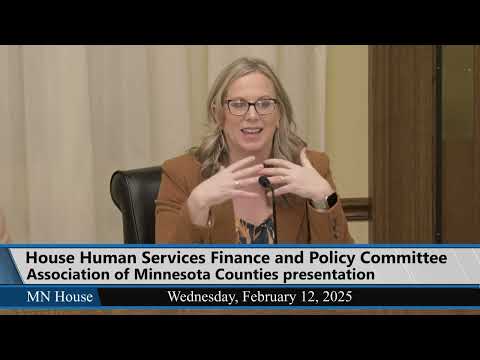
County administrators and human services directors from across Minnesota told the House Health and Human Services Finance Policy Committee on Feb. 11 that parts of Gov. Tim Walz’s budget would shift millions of dollars in state service costs to counties, with consequences for property taxes and access to care.
"Most of the areas I'm here for today, if passed, would result in increases in local property taxes," Angela Jungerberg, director of business operations for Blue Earth County Human Services, told the committee while representing the Minnesota Association of County Social Service Administrators and the Minnesota Inter-County Association. "Shifting costs related to our most vulnerable Minnesotans onto property taxes will create inequities in access to services."
Jungerberg described three program areas singled out in the governor’s proposal: the behavioral health fund, the Minnesota Sex Offender Program (MSOP), and competency restoration services. She said the budget would raise the county share of the behavioral health fund from about 22.95% to 50%, an increase she said would add roughly $9 million per biennium statewide to county budgets. On MSOP she said the proposal raises county cost shares to 40% and estimated a $39.6 million total county obligation per biennium, which she characterized as roughly a $19.8 million shift to counties. For competency restoration services, she said the budget would apply existing county cost shares and estimated $16.7 million per biennium in county responsibility.
Katie Molinaire, deputy director of Ramsey County Social Services, testified that a new 5% county share for disability waiver services in the governor’s plan would be substantial for some counties. "This 5% cost shift is projected to be $13,000,000 annually" for Ramsey County, she said, adding that the county estimated the change would amount to a roughly 4% tax levy increase locally. Molinaire warned that if counties cannot raise the revenue, "it may result in vulnerable residents not receiving services that they are assessed to need or create a patchwork of access across our state's 87 counties."
County administrators from rural and suburban counties gave examples of local impacts. Pine County Administrator David Minkie estimated a roughly $600,000 hit for his county — “it would require an increase in the HHS levy of about 15%.” Sherburne County Administrator Bruce Messelt estimated identified shifts in the governor's proposal would amount to nearly $3 million to his county and said combined state shifts could be a $6 million increase overall when other mandates are included, equal to a projected 10% levy increase. Beltrami County Administrator Tom Berry said the proposed shifts could require a near 12% property tax increase for his county to cover new costs.
Several witnesses stressed that counties have limited ability to influence costs in some of these programs because admission, treatment and placement decisions are made by courts, state facilities or providers. "This, what once was a model based around function and role is simply a cost share with no ability to influence services," Jungerberg said of the behavioral health fund. She and other witnesses urged lawmakers to consider system modernization and administrative changes as alternatives to shifting costs.
Speakers repeated that the effects would be uneven because counties with higher poverty and smaller tax bases have less ability to raise revenue. "Shifting state costs to local government, particularly counties, is short sighted, reckless, and irresponsible," Josh Berg of Accessible Space, Inc., said in testimony that echoed county concerns.
Committee members asked questions about whether county program aid offsets the proposed shifts and about the distributional impact across rural and urban counties. Matt Hilgert of the Association of Minnesota Counties said county program aid now represents roughly 3–5% of an average county budget and that its relative share has eroded over decades. "County program aid...has eroded every year," he said.
The testimony did not include any formal votes by the committee; speakers asked lawmakers to consider alternatives to outright cost shifts, including targeted state investments and IT modernization to reduce administrative burdens that counties and providers said increase operating costs.
The topic will continue to be central to budget negotiations: county officials urged lawmakers to weigh both short-term fiscal changes and longer-term reforms to administrative systems and provider rates before imposing broad cost shifts to local property taxpayers.