
Providers urge rate rebasing for adult residential facilities serving dementia and brain‑injury patients; committee pauses for redrafting
Get AI-powered insights, summaries, and transcripts
Sign Up Free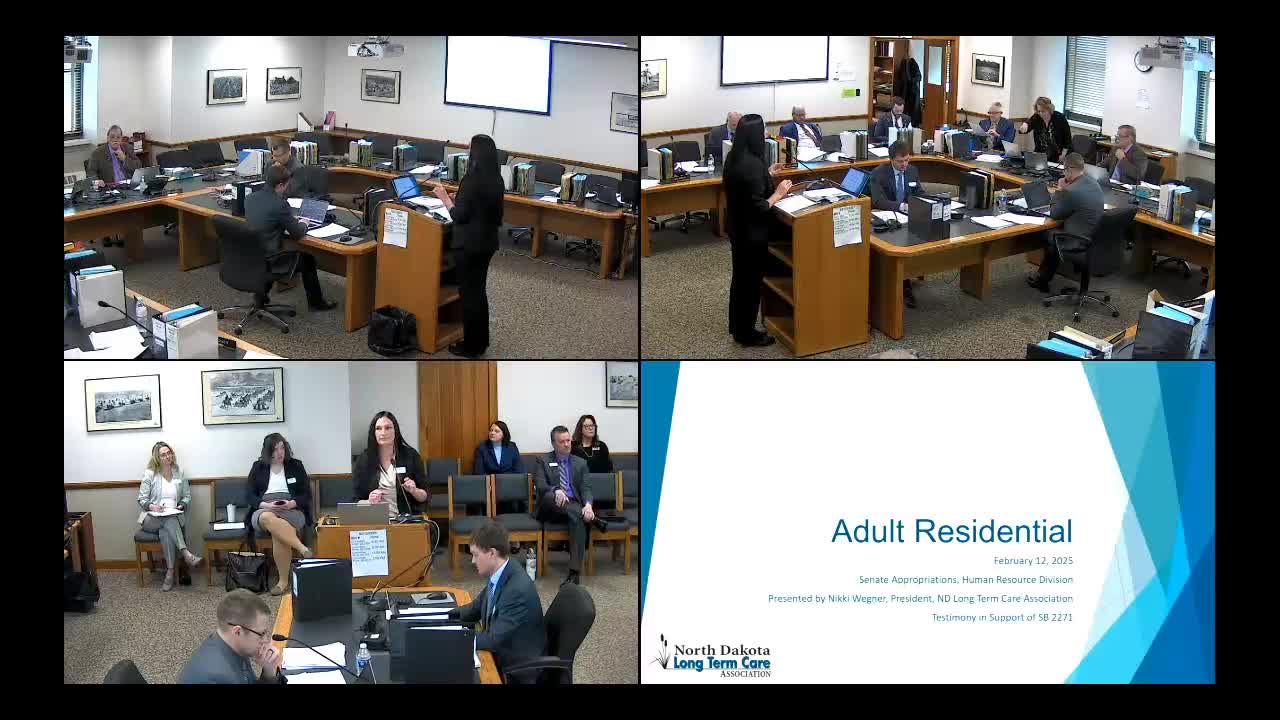
Summary
Long Term Care Association members told a Senate appropriations subcommittee that adult residential facilities that serve people with dementia and acquired brain injury are reimbursed far below actual costs and urged rate rebasing and short‑term inflators to keep facilities open.
Long Term Care Association representatives told the Senate Appropriations Human Resources Division that adult residential facilities (ARCs) that serve people with dementia or acquired brain injury are operating at rates well below the cost of care and face closure or decisions to stop taking Medicaid residents unless rates are adjusted.
Nikki Wagner, president of the North Dakota Long Term Care Association, said the existing ARC daily Medicaid reimbursement averaged $162.04, while average nursing facility daily cost was about $403.13, a widening gap since the program was piloted in the late 1990s. Wagner told the committee facilities lose "an average of $45.77 per day per Medicaid resident" and said two licensed ARC operators currently decline Medicaid residents because the rates do not cover costs.
The association proposed a multi‑step solution in SB2271: an immediate 4% inflator effective July 1, 2025; a 5% operating margin included in rates beginning Jan. 1, 2026 (the committee requested clarifying language to ensure the margin would apply for a defined period rather than obligate future legislatures); a 3% inflator July 1, 2026; and a rebasing of rates in the next biennium using facility cost reports plus a 5% margin. The association requested an initial appropriation of $2,200,000 to begin the adjustments.
Ashley Brandt Duda, a partner at accounting firm Eide Bailly who analyzed provider cost reports, walked the committee through estimated fiscal impacts. Using 2023 cost data from 14 facilities, she estimated the rebasing and margin changes would produce an annualized state general fund impact (after federal match) in the low millions; she estimated the total effect for all 16 licensed facilities at roughly $2.25 million (state share after FMAP). Brandt said a 5% operating margin equated to roughly $9.08 per resident per day on current averages and emphasized that the 5% margin is an operating margin to provide reserves for businesses rather than an outsized profit.
Department of Health and Human Services staff said ARCs receive the governor's recommended inflation in the agency budget (1.5% per year in the current recommendation) but that the provider request would be an addition. DHHS also signaled the department wants to move toward streamlined payment systems and noted any long‑term redesign would require additional planning; committee staff asked the department to clarify how much of the requested appropriation would be general fund versus other funding sources.
Committee members questioned whether the bill's language would obligate future legislatures to continue the margin indefinitely; the sponsor agreed to a drafting change to limit the 5% margin to the current biennium (committee counsel suggested a targeted sunset). Lawmakers split over whether standalone statutory changes or a budgetary approach would be the appropriate vehicle for the requested increases. A motion for a "do not pass" recommendation failed on a roll call; members asked staff to draft an amendment that clarifies the sunset and funding sources and to return with a revised bill for further consideration.