Get Full Government Meeting Transcripts, Videos, & Alerts Forever!
Get email alerts on the Transit Blue Line Moratorium topic
No spam. Unsubscribe anytime.
Transportation committee re-refers HF 14 after heated debate over Blue Line spending pause
Summary
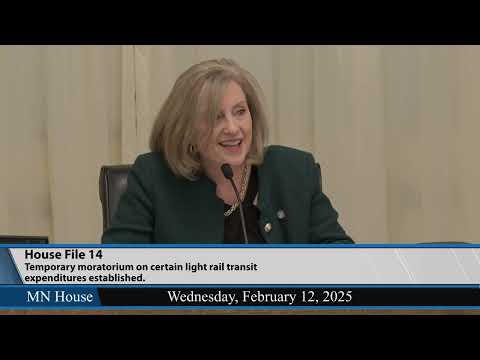
The House Transportation Committee voted 8–7 to re-refer House File 14, a proposal to pause Metropolitan Council construction spending on the Blue Line Extension until the Southwest Light Rail opens, after hours of testimony from local officials, transit advocates and riders.
The Minnesota House Transportation Committee voted 8–7 to re-refer House File 14 — a bill that would pause Metropolitan Council spending on construction of the Blue Line Extension until the Southwest Light Rail is in revenue service — after more than an hour of testimony from elected officials, transit advocates and community groups.
Representative Lisa Robbins, sponsor of HF 14, told the committee the pause is intended to “help save taxpayers money” by delaying Blue Line construction until Southwest Light Rail is complete so the state can reassess whether the Blue Line still makes sense. Robbins cited large cost increases on recent projects, saying Southwest Light Rail went from an original estimate of $1.25 billion to a 2025 projection of $2.9 billion and that the Blue Line projection has risen from about $999 million to roughly $3.2 billion.
The bill would prohibit the Metropolitan Council from expending funds on capital construction of the Blue Line Extension until the Southwest line is operational. Opponents and proponents offered sharply contrasting views at the hearing.
Why it matters
HF 14 would restrict how the regional transit agency may use funds on a multi‑billion-dollar light‑rail extension that Hennepin County and a set of municipalities have been planning. Supporters said the statewide fiscal picture and recent rail cost overruns justify a pause and a comparison with bus rapid transit (BRT) alternatives. Opponents warned that a pause would delay the project further, risk losing federal dollars and harm communities that county and city leaders say have supported the extension.
What supporters said
Representative Lisa Robbins, sponsor, described the bill as “a way we can save money for taxpayers” and urged a halt until Southwest Light Rail is operating so the state can evaluate alternatives. She cited published reports and a Star Tribune story about a newly identified $50 million bridge redesign as examples of additional cost risk.
Representative Robbins also compared the projected per‑mile cost of the Blue Line to bus rapid transit, saying the F Line BRT was built for roughly $75–85 million for 13 miles and “we could do the whole project for less than the cost of a mile of the fixed light rail.”
Testimony in support of the project pause was limited in the record; most public testimony at the hearing opposed HF 14.
What opponents said
Judd Shetnan, government affairs director for the Metropolitan Council, told the committee the council is in a planning and implementation phase and that a pause would delay Blue Line construction by about two years and could add roughly $100 million of inflationary cost per year, producing about $200 million in additional cost for a two‑year suspension. “We'd like to see this project move forward,” Shetnan said, urging continuation of regional planning and use of recently passed regional sales tax revenues.
Transit and environmental advocates said pausing the project would harm riders and the region’s climate and equity goals. Nas (state policy lead, Move Minnesota) testified HF 14 would undermine transit investments and make life less affordable for people who rely on transit. Joshua Hodak (senior program manager, Sierra Club) emphasized that light rail produces no tailpipe emissions and leverages federal funds, saying, “Light rail carries significantly more passengers than a bus or miles of congested traffic on our roads.”
Local elected officials representing corridor communities also urged the committee to oppose the moratorium. Minneapolis City Council Member Jeremiah Ellison said all cities along the route have passed municipal consent and warned that “further delay is only going to put us in a less financially ideal situation.” Irene Fernando, chair of the Hennepin County Board, said the extension would connect North Minneapolis, Robbinsdale, Crystal and Brooklyn Park to jobs and services and that “these communities have some of the highest transit ridership rates in the state.”
Brooklyn Park Mayor Hollands Winston said the city has committed staff time and $8,000,000 for infrastructure improvements along West Broadway in anticipation of the Blue Line Extension and argued the project will stimulate economic development and expand the tax base.
Other public testimony included small‑business and neighborhood representatives and residents who said the Blue Line Extension is an equity and access investment for corridor communities. Ricardo Perez (Alliance for Metropolitan Stability) described longstanding local planning and community expectations dating back to 2013, and Andrea Young (Heritage Park Neighborhood Association) said “the people of the communities that I serve deserve the same opportunities as the people that live along the Green Line.”
Points raised by committee members
Several committee members pressed both cost and ridership questions. Representative Olson presented a numerical critique of long‑term ridership economics and argued the train is a poor investment compared with bus options; that analysis was offered as a member comment rather than as committee findings. Representative Jones and others noted technical differences among projects — for example, a tunnel on another line — and cautioned against directly equating challenges on Southwest Light Rail with those the Blue Line Extension may face.
Committee action and procedural notes
Representative Robbins initially moved to place HF 14 on the General Register. Representative Ben Tapke moved to amend that referral and re‑refer HF 14 to the House Ways and Means Committee. The amendment passed on a roll call vote, 8 yes and 7 no. The roll call recorded the following votes: Kosnick (yes), Myers (yes), Anderson (yes), Berg (no), Fogelman (yes), Green (no), Jones (no), Joy (yes), Kraft (no), Murphy (yes), Olson (yes), Ream (no), Sensamura (no), Scrabble (yes), Tadke (no). After the roll call the transcript records some clerical confusion in committee comments about whether the file would go to Ways and Means or the General Register; the committee clerk later stated, “The motion, the House File 14 will be moved to the General Register.” The roll call result in the record shows the amendment to re‑refer to Ways and Means prevailed 8–7.
Discussion versus decision
The record shows extensive discussion and competing testimony but only one formal committee action on the motion to re‑refer: the amendment to re‑refer HF 14 to the Ways and Means Committee, which passed 8–7 by roll call. The transcript also records later procedural statements that reference the General Register; the transcript itself is internally inconsistent on the final referral. The committee did not adopt or reject the substantive content of HF 14 on the merits at this hearing.
What’s next
With the amendment carried by roll call, HF 14 will move out of the Transportation Committee for further consideration in the next procedural step recorded by the committee (the transcript shows both Ways and Means and General Register referred to; the roll call on record moved the amendment to re‑refer to Ways and Means). Further action would be required in subsequent committees or on the floor before any pause would take effect.