Get Full Government Meeting Transcripts, Videos, & Alerts Forever!
Get email alerts on the Born Alive Infant Care topic
No spam. Unsubscribe anytime.
Committee recommends bill clarifying care for infants born alive after failed abortions
Summary
House File 24, a two‑sentence bill proposing to require medically appropriate care for infants born alive after attempted abortions, was recommended to pass by the Health Finance Policy Committee on a narrow 11–10 vote after competing testimony from clinicians and advocacy groups.
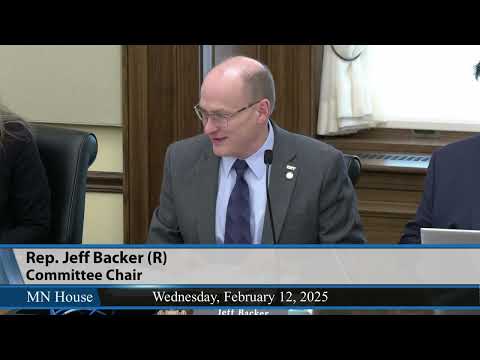
The House Health Finance Policy Committee on Feb. 12 recommended passage of House File 24, which would clarify the standard of care for infants who are born alive after an attempted abortion. The committee recommended the bill to pass on a roll call of 11–10.
Representative Knudson introduced HF24 as a short bill, asking the committee to “reinstate protections for babies that survive abortion, ensuring that they receive medically necessary care to preserve the life and health of that baby.” Committee members then heard roughly two hours of testimony from advocates, survivors, and medical organizations before the roll call.
Supporters included legal and pro‑life organizations and individuals who said Minnesota law should explicitly require life‑preserving measures and reporting. Renee Carlson, general counsel for True North Legal, and Kathy Blaser of Minnesota Citizens Concerned for Life said the bill restores protections that were in Minnesota law previously and cited Minnesota Department of Health records showing instances of infants born alive after failed abortions. “Leaving one infant to die is one too many,” Carlson said.
Survivors also testified. Sarah Zivorski and Mikaela Clay described being born alive during attempted abortions and urged lawmakers to require care for infants in that circumstance.
Medical organizations opposed the bill. Dr. Erin Stevens, an OB‑GYN and legislative chair for the Minnesota section of the American College of Obstetricians and Gynecologists (ACOG), told the committee HF24 is based on misunderstandings of clinical practice and could lead to unintended consequences that interfere with patient‑centered decision‑making. “Bills like this are often well intentioned but come from unfortunate misinformation,” she said, describing clinical scenarios — for example, pregnancies with lethal fetal anomalies or severe maternal illness — in which patients and clinicians make complex decisions about care.
Other committee members framed the debate around parental autonomy and palliative care. Multiple lawmakers described difficult situations in which families chose to hold infants who were not expected to survive, and some members said the bill as written narrowly focuses on infants born after abortions rather than applying uniformly to all newborns in similar medical circumstances.
Representative Knudson renewed her motion to recommend HF24 to pass; the committee recorded the roll call with 11 ayes and 10 noes. Recorded ayes included Chair Backer; Vice Chair Nadeau; Representatives DePaule, Franzen, Gilman, Knutson, Perriman, Repinski, Schumacher, Van Vinsbergen and Knudson; recorded nos included Representatives Biermann, Bonner, Carroll, Elkins, Hemmingson Yeager, Hewitt, Liebling, Mahamud, Purcell and Breyer. The motion prevailed and the bill was sent forward for further consideration.
Votes at a glance: HF24 — recommended to pass, roll call 11–10.