Get Full Government Meeting Transcripts, Videos, & Alerts Forever!
Get email alerts on the Value Added Agriculture topic
No spam. Unsubscribe anytime.
AURI tells lawmakers it helped drive $187 million in new annual sales, seeks continued base funding
Summary
The Agricultural Utilization and Research Institute told the House Ag Finance Committee it completed about 100 projects in FY24, reported $187 million in attributed new annual sales and confirmed a FY26 goal of $500 million in economic impact; the group outlined facilities, staffing, and program priorities.
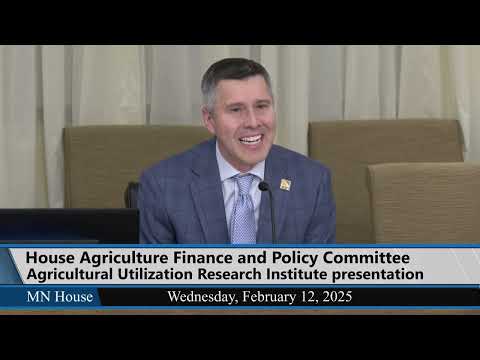
The Agricultural Utilization and Research Institute told the House Agriculture Finance and Policy Committee it completed roughly 100 projects in fiscal year 2024 and helped Minnesota food and agribusinesses generate an estimated $187,000,000 in new annual sales.
“For the record, my name is Dan Sparks, director of government and industry relations at AURI,” Sparks said as the session began. Federico Tripodi, AURI board chair, and Shannon Schlicht, AURI executive director, joined Sparks to outline the institute's work and facilities.
Tripodi described AURI's mission and long-term target: “Our North Star is to drive impact. Tangible results through the work we do, 500,000,000 in economic impact through jobs, investment, and sales growth by the end of our fiscal year 20 26 off of your roughly $4,400,000 in support each year,” he said. Schlicht summarized the institute's core activities, saying AURI ''helps drive new opportunities'' through commercialization services, applied research and outreach.
AURI described its statewide network of facilities and staff: four sites in Crookston, Marshall, Saint Paul and an expanded bioindustrial innovation center in Waseca opened in 2024. Schlicht said AURI ''opened and closed roughly 100 projects'' in the past year, worked on about 200 projects overall, and reached more than 1,000 participants at outreach events. She told the committee the organization supported 717 jobs created or retained and helped catalyze about $85,000,000 in new investment.
Program highlights presented to the committee included work on local and regional meat processing, school lunch procurement assistance for local food businesses, a virtual assistant tool called "AVA" to provide curated technical resources, and bioindustrial projects such as hemp fiber trials for erosion-control products and soybean-meal fertilizer tests. Schlicht said one-time funding permitted upgrades to analytical and digestion laboratories and tripled lab floor space in Waseca.
Committee members asked about outreach to diverse entrepreneurs, hemp fiber development, and soy-meal fertilizer trials. Schlicht said AURI works with community partners and that its staff and food scientists engage diverse food entrepreneurs and can follow up with district-specific client lists. On hemp she said work is ''very much in its infancy'' and noted collaborations with neighboring states and the National Industrial Hemp Association; on soybean meal she said tests and pilot uses are underway and she would follow up with numbers.
Tripodi and Schlicht also described governance: the board composition is set by statute and includes representatives from farm organizations, research and promotion councils, agribusiness, at-large directors and two legislators. Tripodi noted the board meets at least five times a year and reviews priorities at each meeting.
AURI officials confirmed the organization receives a state base appropriation of about $4.34 million per year but previously received one-time state funding and additional federal project grants; Schlicht said FY24 included about $700,000 in federal funding leveraged for projects. She noted AURI is a standalone nonprofit (501(c)(3)) and not part of a collective bargaining unit; cost-of-living adjustments are not automatic and are requested as needed to the legislature.
The presentation concluded with committee members thanking AURI for its work and noting value-added processing as a potential way to bolster farm incomes during tight commodity margins.