Get Full Government Meeting Transcripts, Videos, & Alerts Forever!
Get email alerts on the Solid Waste Management Tax topic
No spam. Unsubscribe anytime.
Senate committee hears bill to redirect solid-waste tax revenue to SCORE grants
Summary
Senate file 1082 would shift a larger share of Minnesota's solid waste management tax from the general fund back to SCORE grants and county programs; witnesses from counties and the Department of Revenue testified in support.
Senate file 1082, a bill from Sen. Scott Dibble that would increase the share of the solid waste management tax dedicated to SCORE grants and other local solid-waste programs, was heard Feb. 12 by the Minnesota Senate Taxes Committee.
The bill would phase up the portion of solid-waste tax revenue directed to SCORE and related programs from the current small percentage to as much as 30 percent over several years, moving more revenue away from the state general fund and toward county and local recycling and organics programs.
Why it matters: Supporters told the committee the change would restore the tax to its original purpose of funding local recycling, waste-reduction and organics programs rather than supplementing the general fund. Proponents said SCORE grants fund county recycling centers, hazardous-waste drop-offs, organics pilots and other services that counties currently finance with local revenue when state support is insufficient.
Stephen Diaz, director of the Minnesota Department of Revenue's Special Taxes Division, gave the committee a technical overview of how the solid waste management tax is collected and allocated. Diaz explained the tax applies to service providers and that collections fluctuate with construction seasonality and filing frequency. He summarized the existing allocation: most revenue is credited to the environmental fund administered by the Minnesota Pollution Control Agency and a smaller portion is available for SCORE and the general fund under the current statute.
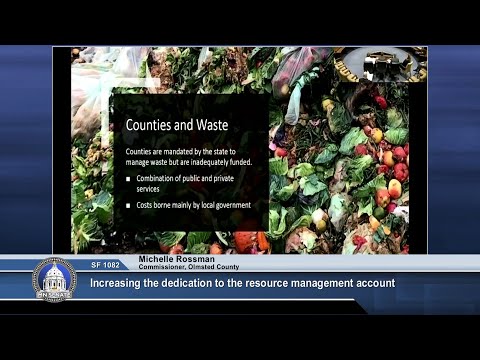
Olmsted County Commissioner Michelle Rossman testified in support of Senate file 1082 on behalf of several local-government coalitions, saying the tax has historically been intended to fund waste-management activities and that counties shoulder rising operational and cleanup costs. "This is a user tax that now generates over $100,000,000 annually," Rossman said, and she told the committee about the local investments that SCORE grants support, including recycling education, organics collection pilots and reuse programs.
Fran Muren, a Washington County commissioner and chair of the Partnership on Waste-to-Energy, told the committee counties use SCORE funds for environmental centers and reuse rooms that residents use for hazardous-material drop-offs and recycling. He said Washington County had nearly 60,000 visits to one environmental center in 2024 and that local governments currently supplement SCORE with landfill fees, assessments and property taxes.
Committee discussion addressed the bill's phased schedule and revenue estimates. Senator Dibble and other senators noted prior incremental changes to SCORE funding and emphasized the bill seeks to return a larger share of the solid-waste tax to its original purposes.
The committee did not vote on the bill; senators laid the measure over for inclusion and consideration in the omnibus tax bill.
Sources and evidence: Testimony and technical explanation were recorded on Feb. 12 before the Senate Taxes Committee and presented by representatives of the Minnesota Department of Revenue, Olmsted County and Washington County.
What's next: The bill will be considered as the Senate and the omnibus tax bill take shape; committee staff will continue to work with agency analysts on revenue modeling and programmatic effects.