Get Full Government Meeting Transcripts, Videos, & Alerts Forever!
Get email alerts on the Academic Health Systems topic
No spam. Unsubscribe anytime.
University of Minnesota, Essentia Health outline plan for unified academic health system with $1 billion investment
Summary
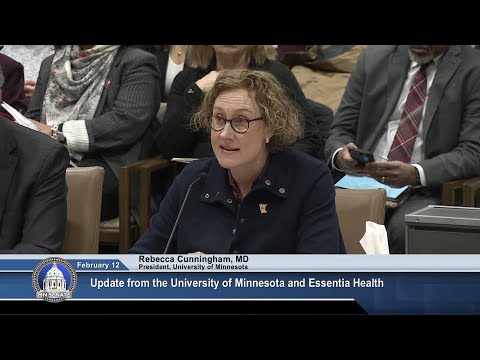
University of Minnesota President Rebecca Cunningham and Essentia Health CEO David Herman told the Minnesota Senate Health and Human Services Committee on Feb. 12 they are exploring a proposal to form an integrated academic health care entity that would “invest a billion dollars over 5 years” and would not request initial state budget funds.
University of Minnesota President Rebecca Cunningham and Essentia Health CEO David Herman told the Minnesota Senate Health and Human Services Committee on Feb. 12 they are exploring a proposal to form an integrated academic health care entity that would combine University physicians and clinics with Essentia’s facilities and invite Fairview Health Services to participate.
Cunningham said the plan would “invest a billion dollars over 5 years to bring this vision to life” and that the initial transformation would not require additional taxpayer dollars or a state budget request. She framed the proposal as a way to expand access—particularly in rural and tribal communities—preserve doctor‑patient relationships and strengthen the University of Minnesota Medical School, which she said “trains 70% of the physicians in every health system across the state.”
The administration described the effort as more than a typical joint venture. Cunningham said the proposed model would be “a new integrated health care system that operates as 1 unified academic health care entity,” not a “joint transactional venture,” and that Accenture (a private-sector partner referenced by witnesses) would support the transformation.
Senators used the hearing to press presenters on how the proposal would affect local services and labor. Several lawmakers expressed concern that past consolidations had reduced services in small towns and asked whether the plan would close clinics or hospitals. David Herman, identified in testimony as CEO of Essentia Health, repeatedly rejected that characterization: “This is certainly not about consolidation,” he said, adding the design aims to bolster rural care by building workforce capacity and using telehealth and mobile services so “people can get their care close to home.”
Committee members asked about overlapping clinics where Essentia and Fairview already operate close to one another. Herman said facilities in places such as Grand Rapids and Deer River were “very busy right now” and that the proposal would seek clinical coordination—particularly for specialty and behavioral health services—without forcing immediate facility closures.
Lawmakers also raised labor questions. Senators asked whether existing union contracts and employee jobs would be preserved. Herman told the committee Essentia has continued to honor labor contracts and said the organization is “looking forward to preserving jobs.” Cunningham added that the approach under discussion would be “minimally disruptive” because it seeks to build on existing services rather than dismantle them.
Several senators asked about care in Catholic facilities within Essentia’s system and whether Ethical and Religious Directives (ERDs) used in Catholic facilities would limit clinical training or reproductive‑health care. Senator Mann described concerns about directive language and emergency care in ectopic pregnancies. Herman responded that Essentia is a secular system with some Catholic facilities and said emergency terminations to save a mother’s life are performed when clinically necessary: “We would never sacrifice the life of a mother, for an unviable pregnancy.” He also said Catholic facilities could maintain their ERD obligations while non‑Catholic facilities in the proposed system would not be bound by those directives.
Presenters said the proposal aims to recapitalize facilities and invest in workforce and training statewide. Cunningham and Herman described talks with Fairview leadership and said more detailed, transparent discussions with patients, providers, labor and communities will be required before any formal restructuring takes place. Cunningham emphasized the plan is early in development and repeatedly told senators she welcomed further engagement and scrutiny.
No formal action, vote or specific implementation timeline was offered at the hearing; presenters asked the committee to continue discussions as the concept is refined.