Get Full Government Meeting Transcripts, Videos, & Alerts Forever!
Get email alerts on the Waste Fraud Accountability topic
No spam. Unsubscribe anytime.
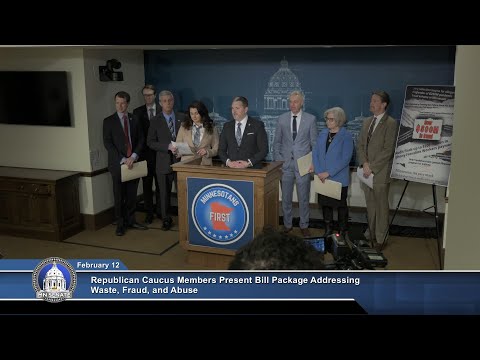
Senate Republicans outline sweeping anti‑fraud package, including new inspector general and whistleblower expansions
Summary
Minnesota Senate Republicans on a press call unveiled a package of bills aimed at preventing waste, fraud and abuse in state government, proposing an independent inspector general, expanded whistleblower protections, centralized grants management and stronger grant oversight.
Senate Republican leaders and bill authors on Tuesday laid out a multi‑bill package designed to curb what they called pervasive waste, fraud and abuse in Minnesota state government.
Senator Mark Johnson, Senate Republican Caucus leader, opened the event by saying the caucus placed rooting out fraud high on its agenda and cited recent polling showing ‘‘20% of respondents felt it should be the top priority of the Minnesota legislature to tackle this session.’’
The proposals presented include several bills: Senate File 475 (whistleblower protections), bills to create an independent inspector general and to strengthen grants management (referred to in the presentations as Senate File 1219 and Senate File 538), Senate File 730 (clarifying public access under the Data Practices Act for the Attorney General’s office), Senate File 263 (giving the Office of the Legislative Auditor more resources and requiring follow‑up on implementation), Senate File 981 (grant program safeguards), and Senate File 1123 (additional grant reforms). The sponsors described reforms ranging from expanded reporting channels for agency employees to a new centralized grants director and on‑site grantee checks.
Senator Julia Coleman (Senate District 48) said the proposals would ‘‘deliver comprehensive reforms to protect every dollar entrusted to us by Minnesotans’’ and framed the package as a response to what speakers repeatedly called a recent pattern of fraud in state programs.
Senator Steve Drazkowski (Senate District 20) described a bill requiring state employees who suspect fraud to pause payments and report concerns to commissioners or supervisors, the inspector general and the Office of the Legislative Auditor. ‘‘They have the right and the responsibility to pause payments every time that they suspect fraud,’’ Drazkowski said, and he cited Minnesota statute 609.455 in describing existing criminal penalties: ‘‘It's a $10,000 fine and or 5 years in prison or both.’’ He also proposed financial consequences for agencies that fail to act on identified fraud, including a two‑year freeze on the agency’s base operations budget.
Senator Andrew Matthews (Senate District 27), the sponsor of Senate File 475, said his bill would expand the list of protected parties a whistleblower may report to — including supervisors, law enforcement, constitutional officers and legislators — and widen protections because ‘‘employees have shared concerns with legislators on the explicit condition that we keep their identity confidential’’ and fear retaliation.
A bill to create an Office of Independent Inspector General was described as giving a single agency criminal investigative capabilities and forensic resources to pursue organized or cross‑agency fraud. A bill sponsor said the office should include subpoena and investigative capabilities as well as forensic accounting and cybersecurity expertise, and that it should not supplant the Office of the Legislative Auditor’s statutory role in compliance and auditing.
On grant oversight, Senator Mark Krenn (identified in remarks as representing Senate District 28) and Senator Carla Nelson (R, Rochester) emphasized reforms prompted by the Office of the Legislative Auditor’s prior findings. Senator Nelson said, ‘‘Every dollar that is fraudulently given out for a purpose it was not intended for actually robs Minnesotans in need,’’ and outlined measures in Senate File 981 including stricter financial audits, background checks for grantees, conflict‑of‑interest rules for nonprofit boards and requirements for immediate reporting of fraud concerns.
Senator Jordan Rasmussen (Fergus Falls) detailed Senate File 263, which would give the Office of the Legislative Auditor additional resources and require it to report whether agencies have implemented its recommendations and to notify relevant legislative committees of implementation status.
Speakers repeatedly framed the proposals as bipartisan or intended to become bipartisan, noting existing committee hearings and some cross‑aisle cosponsors. Senator Matthews said his bill had bipartisan coauthors and ‘‘has had 2 committee hearings already so far.’’ Other speakers said they expected to work with colleagues across the aisle and with the governor’s office to reach a bipartisan, bicameral solution.
None of the sponsors announced enacted votes or formal legislative outcomes at the press event; the session was a policy rollout and question session about the bills and their differences. Questions from senators and reporters addressed points of scope (how an inspector general would differ from the Office of the Legislative Auditor), data retention, and whether legislatively named grants would be subject to the same criteria as other grants; speakers said some bills would require legislative grants to meet the same criteria but that the measures did not outright ban such appropriations.
The sponsors identified multiple goals: create clearer reporting and pausing mechanisms for suspected fraud; expand whistleblower protections and reporting paths; centralize grant management and tracking; require follow‑up on OLA recommendations; and provide an independent investigatory office with forensic and criminal investigative capability. They also emphasized training and cultural change across state agencies to prevent and detect fraud sooner.
The press event did not include formal votes or enacted changes; sponsors said their bills were at various stages (some with committee hearings) and that they anticipated continued negotiation and possible incorporation of ideas across bills as they move through the legislative process.
Looking ahead, sponsors said they hope to advance bills this session and to work toward bipartisan agreement. ‘‘We think at this point in the legislature… that we can have a very large number of legislators support a bipartisan, bicameral solution,’’ one sponsor said, adding they planned to continue negotiations with colleagues and the administration.
The proposals referenced existing authorities and oversight mechanisms, including Minnesota statute 609.455 and the Office of the Legislative Auditor, and called for statutory clarifications to the Data Practices Act as it applies to the Attorney General’s office. Specific bill numbers, sponsors and the details described above are based on remarks at the press event; none of the measures was presented as enacted at the time of the event.