Get Full Government Meeting Transcripts, Videos, & Alerts Forever!
Get email alerts on the Public Safety topic
No spam. Unsubscribe anytime.
Authors, law enforcement and sheriffs push different approaches to address rising vehicle fleeing; mobile-tracker exemption debated
Summary
Three Senate proposals to address a rise in fleeing-from-police incidents were presented to the Judiciary Committee on Feb. 12. Proposals differ on punishment tiers, whether low-level fleeing should remain a felony or become a gross misdemeanor, and whether to add a targeted exemption allowing mobile tracking devices on actively fleeing vehicles.
Three competing Senate bills aimed at reducing dangerous instances of fleeing from peace officers in motor vehicles were the focus of an informational hearing on Feb. 12 before the Senate Judiciary and Public Safety Committee. Authors, prosecutors, chiefs and sheriffs testified about a rise in pursuits and proposed statutory changes to add intermediate felony tiers and to allow narrow use of mobile tracking devices to reduce high-speed chases.
Senator Amy Gustafson (author of one proposal) opened with statistics and a framework for higher penalties keyed to increasing danger. "In 2023, there were 2,262 agency-initiated pursuits," Gustafson said, and she cited a large increase in auto thefts, telling the committee the bill would add two felony tiers for fleeing that raise maximum imprisonment by one year at each higher tier and would add a statutory exemption to allow an officer to deploy a mobile tracking device on a fleeing vehicle in narrowly defined circumstances.
Senator Erin Coleman (author of a second proposal) described a personal incident that motivated her work: a stolen vehicle nearly struck her family while she was driving with small children. "I look to my right and I see this device being pulled across the highway...I hear screeching tires, screaming kids," Coleman said. She said her bill would create an offense for endangering the public while fleeing and noted bipartisan and law-enforcement support.
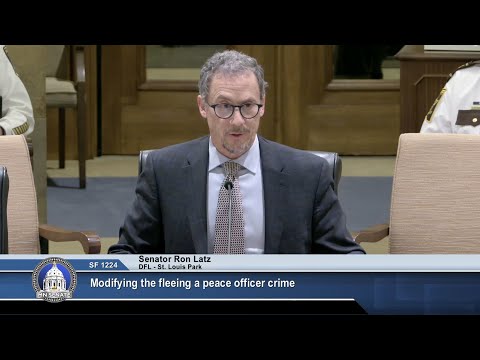
A third bill, Senate File 1224, introduced by Senator Lats, proposes two changes: add a culpable-negligence felony tier for particularly dangerous, but not necessarily crash-producing, conduct; and convert the lowest-level fleeing offense from a felony to a gross misdemeanor to remove automatic vehicle-forfeiture and some automatic licensing consequences. "That lowest level fleeing offense...should not be a felony level offense," the author said, explaining the change is intended to prevent disproportionate felony records for relatively brief or minimal evasive maneuvers.
Law-enforcement organizations and chiefs generally supported stiffer penalties and the mobile-tracker exemption. Jay Henthorn, appearing for the Minnesota Chiefs of Police Association, said officers find current tracking-device exceptions impractical because obtaining owner consent or a confirmed stolen-vehicle report often takes minutes and the fleeing vehicle can escape during that delay. "By deploying a device onto the fleeing vehicle...the officer can back off from the pursuit or keep the motoring public safe while also maintaining the ability to find the individual or vehicle," Henthorn said.
Kevin Torgerson of the Olmsted County Sheriff's Office, testifying for the Minnesota Sheriffs Association, said fleeing incidents are increasingly dangerous and frequently involve repeat or very young offenders. He urged stronger penalties to deter repeat behavior and called for complementary intervention programs for juveniles.
Several law-enforcement witnesses supported a cautious, narrowly drawn tracking-device exemption that would allow officers to place a mobile tracker on a vehicle while pulling back from a pursuit, enabling planned arrest operations rather than extended high-speed chases. Attorney Rich Neumeister cautioned the committee about Fourth Amendment issues and urged that any statute include post-event documentation or reporting requirements to maintain accountability.
Committee discussion highlighted the differences between the bills. Some senators opposed lowering the base fleeing offense from a felony to a gross misdemeanor, citing the seriousness and public-safety risks when someone chooses to flee. Others said there are factual situations—such as a motorist briefly accelerating or making an immediate right turn out of fear—that should not automatically carry a felony record. The Sentencing Guidelines and potential fiscal effects on prison beds were raised; staff said updated fiscal notes were pending.
No vote was taken at the hearing. Authors and stakeholders signaled they will work together to refine language, the tracking-device exemption and the culpable-negligence standard before the committee considers any bill for action.