Get Full Government Meeting Transcripts, Videos, & Alerts Forever!
Get email alerts on the Health And Disability Services topic
No spam. Unsubscribe anytime.
Minn. DHS says CFSS rollout on track but consultation capacity, provider enrollment causing delays
Summary
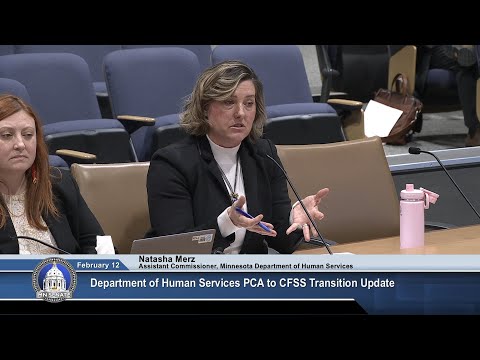
Assistant Commissioner Natasha Mers, the assistant commissioner for aging and disability services at the Department of Human Services, told a Senate committee that Minnesota is midstream in converting the Personal Care Assistance program to Community First Services and Supports and that consultation provider shortages and slow agency enrollment are creating implementation delays.
Assistant Commissioner Natasha Mers, the assistant commissioner for aging and disability services at the Minnesota Department of Human Services, told a Senate committee that Minnesota is midstream in converting the state’s Personal Care Assistance (PCA) program to Community First Services and Supports (CFSS), a redesign she said expands self‑direction and eligible services for people who receive PCA.
Mers said the department received federal approval for the CFSS implementation on 02/27/2024 and that, when fully converted, “there are nearly 50,000 people that are using PCA services that could become authorized for CFSS” and “approximately 900 PCA provider agencies” will need to transition. She said the CFSS option allows new allowances — including payment to parents of minor children and spouses providing support and the ability to use budget funds to buy goods or services in lieu of one‑to‑one personal care — and that CFSS offers access to neutral consultation services to help people choose between an agency model and a self‑directed budget model.
The department and provider witnesses described several implementation bottlenecks that are slowing the conversion. Mers told the panel that “demand is exceeding capacity across Minnesota” for consultation providers and that the department has an open request for proposals to add vendors. She said consultation is a required step under the federal service design before people convert from PCA to CFSS and that a consultation provider “cannot be both a consultation provider and an agency to the same person” to preserve neutrality.
Vicky Garrets, a board member of the Minnesota First Provider Alliance, told the committee that providers and people who receive services have faced confusion and delays. Garrets said agencies were given enrollment forms only in mid‑September for an October transition start and that, “as of this week, 320 of the 946 providers have been coded as a CFSS agency.” She and other testimony said lead agencies and assessors have inconsistent messaging about CFSS and lists of consultation providers, and that appointment wait times for consultations can range from weeks to months.
Olga Shevoleva, vice president of development and strategic planning at Metropolitan Community Services, described operational pressures consultation agencies face, especially for clients who speak limited English. Shevoleva said consultation visits often must be split across sessions and “it takes about 3 to 6 hours per client to write a meaningful service delivery plan” and that interpreting costs and scheduling are significant barriers because some interpreting time is not billable.
Lawmakers pressed DHS on several operational details. Senators asked for the geographic distribution of the 18 currently enrolled consultation providers (Mers said DHS would provide that data), asked whether providers face licensing or program integrity checks (Mers said PCA and CFSS are unlicensed services but providers must meet Medicaid enrollment and program integrity requirements and that DHS is using contracts for consultation vendors), and asked about per‑session reimbursement (Mers said consultation sessions are paid per session; agency staff said the per‑session fee is $100 and recipients are authorized for six sessions, with additional sessions available by approval).
Mers told the committee the department has implemented an automatic six‑month renewal of existing PCA service authorizations in individual cases where transitions are delayed so people “don't experience a disruption in services.” She said DHS is working to separate the PCA revalidation process from CFSS enrollment after finding the combined paperwork slowed providers’ conversions.
DHS said it is tracking enrollment and provider metrics closely, holding regular office hours with consultation providers, accelerating technical assistance to lead agencies and providers, and actively recruiting consultation vendors. Provider groups said they welcome DHS outreach but urged faster, clearer communications to avoid confusing service recipients and to preserve relationships with culturally specific providers.
Members of the committee and provider witnesses urged DHS to continue stepping up outreach, to provide details on provider enrollment status and geography, and to report back with data on how many people have completed consultation and converted to CFSS. DHS agreed to provide follow‑up information to the committee.
The discussion produced no formal vote; committee members suggested further oversight and possible appropriations to address workforce and capacity needs.