Get Full Government Meeting Transcripts, Videos, & Alerts Forever!
Get email alerts on the Billboard Moratorium topic
No spam. Unsubscribe anytime.
Senate committee examines statewide moratorium on billboards; proponents cite safety and scenic benefits, industry warns economic harm
Summary
Senate File 485, sponsored by Senator Marty, would impose a statewide moratorium on new off‑premise billboards and declare existing billboards nonconforming with phased amortization. Supporters emphasized safety, scenic and fiscal concerns; industry witnesses warned of economic harm and constitutional risk. Committee laid the bill on the table.
ST. PAUL, Minn. — The Senate Transportation Committee heard competing testimony Feb. 12 on Senate File 4-85, a bill from Senator Marty that would place a statewide moratorium on new off‑premise billboards, declare existing off‑premise billboards nonconforming and allow jurisdictions to phase removal via amortization. After extended testimony from both supporters and the outdoor‑advertising industry, the committee laid the bill on the table.
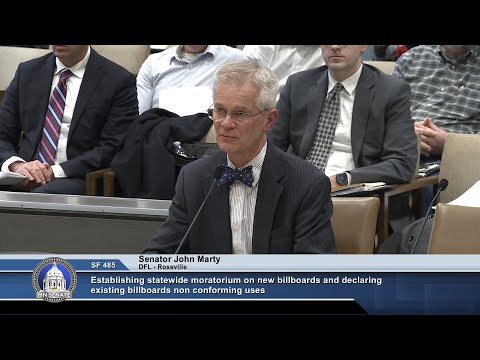
Senator John Marty (sponsor) framed the bill as a modest, statewide moratorium that preserves local control for existing billboards while preventing new installations. “It’s just simply saying, don't we have enough billboards?” Marty said, adding concerns about scenic character, safety and taxpayer costs when billboards must be removed for road projects.
Mark Falzone, president of Scenic America, told the committee his group supports the bill, citing studies that link billboards — especially digital and dynamic signs — to driver distraction and increased risk of accidents. Falzone also highlighted energy and light‑pollution concerns and pointed to a previously reported payment of about $4.32 million by MnDOT (reported in testimony as a Ramsey County District Court award related to a Lafayette Bridge relocation) to compensate a billboard company when a digital billboard had to be removed during a highway project.
Local residents and community advocates described billboards as “visual pollution” and urged limiting expansion. Jeanne Weigam and John Manillo of Scenic Saint Paul said billboards capture a taxpayer‑funded audience (road users) without producing commensurate public benefit and make redevelopment more expensive by creating buy‑out liabilities for property owners and the state.
Industry witnesses strongly opposed the bill. Andrew Carlson, representing the Minnesota Outdoor Advertising Association, said billboards are a cost‑effective advertising medium relied on primarily by local businesses and noted national surveys that advertisers value out‑of‑home placements. Brian Huntington, an attorney for the association, warned the committee that a statewide moratorium would face First Amendment challenges and cited U.S. Supreme Court and circuit precedents that require careful tailoring of restrictions on commercial speech (he referenced Lorillard Tobacco and Eighth Circuit decisions). Huntington provided the committee with written legal materials elaborating those points.
Operators from family‑owned firms testified on the economic role of billboards in local markets. Nels Pearson of Reagan Outdoor and Mike Hilandson of Schubert & Hoy said that most of their Minnesota advertisers are local businesses reliant on out‑of‑home advertising to reach driving customers. Representatives also noted industry jobs, permit fees, property rents to landowners hosting signs and the unionized workforce in some operations.
Committee members returned repeatedly to two practical questions: (1) how amortization would work in practice and whether removing signage for road projects results in large state payouts, and (2) whether a statewide rule would unduly limit local governments’ ability to manage signage. Staff counsel referenced a 1968 Minnesota Supreme Court case in an amortization context and noted that amortization and buyouts raise constitutional and takings questions that often involve public funds.
Senator Marty offered an author amendment to clarify the bill applies only to off‑premise billboard advertising and not to on‑premise business signage. Opponents proposed amendments and cautioned that any statewide ban risks constitutional challenges and economic impacts on small businesses.
The committee did not advance the bill. Chair Dibble said members would continue discussion with stakeholders; Senate File 4-85 was laid on the table. Committee members requested additional materials and a fiscal analysis, and proponents and opponents agreed to continue working with the sponsor and staff before the bill returns.
The hearing included extensive testimony on legal risks, taxpayer exposure to buy‑out claims, aesthetic and safety research, and local economic effects, leaving the committee to weigh tradeoffs between scenic goals and property‑rights, speech and small‑business interests.