Get Full Government Meeting Transcripts, Videos, & Alerts Forever!
Get email alerts on the Agriculture Forever Green Clc Saf topic
No spam. Unsubscribe anytime.
Senate committee hears expansion request for Forever Green, continuous living cover grants as SAF demand grows
Summary
Senate File 1220, carried by Sen. Mark Seaburger, was discussed and amended on Feb. 12, 2025, after University of Minnesota and industry witnesses described progress scaling winter oilseeds and perennial grains that provide environmental benefits and feedstock for sustainable aviation fuel (SAF).
Senate File 1220, carried by Sen. Mark Seaburger, was discussed and amended on Feb. 12, 2025, after testifiers described advances in winter oilseeds and perennial grains developed by the University of Minnesota Forever Green Initiative and the value-chain grants that support those crops.
The billand an A-1 amendment adopting a Continuous Living Cover (CLC) value-chain appropriation were approved for committee consideration and laid over. The committee adopted the A-1 amendment on a voice vote, and Seaburger asked that Senate File 1220 be set up as amended for possible inclusion.
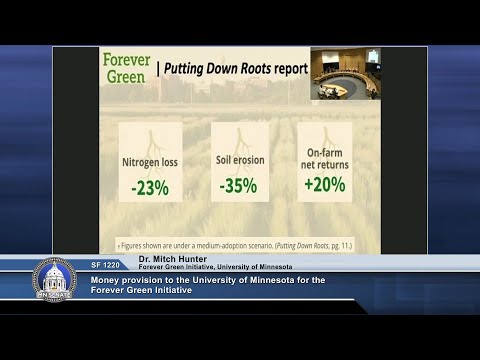
Why it matters: Witnesses told the committee that state seed-stage and value-chain funding is helping move crops such as winter camelina, pennycress and Kernza from research plots to farms and processors, with environmental benefits (reduced nitrate loss and erosion) and new markets, including sustainable aviation fuel (SAF).
Mitch Hunter, co-director of the University of Minnesota Forever Green Initiative, described the program"an innovation platform developing and improving winter hardy annual and perennial crops to help farmers keep the soil covered all year round, which we call continuous living cover." He said state base funding has helped leverage philanthropic and federal dollars, citing a $1,500,000 philanthropic grant and a $2,500,000 gift from Cargill for winter oilseed research. Hunter also said the initiative was selected for a $10,000,000 Department of Energy award that is currently on pause while the university awaits guidance from DOE.
Farmer testimony reinforced the production and market picture. Anne Schwebel, a Browns Valley farmer and vice president of Minnesota Farmers Union, said she planted winter camelina and that the oil from camelina on her farm was crushed and "used locally at Minneapolis Saint Paul International Airport as sustainable aviation fuel, a drop-in replacement for petroleum-based jet fuels." Ben Penner, a grower and custom operator from Mankato, described being present at the first Delta flight from MSP that included Minnesota-grown winter camelina feedstock.
Delta Airlines representative Jeff Davin (Delta) told the committee that SAF is the industryand Deltaprimary available tool to reduce in-flight emissions and that Minnesotathrough a 2023 SAF tax credit and the Minnesota SAF Hubis positioned to scale feedstocks and production. He provided industry figures: U.S. airlines use about 30 billion gallons of jet fuel annually and the sector has a goal to replace 10% with SAF by 2030; global SAF production in 2024 was roughly 370 million gallons. Davin said Minnesota SAF Huba public-private partnershipaims to produce 100 million gallons of SAF in Minnesota before 2030 and described a planned "million-acre" study to model scale-up of winter camelina production.
Witnesses described commercial developments for Kernza, the perennial grain: Hunter noted an 80-acre Kernza planting by Hastings adjacent to a water treatment plant intended to reduce nitrate loading, and Paul Novotny, a Chatfield farmer, said his grant-funded seed-cleaning and storage infrastructure helped expand camelina plantings in his area. General Mills' Ben Bowdich said the company has invested philanthropically and commercially in Kernza products and expects to increase use of Kernza flour in cereals.
Committee action and funding notes: The A-1 amendment (Continuous Living Cover program appropriation) was moved by Sen. Greg Kupak and adopted. Senate File 1220 as amended was laid over for possible inclusion. Testimony referenced multiple funding sources: state base funding for Forever Green, the Clean Water Fund for an ECO program that paid adoption incentives and technical assistance, philanthropic gifts (Cargill and General Mills), and pending federal awards (DOE).
Questions from committee members centered on federal grant status, market readiness, processing and storage constraints, and how state funds leverage private and federal investment. Hunter and other witnesses emphasized flexible state funds to address equipment, breeder support and farmer assistance gaps.
The committee did not take a final vote on the underlying bill; the bill and amendment were laid over for possible inclusion.
Sources and next steps: Committee members said they expect further hearings and that the Forever Green and CLC value-chain topics will remain before the committee as the session continues. The testimony identified concrete follow-ups: monitoring DOE award negotiations, supporting processor and cleaner infrastructure, and continuing the Minnesota SAF Hubvalue-chain coordination.