Get Full Government Meeting Transcripts, Videos, & Alerts Forever!
Get email alerts on the Voter Registration topic
No spam. Unsubscribe anytime.
OLA’s 2018 voter‑registration evaluation cited persistent data challenges; Secretary of State outlines modernization steps
Summary
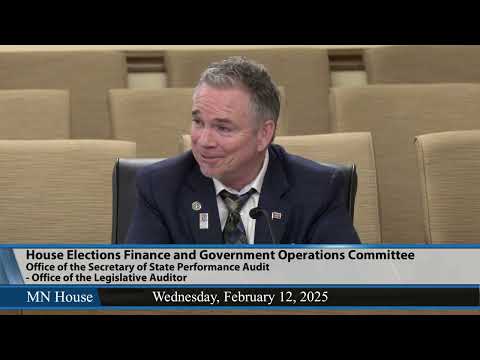
The House Elections Finance and Government Operations Committee heard a presentation on a 2018 Office of the Legislative Auditor evaluation of Minnesota’s voter registration system and a summary of steps the Secretary of State’s office has taken since that evaluation.
The House Elections Finance and Government Operations Committee heard a presentation on a 2018 Office of the Legislative Auditor evaluation of Minnesota’s voter registration system and a summary of steps the Secretary of State’s office has taken since that evaluation.
The OLA review, presented by Judy Randall, described voter registration as a shared responsibility between counties and the state and emphasized that Minnesota’s Statewide Voter Registration System (SVRS) produces a point‑in‑time roster that cannot be perfectly current because people’s circumstances change (moves, deaths, felony incarcerations, name changes). Randall said the team confirmed both errors of ineligible people registering and barriers that can prevent eligible people from registering.
Why it matters: Inaccurate or untimely voter records affect both voter access and election integrity. Committee members discussed how SVRS verification, county practices, interstate data sharing and federal resources factor into roster accuracy—and how law changes since 2018 have affected some eligibility rules.
How the system works and findings from the 2018 evaluation - Registration pathways: Registrations submitted before election day are entered by county officials into SVRS and then matched overnight against other data sources; people who match are marked "verified" and others are "challenged" and may need additional proof on election day. Election‑day registrants present proof of residence to an election judge and the SVRS checks and postcard verification occur afterward. - Verification and data matching: Randall described the SVRS matching process as "persnickety": small differences in spelling, spacing, or ID numbers can produce an "unverified" result even if the registrant is eligible. "It doesn't mean that you're not eligible to vote, it just means that for some reason when we did the data match things didn't exactly match up," she told the committee. - Quantities from the earlier work: in a 2017‑era roster snapshot the auditors found about 3.3 million records with fewer than 31,000 challengers (under 1%); the exam included discussion of roughly 7,800 felony‑related challenges under the prior law. OLA reviewed county attorneys' investigation reports for January 2016–September 2017 and found 69 reported investigations of persons alleged to have registered or voted while ineligible; many investigations did not result in charges.
Actions taken and planned by the Secretary of State’s office Secretary of State staff—Elections Director Paul Linnell and Deputy Secretary Julie Strother—told the committee the office has implemented multiple OLA recommendations and begun planning SVRS modernization. - Online registration improvements: the SOS added verification screens in the online application to reduce typographical errors that can cause mismatch in the data. - SVRS modernization: staff said SVRS is aging and now supports expanded functions (for example, absentee management) that strain the system; the office has begun planning for an SVRS modernization (sometimes described as an "SVRS 2") and is working with counties on timelines and staffing for heavy‑lift work. - Reports and post‑election tools: SOS confirmed that a report to identify inactive or challenged voters who registered on election day was developed after the audit and is available to counties; officials also said they routinely remind counties to run a "voters updated due to voting" report after elections. - Automatic and agency registration: Secretary of State staff described expanded collaboration with state agencies on voter registration services and noted statutory and administrative changes since 2018—including broader automatic voter registration steps tied to driver's license and Department of Human Services practices.
Data‑sharing and interstate tools Paul Linnell and Julie Strother described the benefits of participation in ERIC (Electronic Registration Information Center): interstate comparisons and USPS change‑of‑address feeds help flag likely movers so counties can send the standard postal verification card; if the card is returned and not resolved within a statutory window, the voter may be inactivated. Committee members asked SOS to provide counts (for recent cycles) of the number of postal verification cards sent and the numbers returned or unresolved.
Election‑day registration and provisional ballots The committee discussed differences between Minnesota’s approach and HAVA's provisional ballot processes. Randall explained that Minnesota's system allows election‑day registration and that verification and database checks often occur after ballots are cast; committee members noted Minnesota has an exemption from some HAVA provisional‑ballot requirements and that in the state a ballot cast by someone later found ineligible would have been counted before any later investigation or charges.
Cybersecurity and federal support Members asked whether recent reports that regional CISA (Cybersecurity and Infrastructure Security Agency) election representatives were placed on leave affected services to Minnesota. SOS officials said they were still receiving services at the time of the hearing but were monitoring developments and seeking clarification about long‑term access to CISA resources.
Questions and follow‑up Committee members asked for follow‑up materials: OLA agreed to provide additional implementation progress reports and the OLA and SOS agreed to provide updated counts and details on postcard verification and county entry timelines. Representative McDonald and others asked for data on the effect of changes that allow registrants to provide a description for residence (for unhoused voters) and on whether the system produced a measurable increase in such registrations under new law; Paul Linnell said SOS would look up those numbers and report back.
Ending The 2018 OLA evaluation and the subsequent committee exchange gave members a technical overview of SVRS mechanics, data quality limitations, and the tradeoffs between access and verification. Secretary of State officials described discrete improvements and an SVRS modernization plan; the committee requested specific follow‑up data to inform potential statutory or funding responses.