Get Full Government Meeting Transcripts, Videos, & Alerts Forever!
Get email alerts on the Secretary Of State Audit topic
No spam. Unsubscribe anytime.
Legislative auditor finds grants-monitoring gap at Minnesota Secretary of State’s office
Summary
A November 2023 performance audit of the Minnesota Office of the Secretary of State found generally adequate controls and compliance but identified one written finding: the office did not consistently monitor grants and did not always obtain detailed invoices or receipts from grantees, as state law requires.
The Office of the Legislative Auditor reported to the House Elections Finance and Government Operations Committee that the Office of the Secretary of State generally complied with legal requirements and maintained adequate internal controls but failed at consistent post‑award grants monitoring.
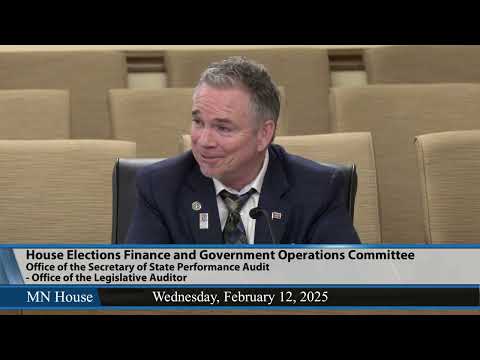
The finding was disclosed during a presentation by Legislative Auditor Judy Randall and Audit Director Jordan Bontheld, who told committee members the audit covered January 1, 2020, through December 30, 2022, and was a full‑scope review of receipts, payroll and non‑payroll expenditures. "We did receive the full cooperation of the office during the course of this audit," Bontheld said. Randall noted the audit produced a mostly positive picture but did identify a single written finding related to grants monitoring.
Why it matters: the Secretary of State’s office disbursed millions in grants to political subdivisions for election‑related activities; without consistent monitoring and supporting invoices, the office cannot always determine whether advance payments were spent for contract‑eligible purposes or whether unspent funds were returned to the state.
Key audit findings and numbers - Audit period appropriations and receipts: the office received about $57 million in state appropriations and about $17 million in federal grants during the audit period, Randall said. The office also collected about $78 million in fees, of which roughly $63 million was deposited into the general fund; payroll was the largest expenditure category at about $26 million and other non‑payroll expenditures about $25 million. - Grants activity: the office made payments on 313 grants totaling a little over $11 million. Most payments were advances issued after the contract was signed but before grantees incurred expenses. - Monitoring gap: auditors sampled 41 grants and found 15 for which grantees did not provide detailed invoices or receipts. Without those documents, auditors said, the office could not determine whether funds were spent in accordance with contracts or whether unspent funds were returned.
Contributing factors and recommendations Auditors identified two contributing factors: the Secretary of State’s office did not maintain documented policies and procedures for grants monitoring during the audit period; and grant contracts contained inconsistent requirements for grantee financial documentation. Randall said constitutional offices are not required to follow the Department of Administration Office of Grants Management policies and the Secretary of State did not have its own documented monitoring guidance at the time reviewed.
The OLA issued three recommendations: establish grants monitoring policies and procedures; revise contract and financial‑report formats to clarify invoice/receipt requirements; and review detailed supporting documentation for existing grants (for example, invoices and receipts).
Responses and follow‑up Jordan Bontheld told members the full report (released November 2023) includes the finding and the supporting details on page 23. Chair Quam and members asked for follow‑up materials; Representative Roche specifically requested the list of the 15 grantees that lacked receipts, and Randall said the OLA has that list and can provide it to the committee. "We can provide that information to the committee," Randall said.
The committee discussed the role of the OLA and how audits are reported; some members praised the office for surfacing problems and others sought clearer summaries that would highlight prior findings and progress over time. Randall said OLA had begun to provide more explicit references to prior findings in more recent reports and welcomed feedback about presentation.
Ending The audit presents a largely favorable assessment of the Secretary of State’s overall financial controls but recommends changes to grants monitoring and contract language. The committee asked the OLA to provide the grantee list and indicated it will follow up with the Secretary of State’s office as needed to confirm implementation of the recommendations.