Get Full Government Meeting Transcripts, Videos, & Alerts Forever!
Get email alerts on the Education Policy topic
No spam. Unsubscribe anytime.
Senate hearing spotlights student mental-health crisis, social workers urge more staff and funding
Summary
Witnesses told the Minnesota Senate Education Policy Committee that student mental-health needs are rising sharply, contributing to chronic absenteeism and classroom disruption; school social workers said statewide staffing and treatment resources are insufficient and urged lawmakers to increase funding and community services.
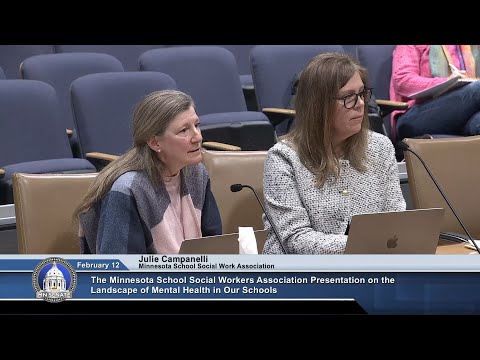
The Minnesota Senate Education Policy Committee heard testimony Feb. 12 that school mental-health needs have grown markedly and are straining school staff and community treatment systems.
Julie Campanelli, president of the Minnesota School Social Workers Association, and Abby Rufslin, a licensed independent clinical social worker and member of the association’s board, told the committee that student mental-health problems are widespread across grades and communities. Rufslin said survey and local data show “nearly 1 in 3 students report experiencing long term mental health problems,” and that some groups — including eleventh-grade female students and LGBTQ students — report notably higher rates of struggle.
The witnesses described a range of harms tied to untreated mental-health needs: rising chronic absenteeism, in-school fights and aggression, classroom evacuations, and an increase in suicide-risk assessments. Rufslin said her district conducted “almost 20 suicide risk assessments” in a recent two-week period, “the majority... in elementary buildings.” She and Campanelli emphasized that many students do not deliberately skip school but are unable to attend because of severe anxiety, trauma, homelessness or victimization.
School social workers told senators they provide counseling, crisis intervention, home visits and reintegration plans for students returning from hospitalization, but they are overwhelmed. Campanelli said many school social workers carry caseloads of “600, 800, even over a thousand students,” while the National Association of School Social Workers recommends about 250 students per social worker.
Committee members pressed witnesses on solutions. Senator Duckworth asked about telehealth and whether remote services are effective for younger students; witnesses said teletherapy expands access in communities that lack providers but requires extra effort to build relationships, and younger children typically need an adult present to use the technology. Senator Koenig and others discussed pilot programs that have tested targeted interventions and attendance strategies.
Witnesses urged several policy steps: increased funding to hire more school-based mental-health professionals (social workers, counselors, psychologists), expanded community treatment capacity including inpatient/residential beds and crisis stabilization, better reimbursement for providers, and trauma-informed prevention and early-intervention programs. Campanelli and Rufslin also recommended replacing punitive truancy approaches with mental-health–informed interventions.
Committee members asked staff to supply additional data, including district-level examples of attendance interventions and information about existing state and federal funding streams; senators said they would invite state agencies and additional witnesses to future meetings.
While no formal legislation was taken at the hearing, senators repeatedly cited workforce pipeline issues and budget constraints as barriers to immediate change. Witnesses asked lawmakers to consider sustained funding and workforce incentives to reduce caseloads and expand services so school staff can move from crisis response to prevention.