Get Full Government Meeting Transcripts, Videos, & Alerts Forever!
Get email alerts on the Und Medical School Mill Levy topic
No spam. Unsubscribe anytime.
Committee hears approaches to repeal of 1‑mill UND medical school levy; school warns of multi‑million shortfall
Summary
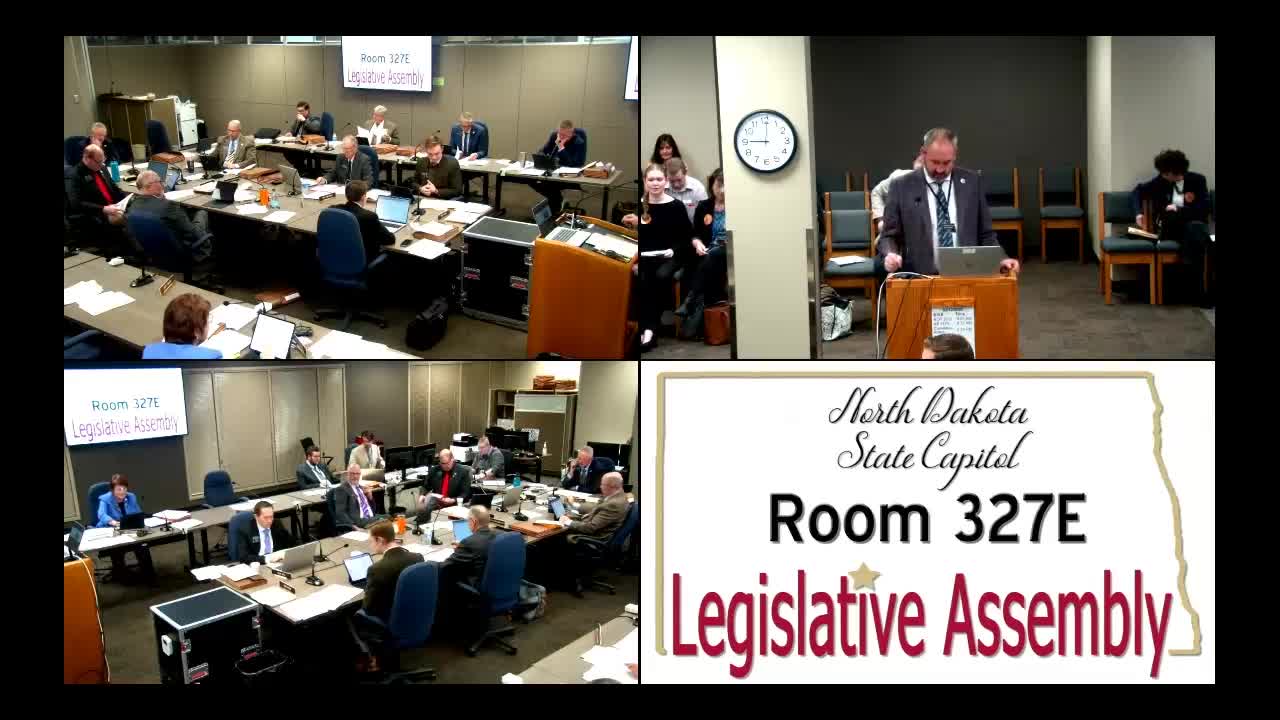
The House Finance and Taxation Committee heard testimony on House Concurrent Resolution 3012, which would submit to voters a repeal of the statewide 1‑mill property tax levy that funds the University of North Dakota School of Medicine and Health Sciences.
The House Finance and Taxation Committee heard testimony on House Concurrent Resolution 3012, which would submit to voters a repeal of the statewide 1‑mill property tax levy that funds the University of North Dakota School of Medicine and Health Sciences.
Sponsor Representative Jared Haggart, R‑District 20, told the committee the measure is intended to prompt a public decision and discussion about whether property owners should continue to pay the levy. “To be clear, this is not brought to punish or take away funding from the state medical school,” Haggart said, adding he would support finding other funding if voters approve repeal.
The question, supporters said, is fairness and local control. Danelle Preske of the North Dakota Association of Counties told the committee the 1‑mill levy is an outlier on property tax statements that local governments cannot control. Preske said the levy generated about $6,200,000 in 2024 and has grown roughly 39% over the last nine years because of valuation increases.
Opponents, including University and medical‑school leaders, urged the committee not to repeal without a guaranteed replacement. Marjorie Jenkins, dean of the School of Medicine and Health Sciences and UND vice president for health affairs, excerpted the school’s codified purpose in the North Dakota Century Code and outlined how the mill has supported expansion of medical education and training across the state since the levy was enacted in 1948.
Jenkins said the levy supports a range of clinical and training staff and programs. “We are North Dakota’s medical school,” she said, and noted the school’s graduates provide a large share of the state’s physicians: “79 percent of the family medicine physicians in North Dakota are alumni of this medical school. One in two physicians are alumni of this medical school.”
University President Andy Armacost and the medical association also testified in opposition, warning of budgetary and workforce impacts. Armacost said the mill levy repeal would produce a projected biennial shortfall of more than $14,700,000 if the governor and legislature do not replace the funding. Jenkins told the committee that the mill levy comprises about 5% of the medical school’s budget, while state appropriations represent roughly 36%.
Several lawmakers pressed the medical‑school witnesses about whether voters would support a repeal and whether any replacement language could be included in a constitutional amendment. Jenkins said she would support a referendum only if accompanying language guaranteed replacement funding, but said she was hesitant to ask for that language in a constitutional measure.
The committee took testimony from county and medical groups representing both sides, and closed the hearing without a committee vote. No committee action on HCR 3012 was recorded at the hearing’s close.
What’s next: HCR 3012 will remain a public record of this hearing. Any committee vote, amendment or final recommendation will be recorded in later committee minutes or roll calls.