Get Full Government Meeting Transcripts, Videos, & Alerts Forever!
Get email alerts on the Agricultural Research Extension Budget topic
No spam. Unsubscribe anytime.
University of Idaho officials tout research, extension reach while asking for targeted faculty and facility support
Summary
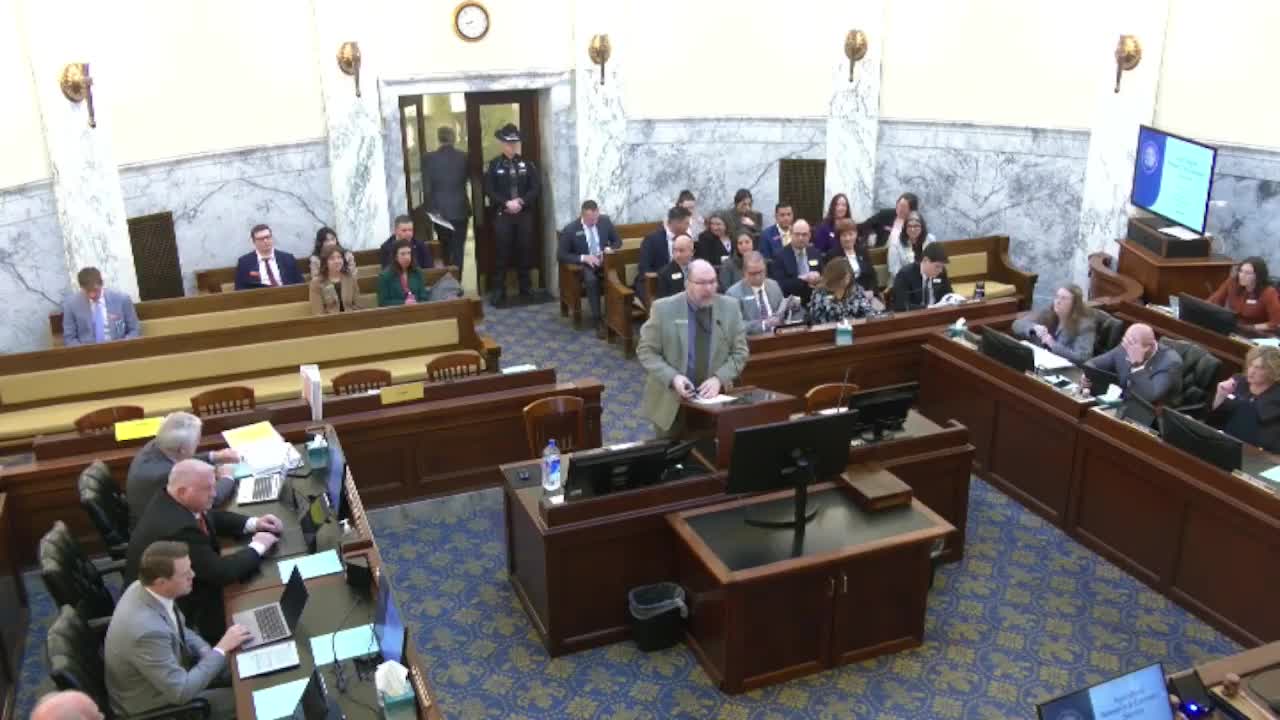
University of Idaho agricultural research and extension leaders told the Joint Finance‑Appropriations Committee on Feb. 10 that the college has statewide reach and is requesting targeted ongoing funds for research faculty and facility maintenance.
University of Idaho agricultural research and extension leaders told the Joint Finance‑Appropriations Committee on Monday that their programs have broad statewide reach and are seeking targeted funding for faculty and facility maintenance.
Kevin Campbell, a budget and policy analyst with the Legislative Services Office, presented the division’s budget overview and said the Agricultural Research and Extension Service has staff and research centers serving 42 of Idaho’s 44 counties and three recognized tribal communities. Michael Perella, dean of the College of Agricultural and Life Sciences, summarized recent investments in research facilities and faculty and said the college is seeking FY2026 requests that include funding for a viticulture and small‑fruits research faculty position and a portion of building maintenance costs at the Idaho Center for Agriculture, Food and the Environment.
Why it matters: the college supports research and extension activities that feed Idaho’s agricultural economy and rural communities. Perella told the committee the college’s extension staff recorded more than 450,000 face‑to‑face contacts with Idahoans last year and engaged more than 75,000 youth in 4‑H programming.
What the college told JFAC
- Scope and staffing: Campbell said the Idaho Agricultural Experiment Station operates 10 research and extension centers and has access to more than 14,000 acres for research. The service reported roughly 341.33 FTP (full‑time positions), near its five‑year average.
- Recent appropriations and requests: FY2024 and FY2025 appropriations included new faculty in animal and plant sciences, maintenance funding for a Parma research lab and ARPA funding tied to broadband and computer literacy work. For FY2026 the college requested $157,900 ongoing for a viticulture and small‑fruits research faculty position and $250,100 for building maintenance at the Idaho Center for Agriculture, Food and the Environment.
- Digital literacy and ARPA/FCC funding: testimony noted a $142,000 ARPA appropriation used in coordination with Department of Commerce broadband investments to support adult computer literacy and digital‑skills work. Dean Perella said the college participated in a federal FCC program competition and that a multi‑partner proposal had been selected for an award of about $13 million; he cautioned that federal timing must still be finalized but described the award as a potential complement to state efforts to close the digital divide in rural communities.
Lawmakers’ questions and college responses
- Nutrition and research priorities: Representative Handy asked whether faculty focus on nutritional value as well as yield; Perella said the college is expanding work that connects production to human nutrition and cited the Margaret Ritchie School of Family and Consumer Sciences and a National Science Foundation grant addressing women’s health and nutrition.
- Measures and outcomes: Representative Miller asked about outcomes for programs such as adult computer literacy; Perella said extension collects participant feedback after sessions and provided a summary claim that participants reported aggregate benefits that the college estimated as a $47 million savings in the most recent reporting year; Perella offered to provide committee members with detail on that calculation on follow up.
- Use of ARPA funds and ongoing costs: Senators and representatives noted the difficulty of converting one‑time federal funds into ongoing state obligations. Perella acknowledged ARPA projects were time‑limited but said the college seeks to leverage federal awards and competitive grants to sustain programs and that state investments help attract additional external funding.
No formal vote: the hearing consisted of presentations and questions; no formal committee action was taken during the Agricultural Research and Extension Service briefing.
Ending: Dean Perella thanked the Legislature for past support, noted recent improvements in faculty retention after change‑in‑employee‑compensation appropriations, and said the college will provide additional outcome details and follow‑up information on grant and ARPA expenditures if requested by the committee.