Get Full Government Meeting Transcripts, Videos, & Alerts Forever!
Get email alerts on the Transportation Funding topic
No spam. Unsubscribe anytime.
ITD asks JFAC for $60M supplemental, larger spending authority to finish multi‑year projects
Summary
At a Joint Finance-Appropriations Committee hearing, Idaho Transportation Department officials asked for a $60 million supplemental and changes to spending rules so the department can complete multi‑year highway projects and meet contractor payments amid large contracted workloads.
The Idaho Transportation Department asked the Joint Finance-Appropriations Committee on Wednesday for a $60 million supplemental and expanded spending authority to cover payments on multi‑year construction projects underway across the state.
ITD told the committee that a combination of large, multi‑year contracts and the Legislature's current re‑appropriation cap has left the agency unable to guarantee spending authority to complete contractor payments. "We came dangerously close to this last fiscal year in FY '24 of running out of spending authority because these large multi year projects were paying out," Director Scott Stokes told members, adding that ITD "actually deferred or delayed some payments to some contractors. It wasn't huge. It was 1 to 2,000,000 dollars."
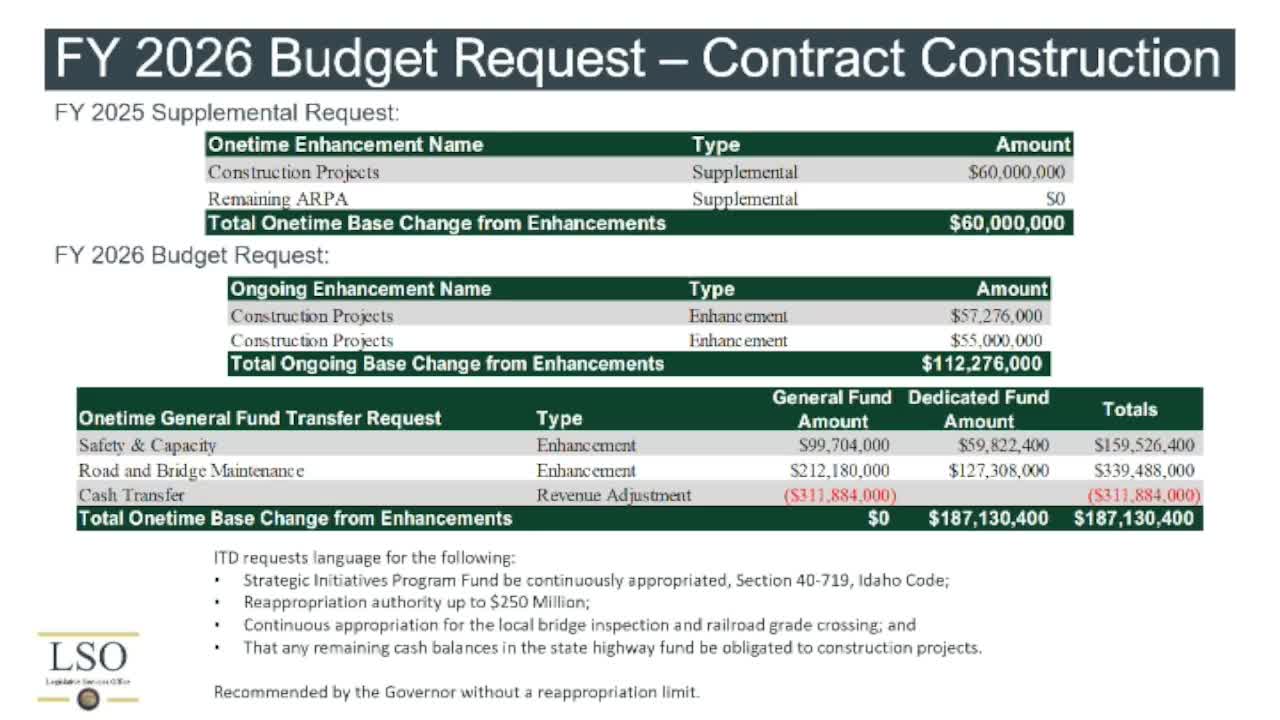
The department's budget analyst, Brooke Dupree of the Legislative Services Office, said the supplemental request includes $10 million from the State Highway Local Fund and $50 million from the State Highway Federal Fund. ITD also asked JFAC to consider language to allow continuous appropriation of the Strategic Initiatives Program Fund and to raise the department's reappropriation cap (the department requested reappropriation authority up to $250 million).
Why it matters: ITD is carrying dozens of large projects at once, many funded from mixed sources and spanning multiple years. Dave Tolman, ITD's chief administrative officer, said that "As of the end of FY 24, our obligated unspent construction program was a little over $600,000,000 across multiple funding sources." Without sufficient spending authority, ITD risks delaying payments to contractors or constraining the timing of work.
ITD and several committee members framed the request as a cash‑flow and authorization issue rather than a reflection of cost overruns. "This is for projects that are underway right now," Stokes said, noting that projects may have been contracted in prior years and now require subsequent‑year spending authority to finish. "We had the funds to do that, but the question is then the repeating spending authority."
The department also described larger 2026 requests tied to federal increases from the Infrastructure Investment and Jobs Act. Dupree told the committee the department expects additional federal funds and requested ongoing capital outlay authority to respond to those increases. ITD requested a $57,276,000 ongoing capital outlay increase tied to expected federal funds from IIJA and an additional $55,000,000 ongoing capital outlay request (50 million federal, 5 million local) to appropriate revenue for projects that lack current appropriation because of the reappropriation cap.
Committee members asked whether the Legislature should raise the reappropriation cap and how much carryover would be appropriate. Tolman said that projects under contract and committed obligations exceed available appropriations, and that the strategic‑initiatives continuous appropriation in code was designed to address similar multi‑year spending needs. "Having that appropriated limits our ability to spend those dollars," Tolman said, explaining one reason the department favors continuous appropriation language.
The committee did not take an immediate vote on the supplemental or the language requests and heard follow‑up questions about the size and timing of contractor payments, which Stokes said can reach $50 million to $80 million in a month during the construction season.
Ending: Committee members asked ITD to return with additional cash‑balance detail and project status updates. Dupree and department staff offered to follow up with more precise fund balances and a progress report on major projects that are under contract.