Get Full Government Meeting Transcripts, Videos, & Alerts Forever!
Get email alerts on the Education topic
No spam. Unsubscribe anytime.
Senate Education Committee holds hearing on bill asking DPI to include intelligent design in next science standards
Summary
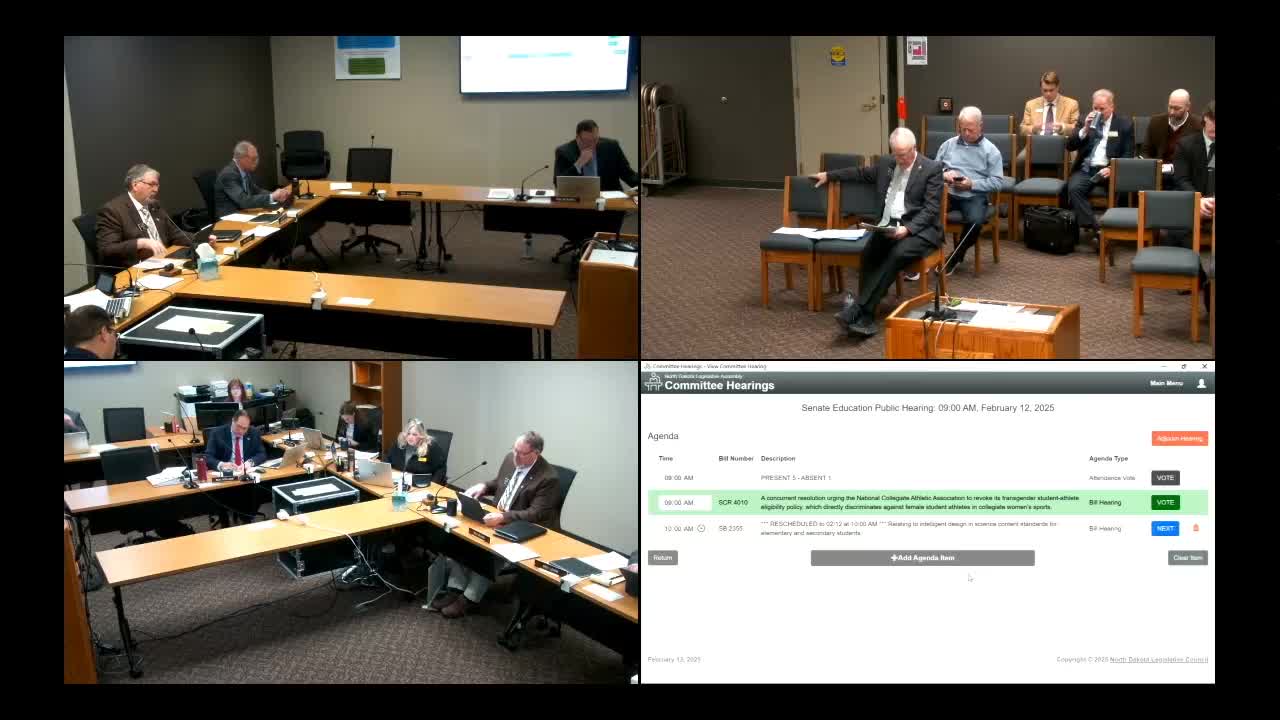
At a public hearing, the Senate Education Committee considered Senate Bill 2,355, sponsored by Senator Donald Dwyer, which would request that the Department of Public Instruction include “intelligent design” when it next revises the state's science content standards for elementary and secondary students.
At a public hearing, the Senate Education Committee considered Senate Bill 2,355, sponsored by Senator Donald Dwyer, which would request that the Department of Public Instruction include “intelligent design” when it next revises the state's science content standards for elementary and secondary students.
The bill drew divided testimony. Senator Dwyer framed the measure as encouraging ‘‘the search for truth’’ and said the proposal would add intelligent design alongside evolution in the standards-writing process; he also offered an amendment to phrase the request so the state could preserve federal funding available to support the standards-writing committees. Opponents — including the American Civil Liberties Union of North Dakota and multiple scientists and science educators — said intelligent design is a form of creationism, not a scientific theory, that it makes no testable hypotheses, and that including it in public-school science curricula would raise serious constitutional concerns and invite costly litigation.
Why it matters: The hearing focused on whether a concept many scientists characterize as religious should be brought into public-school science standards. Witnesses for the bill argued it would broaden students’ critical-thinking skills; witnesses against the bill said it would undermine science education and likely prompt lawsuits similar to the 2005 federal case about the Dover, Pa., school district.
Sponsor’s presentation and amendment
Senator Donald Dwyer, the bill sponsor, asked that when the superintendent updates the state science content standards the next time they are rewritten, intelligent design be included in the standards-writing discussion. ‘‘This bill has absolutely nothing to do with religion,’’ Dwyer said, ‘‘but everything to do with continuing the search for truth and giving our students the ability to understand and learn more than just one theory based on science.’’ He described scientific questions about the origin of life and cited scientists who have questioned aspects of evolutionary theory in recent decades. Dwyer told the committee he had worked with the Department of Public Instruction on an amendment that, in his words, ‘‘accomplishes the same intent of the bill, but also allows them to receive the federal funding that they would receive for this effort.’’
Support testimony
Mara Heidbreder of North Dakota Family Alliance Legislative Action testified in support, saying intelligent design is ‘‘based on scientific methods with evidence from nature’’ and that presenting alternatives to evolution would teach students ‘‘how to think rather than what to think.’’ She urged the committee to give the bill a ‘‘do pass’’ recommendation.
Opposition testimony
Cody Schueller of the American Civil Liberties Union of North Dakota urged a ‘‘do not pass’’ recommendation. Schueller told the committee that federal courts have repeatedly held teaching creationism in public schools unconstitutional and cited the 2005 Dover trial, saying the judge ruled intelligent design is ‘‘merely creationism relabeled’’ and is not science because it lacks testable, natural explanations. He warned the bill would ‘‘invite costly litigation’’ and noted litigation costs in the Dover matter.
Multiple scientists and science educators also testified in opposition. Neuroscientist and biology professor David Randeros said evolution is supported by a large body of evidence across disciplines and cautioned that mandating intelligent design in the classroom could ‘‘undermine religious belief among students by pitting faith against science.’’ Magdalene Mercado, a Ph.D. student in evolutionary biology, told the committee that ‘‘intelligent design makes no testable hypotheses’’ and that discussion of intelligent design belongs to philosophy, theology or family instruction rather than to science class. Stephen Travers, speaking for a group of college-level science educators, called intelligent design ‘‘not science’’ because it depends on supernatural explanations and is not subject to revision through empirical testing. Travers and others warned the state against diminished STEM standards and the reputational and financial costs that can follow attempts to teach intelligent design in public classrooms.
Neutral testimony
David Tamesia (listed in the transcript as David Tamesia) of the North Dakota Catholic Conference said the conference was neutral on the bill but requested that nonpublic schools be exempt if the legislature moves forward, to avoid conflicts with religious schools’ curricula and internal teachings.
Committee questions and concerns
Committee members asked whether the bill’s language would leave implementation to individual teachers. Senator Axman asked whether the amendment’s wording — which Dwyer said would ‘‘permit’’ teachers to include intelligent design — meant the decision would be left to individual science teachers. Dwyer said the intent was to include intelligent design in the standards while giving teachers flexibility in how or whether to present it. Senator Baucher asked whether the measure might harm recruitment and retention of science teachers who were trained in biology and chemistry; witnesses said those concerns were real and that introducing non-testable concepts into science courses could complicate instruction.
Hearing outcome and next steps
The committee held the public hearing, received pro, con and neutral testimony, discussed an amendment intended to preserve federal funding for standards-writing work, and recessed; no committee vote on SB 2,355 was recorded at the hearing.
Ending
The committee closed the hearing with no vote recorded and recessed. SB 2,355 may return to the committee for further action or amendment at a later date.