Get Full Government Meeting Transcripts, Videos, & Alerts Forever!
Get email alerts on the Legal Representation Access topic
No spam. Unsubscribe anytime.
Hearing draws split views on bill to let nonlawyers represent parties with an 'equitable interest'
Summary
Supporters of HB 1409 said expanding the definition of ‘interest’ would give people without money or counsel access to the courts; opponents — including the State Board of Law Examiners and disciplinary counsel — warned the change could permit unlicensed practice, reduce oversight and harm the public.
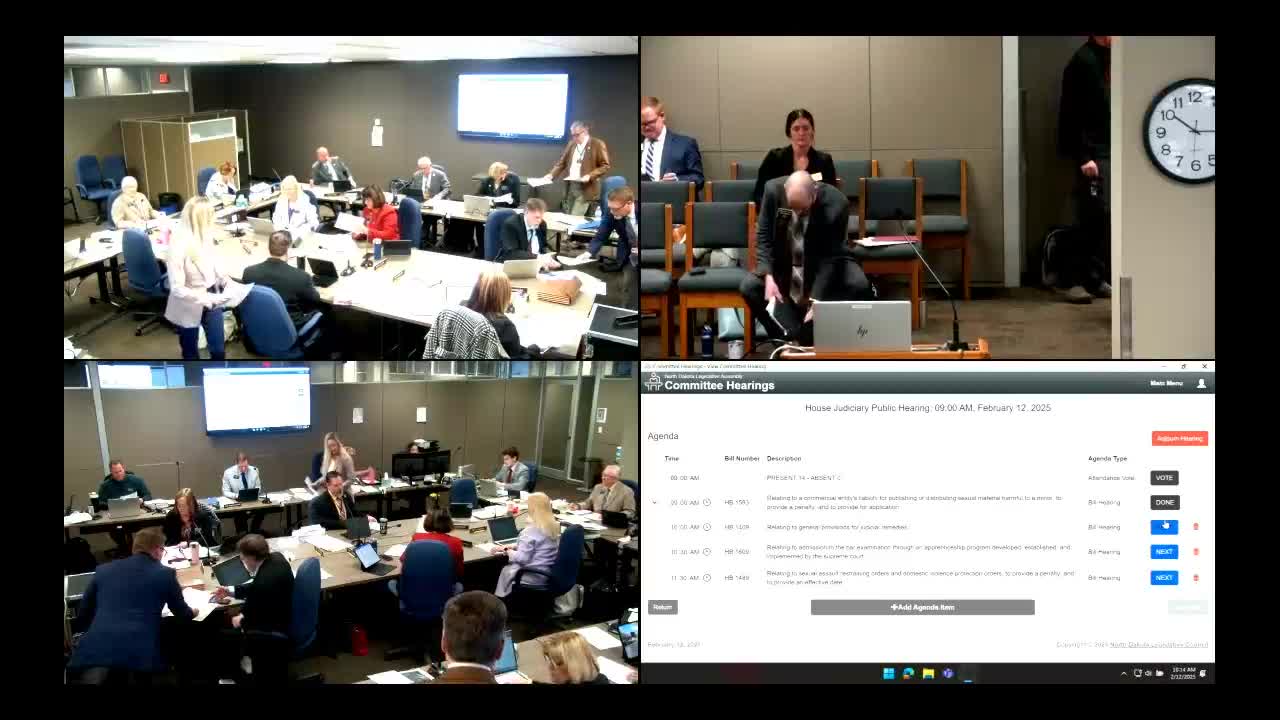
House Bill 1409, a proposal to broaden the statutory definition of “interest” in chapter 32‑01 of the North Dakota Century Code so that a person with an equitable or legal interest could represent another party, drew sharply divided testimony at a House Judiciary Committee hearing.
Sponsor Representative Laurie Van Winkle, R‑Minot, said the proposal is intended to increase access to justice for people who cannot afford or cannot find counsel, allowing friends, family members, or other interested parties with a legal or equitable stake to appear on behalf of someone and to protect shared rights. “We need to make sure our citizens are allowed due process of law and are not restricted or hindered in their ability to retain counsel that they believe will put their interest as priority,” Van Winkle said.
Paul Sorum, a private citizen and longtime legal researcher, testified in support and described use cases he said would benefit: petition sponsors who face suppression of public speech, homeowners challenging rapid assessment increases, parents of adult children with diminished capacity and others who lack money for attorneys. Sorum told the committee that multiple other states already recognize equitable interests in certain actions and said the change would “widen the definition of interest to what it really should be.”
But the State Board of Law Examiners, disciplinary counsel for the Supreme Court and several bar representatives urged the committee to reject the bill. Petra Holm, secretary‑treasurer of the State Board of Law Examiners, said the proposal’s broad language would allow spouses, co‑owners, trustees and other nonlicensed parties to represent litigants without any lien, bond, licensure, character review or formal curriculum. “Practicing law is a criminal offense,” Holm said, warning that “the potential harm to the public is significant.”
Kara Erickson, disciplinary counsel for the Supreme Court, said her office would not have jurisdiction over nonlawyers and that permitting representation by unlicensed people would likely increase complaints, ethical problems and public harm: “These interested parties would not be required to have legal background or training, which presents a potential danger to the public,” she said.
Representatives of the North Dakota Petroleum Council and other opponents echoed those concerns, citing possible increased litigation and fewer protections for people who rely on counsel. The Attorney General’s office offered neutral remarks, cautioning that the term “interest” appears widely across state law (the word appears thousands of times in the Century Code) and that a broad redefinition could have unintended effects in areas such as quiet title, mineral rights, liens and estate matters.
Committee members questioned practical effects and safeguards. Supporters said the bill is narrowly intended to let people with a genuine stake assist or represent others when formal counsel is unavailable; opponents urged the committee instead to pursue funded alternatives such as the Supreme Court’s allied legal professional and navigator proposals and to consider legislative support for public defender or indigent defense resources.
No committee vote on HB 1409 was recorded in the hearing transcript.