Get Full Government Meeting Transcripts, Videos, & Alerts Forever!
Get email alerts on the Age Verification topic
No spam. Unsubscribe anytime.
House panel advances bill requiring online age checks for adult content, adds fines and privacy limits
Summary
The House Judiciary Committee amended and voted to advance HB 1593, a measure that would require websites that distribute obscene or indecent material to verify users’ ages, add a private right of action, impose a per‑day fine for noncompliance, and restrict retention of verification data.
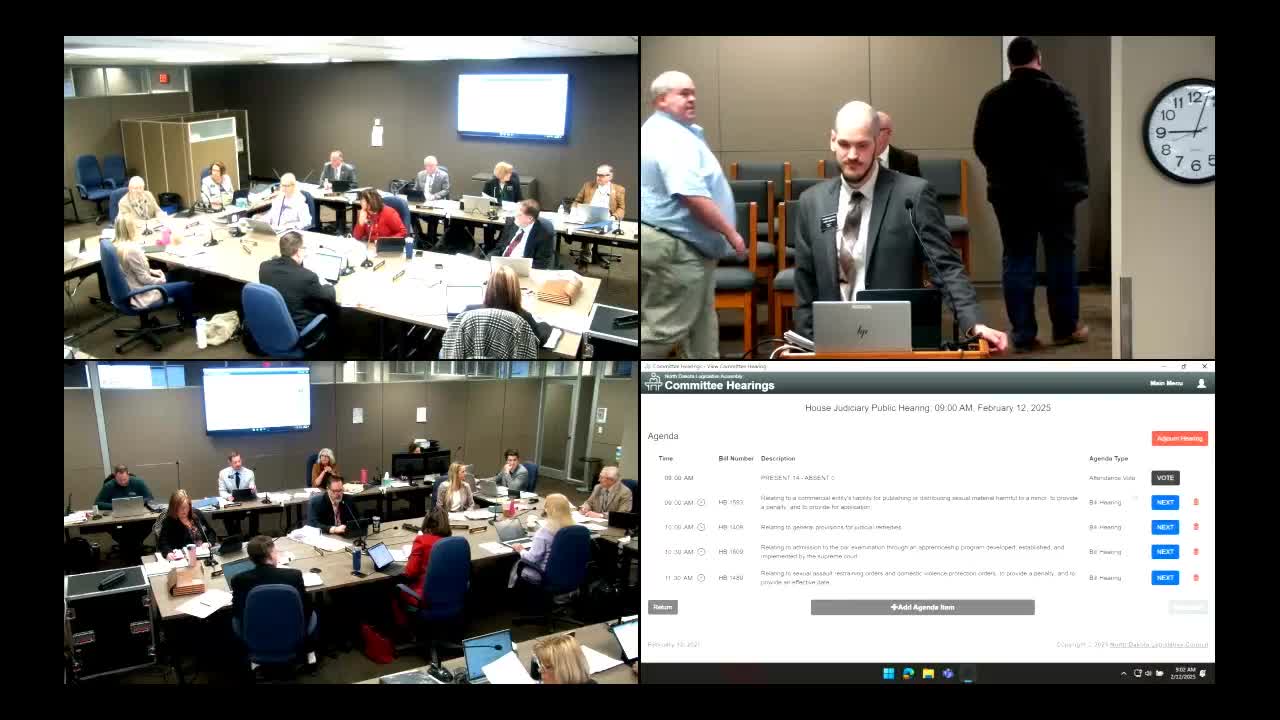
The House Judiciary Committee on Tuesday amended and approved House Bill 1593, a measure that would require online platforms that regularly publish obscene or indecent material to verify a user’s age before granting access and to limit retention of any identifying information collected for verification.
Sponsor Representative Jared Hendricks, R‑Fargo, told the committee the bill is intended to protect minors from “mental, emotional and developmental” harms and that drafters tailored the text to address issues raised in recent federal court proceedings. “This legislation is [a] forward‑thinking, comprehensive, and constitutional approach to ensuring minors are protected from harmful, primarily pornographic online content,” Hendricks said.
The bill replaces a prior threshold test used in similar proposals with a “regular course of business” standard to target platforms that profit from harmful material and avoid sweeping in sites that incidentally host protected speech. HB 1593 lists acceptable age‑verification methods — including state‑issued ID and bank‑account verification — and adds an explicit privacy requirement: platforms and third‑party verifiers would be prohibited from retaining personally identifiable information collected solely for age checks after access is granted. Hendricks proposed additional language to require verifiers to “anonymize” identity data and ensure it cannot be used to build a profile of a user.
HB 1593 also establishes both a private right of action and regulatory penalties. The draft authorizes civil suits against covered platforms and their suppliers and sets a civil fine of $10,000 per day for failure to implement required age verification. Hendricks told the committee the fine is meant to provide an enforcement mechanism when individual injury is difficult to prove.
The measure tries to limit its geographic reach and address what Hendricks called the “VPN fallacy,” directing covered platforms to use due diligence and not rely solely on IP addresses to determine whether a user is in the state. The bill lists narrow exemptions for entities such as news organizations, Internet service providers and cloud providers.
Ian Corby, executive director of the Age Verification Providers Association, testified remotely in support and described technical approaches that can prove age without revealing identity. “It’s about proof of age, not proof of identity,” Corby said, and he told the committee current technology can deliver privacy‑preserving age verification at low per‑user cost.
Also speaking in support were Mark Jortsman of North Dakota Family Alliance Legislative Action and Rose Feliciano of TechNet, both urging the committee to move the bill forward to protect children.
Committee members exchanged technical and civil‑liberty questions about geolocation methods, the potential for location tracking, and whether the bill could create incentives for platforms to collect more data. Representative Christiansen said he supported the concept but worried that the bill “sets up the precedent that websites are going to be able to track people’s physical location.” Representative Van Winkle and others argued the proposed geolocation checks mirror technology already used by other regulated online services such as gambling operators.
After debate and sponsor amendments (including an amendment package labeled the “hog house” amendment), the committee approved a sequence of motions: it adopted the sponsor’s amendment package, removed a proposed residency‑for‑one‑year phrase by separate amendment, and ultimately voted to give the bill a do‑pass recommendation as amended. The committee votes recorded in the transcript were: adoption of the Hendricks amendment package (12 yes, 2 no), an amendment to remove the “resides in the state for more than 1 year” language (14 yes, 0 no), and a final do‑pass as amended vote (11 yes, 3 no).
HB 1593 now moves toward the next legislative step with a committee recommendation, carrying strengthened privacy language and civil penalties as part of the amended text.